

TL;DR:
- Pattern recognition in emotions involves identifying recurring sequences of feelings, thoughts, and behaviors that respond automatically to specific triggers. Recognizing these patterns enhances emotional regulation, personal growth, and healthier relationships.
Pattern recognition in emotions is defined as the conscious identification of recurring sequences of feelings, thoughts, and behaviors that reveal how you habitually react to the world. This process, formally studied under emotional pattern recognition in psychology, gives you the ability to step between a trigger and your automatic response. The result is not just self-knowledge. It is the foundation of emotional regulation, healthier relationships, and lasting personal growth. This guide walks you through what emotional patterns are, how to spot them, and how to use that awareness to change your life.
What is a guide to pattern recognition in emotions?
An emotional pattern is a recurring sequence of feelings that fires automatically in response to a specific trigger. Experts confirm a sequence qualifies as a true pattern only after it appears across at least 3–5 separate instances over time. That threshold matters because it separates a one-off reaction from a genuine habit of mind.

The fundamental unit of any emotional pattern is the trigger-response pair. A trigger is rarely as broad as "conflict" or "rejection." Specific sensory cues like a particular tone of voice, a phrase, or even a smell link directly to past conditioning. Identifying the precise cue rather than a vague category is what makes intervention possible.
Understanding emotional patterns also requires looking at what researchers call affective chronometry. This framework measures three dimensions of your emotional response: the threshold at which an emotion activates, the peak intensity it reaches, and the recovery time it takes to return to baseline. Together, these dimensions give you a detailed map of how you experience any given emotion, not just what you feel.
How to identify your own emotional patterns
Identifying your patterns follows a clear sequence:
- Notice the trigger. Write down the exact situation, not a summary. "My manager interrupted me in the meeting" is more useful than "work stress."
- Record the emotion immediately. Name it specifically. "Shame" and "embarrassment" are different emotions with different implications.
- Log the behavior. What did you do next? Withdraw, snap back, go quiet?
- Track the recovery. How long before you felt neutral again? An hour, a day, a week?
- Look for recurrence. After 3–5 logged instances, compare them. Shared triggers, shared emotions, and shared behaviors confirm a pattern.
Pro Tip: Set a phone reminder for 9:00 PM each night to spend three minutes logging one emotional moment from the day. Consistency over three weeks produces enough data to see real patterns.
A common mistake is over-personalizing every reaction. Not every strong emotion signals a deep pattern. The goal at this stage is observation, not judgment.
How do multimodal cues improve emotional recognition?
Emotional information travels through multiple channels simultaneously, and most people only pay attention to one. Facial expressions convey approximately 55% of emotional information, while tone and voice account for 40%, and verbal content carries only 7%. That means the words someone says are the least reliable signal in any emotional exchange.
This finding has a direct personal application. When you are trying to read your own emotional state or someone else's, the face and voice tell the fuller story. Microexpressions, brief flashes of emotion lasting a fraction of a second, often reveal what words conceal.
Synchronizing multiple data channels sharpens accuracy further. Combining physiological data like heart rate with behavioral cues such as facial video improves recognition accuracy by 10–20%. That improvement reflects a principle you can apply without any technology: the more channels you observe at once, the clearer the emotional signal becomes.
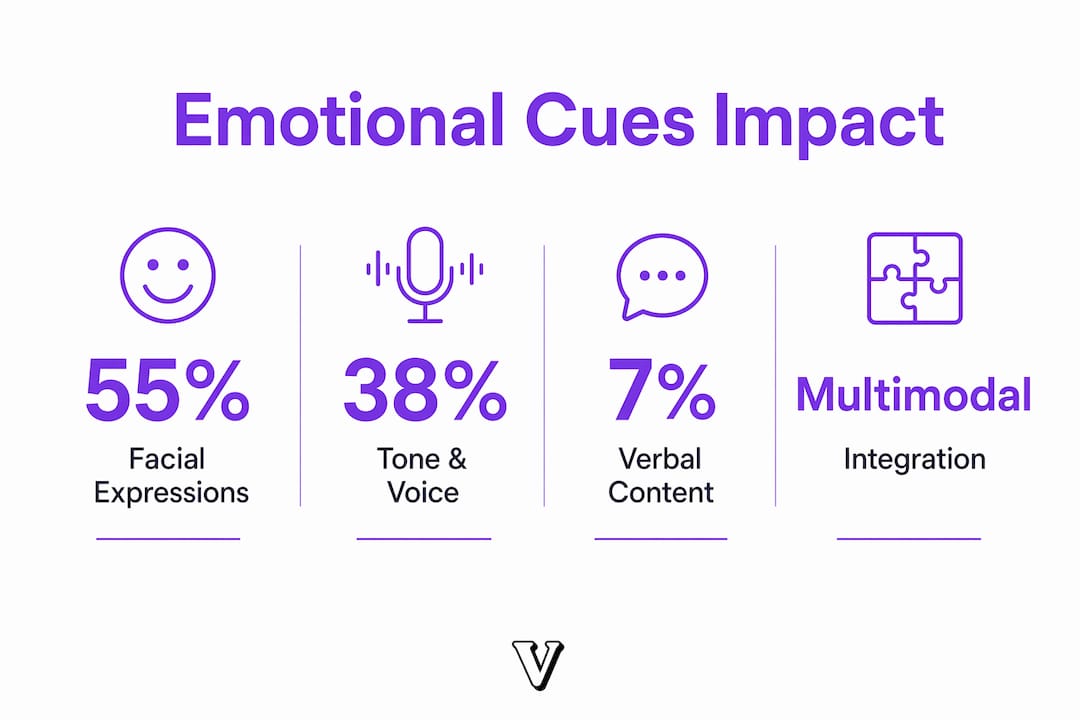
Modern recognition systems now use multimodal large language models that integrate text, audio, and visual inputs into a shared semantic space. These systems can reason over combined cues and explain their conclusions in plain language. The underlying logic mirrors what skilled therapists do naturally: they read the room across multiple channels at once.
| Cue channel | Contribution to emotional information |
|---|---|
| Facial expressions | 55% |
| Tone and voice (paralinguistic) | 40% |
| Verbal content | 7% |
Pro Tip: During your next difficult conversation, mute the words mentally for ten seconds and focus only on the other person's face and voice. You will often pick up an emotional signal you would have missed entirely.
What are common emotional schemas and coping styles?
Emotional schemas are patterns shaped by early life experiences and the unmet needs that came with them. They are not character flaws. They are interpretive lenses your brain developed to make sense of a world that felt unpredictable or unsafe. Once formed, schemas color how you read situations, relationships, and your own worth.
Common schemas include:
- Abandonment: A persistent fear that people you depend on will leave, often triggered by any sign of distance or silence.
- Defectiveness: A deep belief that something is fundamentally wrong with you, activated by criticism or comparison.
- Subjugation: A pattern of suppressing your own needs to avoid conflict or rejection.
- Unrelenting standards: A drive toward perfection that generates chronic anxiety and self-criticism when outcomes fall short.
- Emotional deprivation: A belief that your emotional needs will never be met, leading to either withdrawal or overdemanding behavior.
Each schema connects directly to a coping style. Common coping responses include avoidance, overcompensation, and surrender. Avoidance keeps you from situations that activate the schema. Overcompensation pushes you to fight the schema's message by going to the opposite extreme. Surrender means accepting the schema as true and acting accordingly.
Recognizing your schema is not about labeling yourself. It is about building awareness so you can name what is happening, ground yourself in the present moment, and create space between the trigger and your reaction. Curiosity works better than self-criticism at every stage of this process.
How can you track and transform your emotional patterns?
Tracking emotional patterns requires a structured method, not just good intentions. The following approach combines journaling, affective chronometry, and mindful observation into a repeatable daily practice.
- Name the emotion precisely. Expanding your emotional vocabulary is the first step. "Bad" becomes "humiliated," "anxious," or "disappointed." Each word points to a different cause and a different solution.
- Map the chronometry. For each logged emotion, note the threshold (what activated it), the peak (how intense it got), and the recovery time (how long it lasted). Tracking these dimensions across multiple instances reveals your characteristic response profile.
- Practice mindful observation. Watch the emotion as it rises without immediately acting on it. This "observed awareness" is the gap between stimulus and response that emotional regulation depends on.
- Use journaling as your primary tool. Guided journaling for emotional patterns externalizes your inner experience, making invisible sequences visible on the page.
- Let AI assist the analysis. AI can analyze month-long emotional check-ins and identify clusters of triggers and reactions that are invisible from a single day's perspective. Patterns that feel random in the moment often show clear structure when viewed across weeks of data.
Pro Tip: After four weeks of daily logging, read your entries as if they belong to a close friend. The emotional distance often reveals patterns you cannot see when you are inside the experience.
The goal of tracking is not to eliminate emotions. It is to understand them well enough to respond rather than react. Emotional regulation, as explored in science-backed strategies, builds directly on this kind of pattern awareness.
Key Takeaways
Emotional pattern recognition is the most direct path from automatic reactivity to conscious, regulated response, and it requires consistent observation across multiple emotional channels and instances.
| Point | Details |
|---|---|
| Define the pattern threshold | A sequence qualifies as a pattern only after 3–5 repeated instances across separate situations. |
| Read all three cue channels | Facial expressions carry 55% of emotional data; verbal content carries only 7%. |
| Map affective chronometry | Track threshold, peak intensity, and recovery time to build a precise emotional profile. |
| Identify your schema | Schemas link emotional patterns to early unmet needs and drive avoidance, overcompensation, or surrender. |
| Use structured tools | Daily journaling and AI-assisted analysis reveal clusters invisible to in-the-moment awareness. |
The part of emotional pattern work nobody warns you about
Most guides treat emotional pattern recognition as a linear process: observe, identify, change. The reality is messier, and that messiness is actually useful information.
The biggest mistake I see is people expecting to identify a pattern once and then be done with it. Schemas resurface under stress. A pattern you thought you had resolved in one relationship shows up in a different form at work. That is not failure. That is how emotional learning works. The pattern is showing you where the work still lives.
The second pitfall is over-analyzing. When you start tracking emotions, there is a pull to turn every feeling into a data point. That approach creates distance from the very experience you are trying to understand. The skill is to observe without immediately categorizing. Let the emotion exist before you label it.
What actually works is treating this as an evolving practice rather than a problem to solve. Self-compassion is not a soft add-on to this work. It is the mechanism that keeps you honest. When you approach a pattern with curiosity instead of shame, you stay in contact with the real experience long enough to learn from it. Depersonalizing the trigger helps too. The trigger did not create the pattern. It just revealed one that was already there.
The benefits of self-reflection compound over time. The person who has been tracking their emotional patterns for six months does not just know themselves better. They respond differently in real time, because the gap between trigger and reaction has genuinely widened.
— Voisley
How Voisley supports your emotional pattern work
Voisley is built for exactly this kind of structured self-awareness practice.

The platform combines mood tracking, AI-powered insights, and guided journaling prompts designed to surface emotional patterns you might not notice on your own. Whether you are working through shadow work, gratitude practice, or future goal setting, Voisley gives your reflections a structure that makes patterns visible over time. The visualizations show your emotional trends across weeks and months, turning daily check-ins into a clear picture of how you actually feel and why. If you are ready to move from awareness to real change, start with Voisley and let the data do the heavy lifting.
FAQ
What is emotional pattern recognition?
Emotional pattern recognition is the process of identifying recurring sequences of feelings, thoughts, and behaviors that fire automatically in response to specific triggers. A sequence qualifies as a true pattern after appearing across at least 3–5 separate instances.
How do I know if I have an emotional pattern?
You have an emotional pattern when the same trigger consistently produces the same emotional response and behavior across different situations and time periods. Journaling daily for three to four weeks is the most reliable way to confirm recurrence.
What role do facial expressions play in reading emotions?
Facial expressions carry approximately 55% of emotional information, making them the most data-rich channel available. Verbal content, by contrast, carries only 7%, which means what someone says is the least reliable indicator of what they feel.
Can AI help with identifying emotional patterns?
AI can analyze extended records of emotional check-ins and identify clusters of triggers and reactions that are not visible from a single day's perspective. Platforms like Voisley use AI-powered insights to surface these structural patterns from your journaling data.
What is the difference between a trigger and a schema?
A trigger is a specific sensory or situational cue that activates an emotional response. A schema is the deeper interpretive pattern, shaped by early life experiences, that determines why that trigger produces such a strong reaction.