

TL;DR:
- Emotional self-analysis involves intentionally observing and interpreting feelings to understand their signals.
- It takes 10 to 20 minutes in a focused environment to effectively analyze emotions and foster personal growth.
Emotional self-analysis is the practice of deliberately observing, naming, and interpreting your feelings to understand what they signal about your inner state. Learning how to analyze emotions step by step gives you a structured way to move from confusion or reactivity to clarity and conscious choice. Mental health professionals, including practitioners at the Center for Individual and Family Therapy, recognize this process as a foundation for emotional regulation and personal growth. Emotions are not commands to obey. They are signals designed to inform you, and learning to read them accurately changes how you respond to life.
What do you need before starting emotional analysis?
Effective emotional analysis starts with preparation, not with the emotion itself. Rushing into self-reflection without the right conditions produces shallow results. You need a focused environment, a non-judgmental mindset, and a few simple tools before you begin.
Set aside protected time. Research supports 10–20 minutes of distraction-free time with physical grounding as the standard setup for emotional self-analysis. That window is long enough to go deep and short enough to stay consistent. Put your phone on silent, close unnecessary tabs, and treat this time as non-negotiable.
Ground your body first. Your nervous system needs to settle before your mind can observe clearly. Grounding techniques that work include:
- Deep breathing. Inhale for four counts, hold for four, exhale for six. This activates the parasympathetic nervous system and reduces physical tension.
- Body scanning. Slowly move your attention from your feet to the top of your head, noticing any areas of tightness, warmth, or numbness.
- Mindful breathwork and grounding. Even two minutes of intentional breathing shifts your state from reactive to receptive.
Gather your tools. A journal, a notebook, or a digital platform works equally well. Regular journaling is associated with long-term emotional relief and fewer symptoms of depression. That makes it one of the most practical tools you can use. A feelings wheel or emotional thermometer is also worth having nearby for the steps ahead.
Adopt a non-judgment stance. The goal is observation, not evaluation. You are not here to decide whether your feelings are correct. You are here to understand what they are telling you.

Pro Tip: Set a recurring calendar block for your emotional analysis sessions. Consistency matters more than duration. Even 10 minutes done regularly builds stronger self-awareness than a two-hour session done once a month.
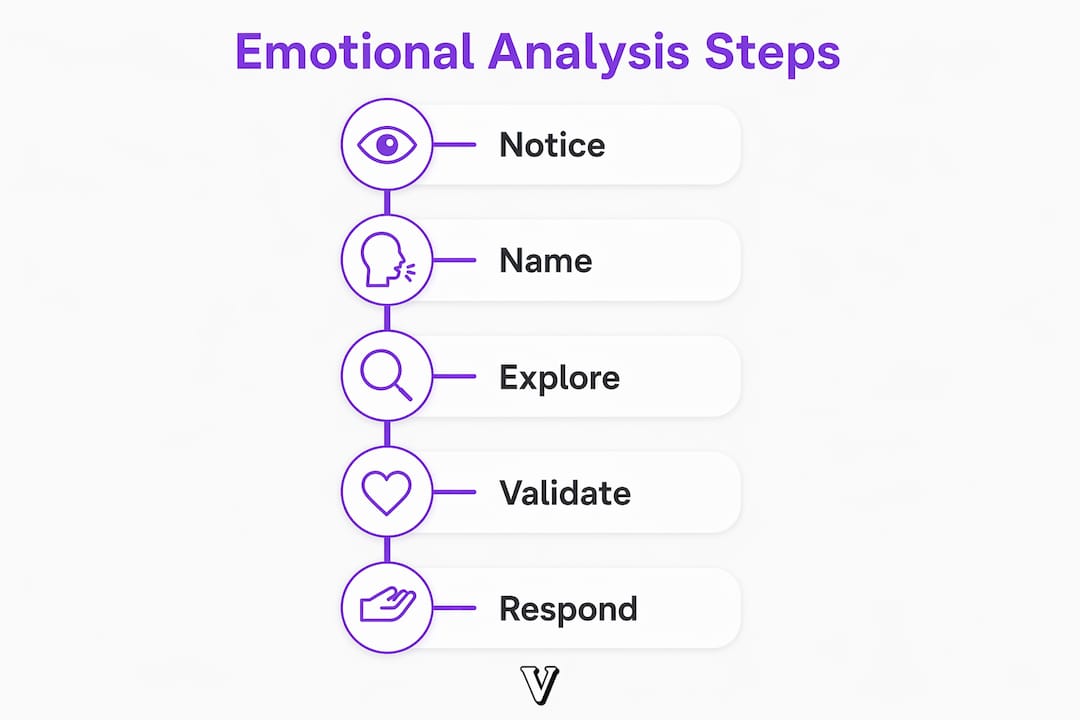
How to notice, name, and physically sense your emotions
The first active phase of emotional analysis involves three connected steps: noticing, naming, and locating the emotion in your body. Most people skip straight to problem-solving. That skips the data.
-
Create a mindful pause. Stop what you are doing and shift your attention inward. Ask yourself: "What am I feeling right now?" Do not answer immediately. Sit with the question for 30 seconds and let whatever is present rise to the surface without forcing it.
-
Name the emotion without judgment. Use specific language. "Upset" is vague. "Disappointed," "embarrassed," or "resentful" are precise. A feelings wheel helps here because it maps broad categories like "anger" or "sadness" into more specific emotional states. Precise naming reduces emotional intensity because it activates the prefrontal cortex, the part of your brain responsible for rational thought.
-
Locate it in your body. Ask yourself where you feel this emotion physically. Anxiety often sits in the chest or stomach. Grief can feel like heaviness in the shoulders. Anger frequently shows up as heat in the face or tension in the jaw. Sitting with physical sensations without judgment allows the emotion to move through you rather than get stuck.
-
Rate the intensity. Use a simple 1–10 scale, sometimes called an emotional thermometer. A rating of 3 calls for a different response than a rating of 9. Knowing the intensity helps you calibrate how much attention and care the emotion needs right now.
-
Record what you find. Write down the emotion name, its physical location, and its intensity. This turns a fleeting internal experience into a concrete data point you can work with. Voisley's mood tracking features make this step fast and consistent over time.
Pro Tip: If you cannot name the emotion, describe the physical sensation first. "There is a tightness in my chest and my breathing is shallow." That description often leads you directly to the emotional label.
How do you explore secondary feelings and underlying needs?
Surface emotions rarely tell the full story. Beneath the first feeling you identify, there are almost always secondary feelings and unmet needs waiting to be recognized.
Emotions travel in constellations, meaning a single emotional experience often contains multiple feelings pointing toward a shared underlying need. A person who feels angry after being ignored at work may also feel hurt, embarrassed, and invisible. All three emotions point toward the same need: to be seen and valued. Treating only the anger misses the full picture.
Strategies to uncover secondary feelings:
- Ask yourself: "What else am I feeling underneath this?" Give yourself permission to list more than one emotion.
- Look for opposites. Grief and relief can coexist. Love and resentment can appear together. Accepting this complexity is a sign of emotional maturity, not confusion.
- Use reflective questions like: "When did I first feel this way?" or "What situation does this remind me of?" These questions surface emotional patterns that repeat across different contexts.
- Recognize your bias in reading emotional cues. Some people focus heavily on facial expressions and miss context. Others do the opposite. Knowing your tendency improves the accuracy of your self-reading.
Once you have identified the constellation of feelings, map them to underlying needs. The table below shows common emotions and the needs they frequently signal.
| Emotion | Underlying need |
|---|---|
| Anger | Respect, fairness, or autonomy |
| Anxiety | Safety, certainty, or control |
| Sadness | Connection, love, or acknowledgment |
| Shame | Acceptance, belonging, or self-worth |
| Loneliness | Intimacy, community, or presence |
Understanding what need sits beneath the emotion shifts your focus from "why do I feel bad" to "what do I actually need right now." That shift is where real emotional processing begins. Practitioners consistently find that seeking shared underlying needs yields more meaningful insight than categorizing isolated feelings.
How to validate your emotions and choose a conscious response
Validation is not agreement. Validating your emotions means acknowledging that what you feel is real and understandable, without necessarily acting on it. This distinction is the core of emotional regulation.
Validating your emotions fully while choosing your response deliberately is what separates reactive behavior from intentional action. The feeling is valid. The response is a choice.
-
Affirm the feeling out loud or in writing. Say or write: "It makes sense that I feel this way given what happened." This is not self-pity. It is the self-compassion that allows you to process rather than suppress.
-
Separate the feeling from the action. Feeling angry does not mean you must raise your voice. Feeling afraid does not mean you must avoid the situation. Ask yourself: "What response would align with my values right now?"
-
Choose a constructive response. Options include expressing the emotion assertively, taking a short break before responding, writing about the feeling, or asking for what you need directly. Each of these keeps you in the driver's seat rather than letting the emotion steer.
-
Reinforce your insight. Research recommends a 3–4 minute reflection after completing your emotional analysis to solidify what you learned and clarify your personal responsibility in the situation. This short step significantly strengthens self-awareness over time.
"Emotions are alerts designed to protect and inform us, not directives we must obey." — Psychology Today
Emotional intelligence grows precisely at this point: when you can hold a strong feeling and still act from your values. That skill does not develop overnight, but each time you practice it, the gap between impulse and action widens in your favor. For a deeper look at working with complex emotional experiences, the process becomes more natural with repetition.
Key Takeaways
Analyzing your emotions step by step requires noticing, naming, exploring underlying needs, and validating your feelings before choosing a conscious response.
| Point | Details |
|---|---|
| Prepare before you start | Set aside 10–20 minutes, ground your body, and adopt a non-judgment mindset. |
| Name emotions precisely | Specific labels like "resentful" or "embarrassed" reduce intensity better than vague terms like "upset." |
| Explore emotional constellations | Emotions travel in groups; identifying secondary feelings reveals the underlying need driving them. |
| Validate before you act | Affirming your feelings is not the same as acting on them; the response is always a choice. |
| Record your insights | Journaling emotional experiences over time reduces depression symptoms and builds lasting self-awareness. |
What I have learned from sitting with hard emotions
Most people treat emotional analysis as something to do when they are already in crisis. That is the wrong time to start. The skill works best when you practice it on ordinary days, with ordinary feelings, so that when a genuinely difficult emotion arrives, the process is already familiar.
The most common mistake I see is the rush to fix. Someone notices anxiety and immediately wants to solve the problem causing it. But the analysis step comes before the solution step. Skipping it means you are often solving the wrong problem entirely. The anxiety might be about safety, but the real need might be connection. You cannot know until you sit with it.
Suppressing emotions does not eliminate them. It delays them and usually amplifies them. Sitting with discomfort, even for two or three minutes, is more effective than distraction. The physical sensation of an emotion has a natural arc. It rises, peaks, and passes. Your job is to stay present through that arc without running from it or feeding it with catastrophic thinking.
Patience with yourself is not optional here. Emotional self-awareness is a skill, and skills take repetition. Some days the process will feel clear and productive. Other days you will sit with your journal and feel nothing useful. Both are valid. The consistency of showing up matters more than the quality of any single session.
— Voisley
Voisley supports your emotional self-awareness practice
Building the habit of emotional analysis is easier when you have a structured space designed for it.

Voisley is a digital platform built around guided journaling, mood tracking, and AI-powered self-reflection. It gives you a private, structured environment to work through the steps covered in this article: noticing your feelings, recording them, spotting patterns over time, and understanding what your emotions are telling you. Features like personalized prompts, feelings visualizations, and different journal types, including shadow work and gratitude formats, support every stage of the process. Visit Voisley to see how a consistent self-reflection practice can deepen your emotional awareness and support your personal growth.
FAQ
What does it mean to analyze emotions step by step?
Emotional analysis is the structured practice of noticing, naming, locating, and interpreting your feelings to understand what they signal. The step-by-step approach moves you from reactive impulse to conscious, values-based response.
How long does an emotional analysis session take?
A focused session takes 10–20 minutes, with an additional 3–4 minutes of reflection to reinforce what you learned. Shorter, consistent sessions build stronger self-awareness than occasional long ones.
What is an emotion constellation?
An emotion constellation is a group of feelings that appear together in a single experience and point toward a shared underlying need, such as safety, belonging, or autonomy. Identifying the full constellation gives you more accurate insight than focusing on one feeling alone.
Why is naming emotions precisely so important?
Precise emotional labels, like "ashamed" instead of "bad," activate the prefrontal cortex and reduce emotional intensity. Vague labels keep you in a reactive state; specific ones give your brain a clearer signal to work with.
How does journaling support emotional analysis?
Regular journaling of emotional experiences is associated with long-term relief from painful emotions and fewer symptoms of depression. Writing converts internal experiences into concrete data you can observe, track, and learn from over time.