

TL;DR:
- Strong social support improves mental health by reducing stress and fostering emotional resilience. It also lowers the risk of chronic illness and boosts longevity through biological stress buffering. Building quality relationships consistently offers more wellness benefits than simply increasing the number of connections.
Social support is defined as the network of relationships that provides emotional validation, practical assistance, and informational guidance to sustain a person's mental and physical health. The benefits of social support in wellness extend far beyond simple companionship. Strong social support correlates with lower perceived stress, fewer depressive symptoms, and greater resilience against life's hardest moments. The CDC and major research institutions recognize social connection as a core pillar of health, placing it alongside nutrition and physical activity. Whether you are managing anxiety, recovering from illness, or simply trying to feel more grounded, the quality of your relationships shapes your wellbeing in measurable ways.
What are the benefits of social support in wellness?
Social support improves mental health by reducing the biological and psychological impact of stress. When you feel heard and validated by someone you trust, your nervous system literally calms down. Emotional validation from social ties reduces feelings of isolation, lowers cortisol levels, and creates a buffer between stressful events and their damage to your health.
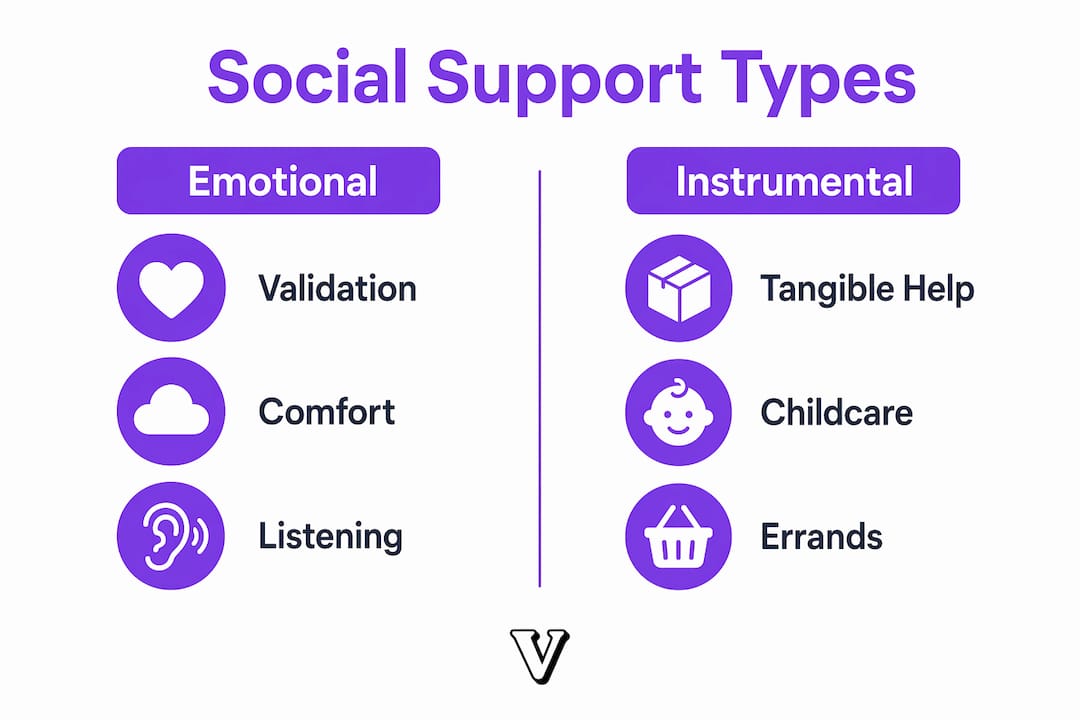
Three distinct types of support each play a different role:
- Emotional support: Empathy, active listening, and validation from friends, family, or a counselor.
- Informational support: Guidance, advice, and health-related knowledge that helps you make better decisions.
- Instrumental support: Practical help such as rides to appointments, meals during illness, or financial assistance.
Social ties also motivate habit formation and goal accountability. A friend who checks in on your sleep schedule or workout routine does more than cheer you on. That accountability loop reinforces positive behaviors and makes it harder to abandon healthy habits when motivation drops.
Social support also builds emotional resilience over time. People with strong networks report higher self-esteem and a greater sense of control over their mental health. That sense of agency is itself protective against anxiety and depression.
Pro Tip: You do not need a large circle to benefit. One or two people who genuinely listen and show up consistently provide more psychological protection than a wide network of shallow connections.
What are the physical health benefits associated with social support?
Social isolation is a significant risk factor for heart disease, stroke, and premature death. This is not a soft claim. A meta-analysis of nearly 40,000 patients found that social support protects against chronic illness and enhances resilience during medical recovery. That scale of evidence makes social connection one of the most well-documented health interventions available.

The biological mechanism is stress buffering. Chronic stress elevates cortisol and inflammatory markers, which damage cardiovascular tissue over time. Social support interrupts that cycle by reducing perceived stress before it translates into physical harm. People with strong support networks show lower blood pressure and more consistent physical activity levels compared to those who are socially isolated.
Longevity is another measurable outcome. Studies with longer follow-up periods show increased survival rates among patients who maintain sustained social support. The benefit compounds over years, not weeks. This means building social connections now pays dividends to your physical health decades later.
| Physical health outcome | How social support helps |
|---|---|
| Cardiovascular health | Reduces chronic stress that damages heart tissue |
| Blood pressure | Lowers perceived stress, which eases vascular strain |
| Recovery from illness | Provides practical help and emotional motivation |
| Longevity | Sustained support correlates with higher survival rates |
| Physical activity | Accountability from social ties increases exercise consistency |
Pro Tip: If you are managing a chronic condition, ask your care team about peer support programs. Multicomponent interventions that combine professional guidance with peer mentorship consistently outperform peer support alone.
What types of social support are most effective for wellness?
Not all support is equally effective, and the type you need depends on the situation. Emotional support is the most universally valued form. It provides empathy and validation without requiring the other person to solve anything. For people managing anxiety or grief, feeling understood often matters more than receiving advice.
Informational support fills a different gap. When you face a health decision, a career change, or a mental health challenge, access to accurate guidance from someone knowledgeable reduces uncertainty and improves outcomes. This is why therapists, coaches, and informed friends all serve a distinct function in a healthy support network.
Instrumental support is the most concrete form. It includes tangible help: covering childcare so you can attend therapy, driving a friend to a doctor's appointment, or preparing meals during a difficult period. People often underestimate how much practical assistance reduces mental load and frees up emotional bandwidth for recovery.
Research on intervention design shows that professional skill-building combined with peer mentorship yields better wellness outcomes than peer support alone. In a 2026 scoping review, 35.4% of effective social support interventions were delivered by mental health professionals and 35.1% by peer mentors. The takeaway is that both models matter, and the strongest programs use both.
Quality consistently outperforms quantity. Trusted confidants of 1 or 2 people provide more meaningful support than a broad network of casual acquaintances. Depth, consistency, and mutual trust are the defining features of relationships that actually protect your health.
The role of community in mental health reinforces this point. Strong community ties reduce depression and anxiety not because they expose you to more people, but because they create reliable, reciprocal relationships where you feel genuinely known.
What barriers prevent building social support?
Social anxiety is the most common obstacle. Many people want deeper connections but feel paralyzed by the fear of rejection, awkwardness, or saying the wrong thing. Social wellness is a learnable skill, not a fixed personality trait. Experts recommend incremental social steps rather than forcing large social commitments before you are ready.
Common barriers and practical ways to address them:
- Social anxiety: Start with low-stakes interactions. A brief conversation with a neighbor or a message to an old friend requires less energy than attending a group event.
- Time constraints: Prioritize depth over frequency. A 20-minute phone call with someone you trust does more than three rushed coffee meetings with acquaintances.
- Geographic isolation: Online communities, interest-based forums, and virtual peer support groups provide real connection without requiring physical proximity.
- Fear of vulnerability: Sharing something small and personal first builds trust gradually. You do not need to open up completely to start forming a meaningful bond.
- Past relationship wounds: Working with a therapist or counselor helps you identify patterns that block connection and build healthier relational habits.
Reconnecting with people you have lost touch with is often easier than building entirely new relationships. A short, genuine message acknowledging the gap and expressing interest in reconnecting has a high success rate. Most people respond warmly to being remembered.
Pro Tip: Joining a group organized around a shared interest, such as a running club, book group, or volunteer organization, removes the pressure of pure socializing. The activity gives you something to focus on while connection develops naturally.
How can you build and maintain social support for lasting wellness?
Building lasting social support requires consistency more than grand gestures. Small, regular contact with a few trusted people creates stronger bonds than occasional intense interactions. Prioritize 1 or 2 relationships where you can be honest, ask for help, and offer genuine support in return.
Practical steps to build and sustain your support network:
- Schedule regular contact. Set a recurring call, walk, or coffee with someone important to you. Consistency signals that the relationship matters.
- Join a community group. Volunteer organizations, faith communities, wellness programs, and hobby clubs all create natural contexts for repeated interaction.
- Use technology intentionally. Text, video calls, and shared apps keep connections alive across distance without requiring constant availability.
- Practice social mindfulness. Be fully present during interactions. Put your phone away, ask follow-up questions, and remember details from previous conversations.
- Complement connection with self-reflection. Practices like journaling and stress management through writing help you process emotions between social interactions, so you show up to relationships with more clarity and less reactivity.
- Seek professional support when needed. Therapists, counselors, and structured wellness programs provide the informational and emotional support that peer networks sometimes cannot.
Sustainable connection does not require a packed social calendar. It requires a small number of relationships where honesty, care, and consistency are mutual. That foundation supports every other dimension of your wellness.
Key Takeaways
Social support is one of the most evidence-backed tools for improving mental, emotional, and physical health, and its benefits grow stronger when you prioritize quality over quantity.
| Point | Details |
|---|---|
| Mental health protection | Strong social ties reduce depression and anxiety by buffering stress at a biological level. |
| Physical health benefits | Social connection lowers cardiovascular risk and correlates with higher survival rates over time. |
| Quality over quantity | One or two trusted confidants provide more wellness benefit than a large, shallow network. |
| Support types matter | Emotional, informational, and instrumental support each serve distinct roles in sustaining resilience. |
| Skill-based approach | Social wellness is learnable; incremental steps and professional guidance accelerate progress. |
Why social support is the most underrated wellness tool
Most wellness conversations focus on sleep, nutrition, and exercise. Those matter. But social connection operates at a level that none of those individual habits can fully replicate. At Voisley, we see this pattern consistently: people who invest in their emotional self-awareness through journaling and reflection also tend to show up better in their relationships. The two reinforce each other.
What I find most striking is how often people underestimate the power of a single trusted relationship. They assume they need a large social network or a perfectly curated community. They do not. One person who genuinely listens, who holds you accountable without judgment, and who shows up when things are hard does more for your mental health than any supplement or productivity system.
The barrier is rarely opportunity. It is vulnerability. Most people have someone in their life they could be closer to, but they hold back out of habit or fear. The research on emotional regulation strategies shows that the ability to manage your own emotions directly improves how you connect with others. Self-awareness and social wellness are not separate goals. They are the same goal approached from different angles.
Build one real relationship. Tend it consistently. That single act will do more for your long-term wellbeing than almost anything else you could prioritize.
— Voisley
Voisley supports your social and emotional wellness
Building meaningful social connections is easier when you also understand your own emotional patterns. Voisley is a digital wellness platform that combines guided journaling, mood tracking, and AI-powered insights to help you develop the self-awareness that makes relationships stronger.

Through features like gratitude journaling, shadow work prompts, and emotional trend visualizations, Voisley gives you a private space to process what you are feeling before, during, and after social interactions. The platform's community features also create shared journaling experiences that connect you with others on similar wellness paths. Whether you are working through social anxiety, building emotional resilience, or simply trying to show up better in your relationships, Voisley provides the structure and insight to support that work.
FAQ
What are the main benefits of social support in wellness?
Social support reduces depression and anxiety, lowers cardiovascular risk, and builds emotional resilience. It also motivates positive health behaviors and improves recovery outcomes from illness.
How does social support affect mental health?
Strong social connections buffer stress by providing emotional validation, which lowers cortisol and reduces depressive symptoms. Recent 2026 research confirms that perceived social support directly correlates with better psychological health outcomes.
Is quality or quantity of social connections more important?
Quality is more important. Research shows that 1 or 2 trusted confidants provide more meaningful wellness benefits than a large network of casual acquaintances.
What types of social support are most effective?
Emotional, informational, and instrumental support each serve distinct roles. Programs combining professional skill-building with peer mentorship consistently produce better wellness outcomes than peer support alone.
How can I build social support if I have social anxiety?
Start with small, low-stakes interactions and increase gradually. Social wellness is a learnable skill, and incremental steps, combined with professional guidance when needed, help overcome anxiety around forming new connections.