

TL;DR:
- Well-being visualization activates neural circuits involved in perception through vivid mental imagery, producing physiological and emotional benefits. Guided imagery, with scripted guidance, is ideal for beginners, while self-directed visualization suits more experienced users focused on personal growth. Regular, sensory-rich practice linked with tracking tools enhances emotional resilience and stress regulation over time.
Well-being visualization is a mind-body technique that uses deliberate mental imagery to promote emotional regulation, relaxation, and measurable improvements in physical health. Clinically, this practice is recognized as guided imagery, a structured method that engages multi-sensory mental images to activate the same neural circuits involved in actual perception. Research from neuroscience and sports psychology confirms that vivid, intentional imagery produces real physiological and psychological responses. Whether you use a recorded script, a therapist-led session, or a self-directed practice, the core mechanism is the same: your brain responds to imagined experience with measurable biological change.
What is well-being visualization and how does the brain process it?
Well-being visualization works because the brain does not draw a sharp line between perceiving something and imagining it. About 40% of neurons in the ventral temporal cortex that activate during visual perception are also reactivated during mental imagery. This means that when you vividly picture a calm forest or a moment of personal success, your brain is running many of the same sensory programs it would use if you were actually there.

This overlap is not superficial. Visualization recruits neural circuits used for seeing, moving, remembering, and assigning value to experiences. That is why a well-constructed visualization session can lower your heart rate, reduce cortisol, and shift your emotional state within minutes. The brain treats the imagined scenario as real enough to trigger a genuine physiological response.
Sensory richness is the key variable. A vague image of "feeling calm" produces far weaker neural engagement than a detailed scene involving the smell of pine, the sound of water, the warmth of sunlight on your skin, and the physical sensation of your breath slowing. The more sensory channels you activate, the more brain territory you recruit, and the stronger the regulatory effect.
Pro Tip: When building a visualization practice, write out your scene in advance using all five senses. Treat it like a script. The specificity is not optional. It is the mechanism.
The distinction between imagining and perceiving at the neural level also explains why visualization is not just positive thinking. It is a form of sensory-level brain training that produces measurable changes in how your nervous system responds to stress, pain, and emotional challenge.
Guided imagery vs. self-directed visualization: which one should you use?
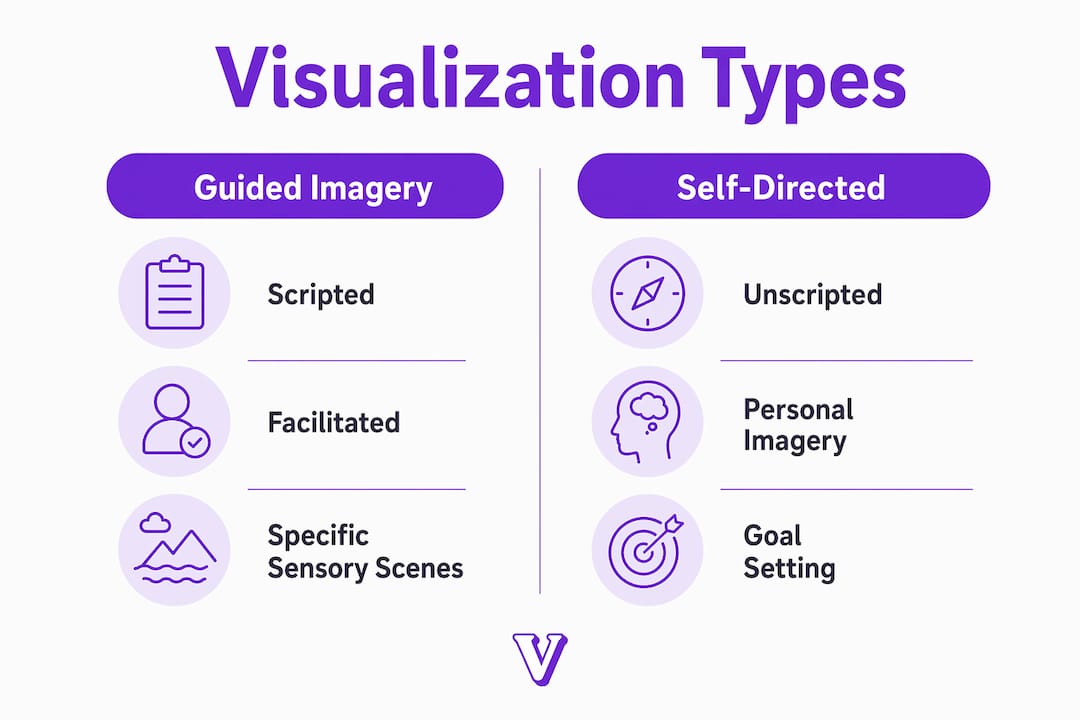
The two primary formats of well-being visualization serve different purposes and suit different experience levels. Understanding the difference helps you choose the right tool for your current goal.
| Format | Structure | Best for | Delivery method |
|---|---|---|---|
| Guided imagery | Scripted, facilitator or audio-led | Beginners, clinical goals, relaxation | Therapist, app, recorded audio |
| Self-directed visualization | Unscripted, internally generated | Experienced users, personal goals, performance prep | Solo practice, journaling prompts |
Guided imagery uses a facilitator, therapist, or pre-recorded script to lead you through a specific sensory scene. The Merck Manual describes it as a mind-body technique that combines relaxation and hypnotherapy elements, with applications ranging from cancer care to chronic pain management. Systematic reviews show it reduces pain and anxiety in fibromyalgia, ICU settings, and oncology contexts. The structure removes the cognitive burden of generating the scene yourself, which makes it significantly more accessible for beginners.
Self-directed visualization is unscripted. You generate the imagery from your own memory, imagination, or goal-setting. This format works well once you have internalized the sensory-richness principle and can sustain focused attention without external prompting. Athletes frequently use self-directed imagery for pre-competition mental preparation, including sensory movement visualization and motivational goal imagery.
For most people starting out, guided imagery formats are more effective because the script handles the sensory architecture for you. The practical recommendation is to begin with guided formats for at least four to six weeks before attempting fully self-directed sessions. Integrative therapy frameworks, including those used in integrative mental health settings, consistently recommend this progression for anxiety and stress-related goals.
How to visualize well-being: techniques and exercises that work
Effective visualization techniques for wellness follow a predictable structure. The steps below apply to both guided and self-directed formats.
-
Set a specific regulatory goal. Decide whether you are targeting stress reduction, sleep preparation, pain management, or confidence building. Vague goals produce vague imagery. A concrete goal like "I want to feel physically relaxed and mentally quiet before sleep" gives your brain a specific state to rehearse.
-
Create a sensory-rich scene. Choose an environment, real or imagined, that you associate with your target state. Populate it with at least three sensory details: what you see, what you hear, what you feel physically. Add smell or taste if they strengthen the scene.
-
Anchor with breath. Begin each session with three to five slow, deliberate breaths. This activates the parasympathetic nervous system before imagery begins, making the brain more receptive to the visualization. Combining breathwork with mental imagery amplifies the relaxation response.
-
Run the scene in real time. Do not fast-forward through the imagery. Experience it at normal speed, noticing sensory details as they arise. Sessions of ten to twenty minutes produce stronger effects than brief two-minute passes.
-
Close with an affirmation or intention. End each session by stating, internally or aloud, the emotional state you just rehearsed. This links the imagery to a verbal anchor, which makes the state easier to recall under stress.
Pro Tip: Pair your visualization practice with a mood tracking tool to measure your emotional state before and after each session. Over two to three weeks, the pattern data will show you which scenes and techniques produce the strongest shifts for you personally.
One underused technique is the well-being radar chart, a visual representation of multiple life domains such as relationships, health, work, and purpose scored on a single diagram. Research published in JMIR Mental Health found that interactive visual tools like radar charts reduce cognitive load and increase user satisfaction in well-being assessments compared to text-only formats. Using a radar chart before a visualization session helps you identify which domain needs the most attention, making your imagery more targeted and personally relevant.
A common pitfall is starting with imagery that is too abstract or aspirational. Picturing yourself as a completely different person in an idealized future creates cognitive dissonance rather than neural rehearsal. The most effective visualization targets a state that is one step beyond your current baseline, not ten steps. Concrete sensory states are the foundation of effective practice.
What benefits does well-being visualization offer for emotional resilience?
The benefits of visualization extend across mental, emotional, and physical health domains, and they are supported by clinical research rather than anecdote.
- Stress and anxiety reduction. Guided imagery lowers physiological stress markers including cortisol and heart rate. Clinical applications in ICU settings and pre-surgical anxiety have demonstrated consistent results across multiple systematic reviews.
- Pain management. Guided imagery improves quality of life in cancer patients and reduces pain perception in fibromyalgia. The mechanism involves shifting attentional focus and modulating pain-processing circuits in the brain.
- Sleep improvement. Visualization exercises designed for sleep preparation reduce pre-sleep cognitive arousal, the mental chatter that delays sleep onset. Sensory-rich scenes of physical relaxation are particularly effective for this application.
- Motivation and confidence. In sports science, structured guided imagery that includes sensory movement visualization and motivational goal imagery measurably improves focus, confidence, and competitive performance. The same principles transfer directly to professional and personal goal pursuit.
- Emotional self-regulation. Regular visualization practice trains the brain to access calm, focused states on demand. This is the core mechanism behind its use in emotional regulation strategies for anxiety, trauma recovery, and burnout.
"Visualization should be treated as state training. The quality of your sensory script and the consistency of your practice determine how effectively it builds emotional resilience over time." — Merck Manual clinical guidance on guided imagery
The importance of well-being visualization becomes clearest when you consider what consistent practice actually builds. Each session is a rehearsal of a regulated emotional state. Over weeks and months, those rehearsals lower the threshold for accessing that state under real-world pressure. This is not metaphor. It is how neural pathways are strengthened through repeated activation.
Key takeaways
Well-being visualization works because sensory-rich mental imagery activates the same neural circuits as real perception, making it a trainable skill for emotional regulation, stress relief, and physical health.
| Point | Details |
|---|---|
| Neural overlap drives results | About 40% of perception neurons reactivate during imagery, producing real physiological responses. |
| Sensory detail is the mechanism | Vague imagery produces weak effects; concrete, multi-sensory scenes engage more brain circuits. |
| Guided formats suit beginners | Scripted guided imagery removes cognitive load and is clinically validated for stress and pain. |
| Consistency builds resilience | Regular practice lowers the threshold for accessing regulated emotional states under pressure. |
| Visual tools sharpen focus | Radar charts and mood trackers help identify which life domains need targeted visualization work. |
Why most people underestimate what visualization actually requires
At Voisley, we have seen a consistent pattern among people who try visualization and abandon it within two weeks: they treat it like passive daydreaming rather than active neural training. The difference is not effort in the conventional sense. It is specificity. A session where you vaguely imagine "feeling better" does almost nothing. A session where you reconstruct the exact physical sensation of calm, the temperature of the air, the weight of your body, the rhythm of your breath, that session changes your nervous system.
The second mistake we see is skipping the measurement step. Visualization without tracking is like exercising without noticing whether you are getting stronger. When you log your emotional state before and after each session using a structured tool, you build a feedback loop that accelerates learning and keeps you motivated. The data also reveals which specific scenes and techniques work for your particular nervous system, because individual responses vary more than most guides acknowledge.
The third underestimated factor is alignment between your visualization script and your actual goals. Generic relaxation scripts are useful starting points, but they plateau quickly. The most durable practice is one where your imagery is calibrated to your specific emotional challenges and personal growth targets. That calibration is exactly what tools like Voisley are built to support, connecting emotional well-being to structured, personalized practice.
Start with guided formats. Track your results. Refine your scripts. That sequence works.
— Voisley
Start your visualization practice with Voisley

Voisley is built for exactly this kind of intentional, structured self-work. The platform combines guided journaling, mood tracking, and AI-powered emotional insights to help you build a visualization and self-reflection practice that actually sticks. You can log your emotional state before and after sessions, use personalized prompts to develop your own imagery scripts, and track emotional trends over time through visual dashboards. Whether you are starting with guided formats or ready to develop a fully personal practice, Voisley gives you the structure and feedback loop that makes the difference between a habit that fades and one that builds real emotional resilience.
FAQ
What is well-being visualization in simple terms?
Well-being visualization is the deliberate use of mental imagery to shift your emotional and physical state toward relaxation, confidence, or calm. It works by activating sensory brain circuits that overlap significantly with those used during actual perception.
How is guided imagery different from regular visualization?
Guided imagery uses a structured script led by a therapist, facilitator, or audio recording, while self-directed visualization is generated internally without external prompting. Guided formats are clinically validated for stress, pain, and anxiety and are recommended for beginners.
How long does it take to see benefits from visualization?
Clinical and sports psychology research shows measurable effects on stress and anxiety within single sessions, while sustained benefits for emotional resilience and pain management develop over consistent practice across several weeks.
Can visualization really reduce physical pain?
Yes. Systematic reviews cited by the Merck Manual confirm that guided imagery reduces pain perception in fibromyalgia and improves quality of life in cancer patients, operating through attentional and neural pain-processing mechanisms.
Do I need an app or tool to practice visualization?
No app is required, but tools that combine mood tracking with structured prompts, like Voisley, significantly improve outcomes by creating a measurable feedback loop that helps you identify which techniques work best for your nervous system.