

TL;DR:
- A productivity journal helps individuals track tasks, goals, and reflections to improve work output and self-awareness. Regular, intentional journaling enhances goal adherence, reduces stress, and fosters mental wellness through structured reflection and mindful practices. Starting with simple routines, guided prompts, and choosing the right format supports long-term habit formation and personal growth.
A productivity journal is a dedicated writing practice where you record tasks, goals, reflections, and progress to systematically improve your work output and track what you actually achieve. Unlike a diary or a simple to-do list, it combines planning, accountability, and self-reflection in one place. Tools like the Intelligent Change Planner and the Journal it! app have popularized this practice, but you can start with a blank notebook today. The best part: only 5–15 minutes daily is enough to see real results, split between a morning planning session and an evening review.
What are the key benefits of a productivity journal?
A productivity journal works because it forces your brain to process goals twice: once when you write them and again when you review them. That repetition builds clarity and commitment in ways that mental notes simply cannot.
Handwriting improves memory and critical thinking, and reflective writing reduces stress while strengthening emotional processing. These are not soft benefits. They directly affect how well you focus, make decisions, and follow through on priorities. Think of it as a daily mental debrief that keeps your work life from running on autopilot.
Here is what consistent journaling delivers over time:
- Stronger goal adherence. Writing goals down makes them concrete. Reviewing them daily keeps them front of mind.
- Reduced stress and mental overload. Offloading tasks and worries onto paper frees up cognitive space for actual work.
- Better self-awareness. Tracking patterns in your energy, focus, and output reveals what conditions help you do your best work.
- Visual progress tracking. Habit trackers and weekly reviews show momentum, which reinforces motivation.
- Improved emotional processing. Reflective writing helps you work through frustration and setbacks rather than carrying them into the next day.
The mental wellness benefits of journaling are well documented, and they compound over time. A person who journals consistently for 30 days develops a sharper sense of what is working and what is not. That self-knowledge is the real engine behind long-term productivity.
How to start and maintain a productivity journaling habit
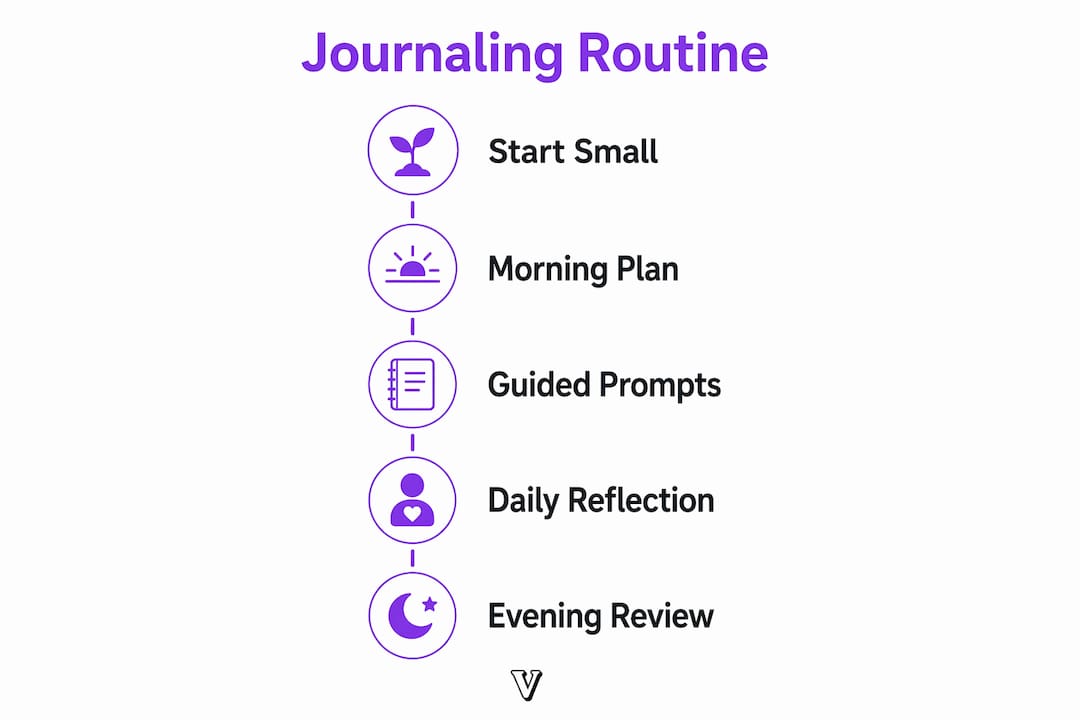
The biggest mistake new journalers make is overcomplicating the setup. You do not need the perfect notebook or the ideal app. You need a consistent time, a simple structure, and the discipline to show up for five minutes.
Build a two-part daily routine
Start with a morning planning session of 5–10 minutes. Write your top three priorities for the day, one intention for how you want to show up, and any potential obstacles you can anticipate. In the evening, spend 5 minutes reviewing what you completed, what you did not, and why. That evening reflection is where the real learning happens.

Use guided prompts to reduce friction
Guided journaling reduces decision fatigue by giving you a structure to follow instead of staring at a blank page. Apps like Journal it! and structured planners like the Intelligent Change Planner include built-in prompts that make starting easier. This matters most in the first 30 days when the habit is still fragile.
Follow these steps to build consistency
- Anchor your journal to an existing habit. Write in the morning right after coffee, or in the evening right before you close your laptop. Habit stacking removes the decision of when to journal.
- Keep your journal visible. A notebook on your desk or an app pinned to your home screen lowers the barrier to starting.
- Do a weekly review every Sunday. Spend 15 minutes looking back at the week: what you accomplished, what you avoided, and what you want to carry forward.
- Share your goals with someone. Sharing goal progress doubles accountability compared to keeping goals private. A friend, a partner, or even a public commitment works.
- Treat missed days as data, not failure. If you skip three days in a row, write about why. That reflection is more valuable than the days you missed.
Pro Tip: Do not use your journal as a glorified to-do list. Reflecting on why tasks go unfinished is far more useful than just listing what you did not do. Ask yourself: Was the task unclear? Did I overcommit? Was I avoiding something? That kind of honest inquiry is what separates a productivity journal from a planner.
Physical vs. digital productivity journals: which one is right for you?
The format you choose matters less than the consistency you build. That said, physical and digital tools have real differences in cost, flexibility, and how they fit into your workflow.
Physical planners cost $20–$60, while digital apps range from $2 per month to $20 per year. The price gap is significant, but so is the difference in what each format offers.
| Feature | Physical planner | Digital app |
|---|---|---|
| Cost | $20–$60 one-time | $2/month to $20/year |
| Tactile writing benefit | Yes, supports memory retention | No |
| Habit and goal tracking | Manual, visual | Automated, with reminders |
| Accessibility | Offline only | Any device, any location |
| Customization | Limited to layout | High, with templates and integrations |
| Search and review | Manual | Instant keyword search |
Physical planners like the Intelligent Change Planner and the Rock Planner work well for people who think better on paper and want a distraction-free writing experience. The act of writing by hand engages the brain differently than typing, which supports deeper reflection.
Digital tools like Journal it! shine when you want integrated planning, tasks, habits, and goals in one place. They also send reminders, track streaks, and let you search past entries instantly. For people managing complex schedules or working across multiple devices, a digital time management journal removes the friction of carrying a notebook everywhere.
The honest answer: try both. Many people use a physical planner for morning planning and a digital app for habit tracking and evening reviews. The combination captures the tactile benefits of writing and the automation benefits of technology.
Effective goal setting and time management inside your journal
A journal without a goal structure is just a diary. The most effective approach connects your big-picture ambitions to what you do today.
Use the cascading goals framework
Breaking goals into cascading milestones from annual down to daily closes the gap between intention and action. Here is how it works in practice:
- Annual goal: Launch a freelance writing business by December.
- Quarterly goal: Land three paying clients by the end of Q1.
- Monthly goal: Send 20 cold pitches and publish two portfolio pieces.
- Weekly goal: Write one pitch per day, Monday through Friday.
- Daily task: Draft and send one pitch before 10 a.m.
Each level feeds the next. When your daily tasks connect to a quarterly goal, the work feels meaningful instead of arbitrary. That connection is what sustains motivation over months, not just days.
Integrate habit tracking and time blocking
Add a simple habit tracker to your weekly spread. Track the behaviors that support your goals: deep work hours, exercise, sleep, or reading. Seeing a streak of checked boxes creates a visual record of consistency that is hard to abandon.
Time blocking works inside a journal by reserving specific hours for specific types of work. Write your blocks the night before. When you sit down in the morning, you already know what the first hour looks like. That removes the low-grade anxiety of deciding what to work on next.
Pro Tip: Focus your daily journal on two or three meaningful tasks rather than ten small ones. Journaling prompts that push you toward growth work best when they are tied to goals that actually matter to you. Momentum comes from finishing important work, not from clearing a long list of minor tasks.
How productivity journaling supports mental wellness
Productivity and mental wellness are not separate concerns. Chronic overwhelm, decision fatigue, and unprocessed stress all destroy work performance. A well-structured journal addresses all three.
Reflective writing gives you a structured outlet for the mental noise that accumulates during a busy day. Instead of carrying unresolved frustrations into tomorrow, you write them out, examine them, and decide what to do next. That process builds emotional regulation over time.
Here is how journaling supports mental wellness alongside productivity:
- Gratitude entries reduce negativity bias. Starting or ending a session with two or three things you are grateful for shifts your mental frame toward what is working.
- Mindfulness prompts slow reactive thinking. Questions like "What distracted me today?" or "What did I avoid and why?" create space between stimulus and response.
- Emotional self-care through writing is supported by research on journaling and mental health, which shows consistent links between expressive writing and lower anxiety.
- Preventing task overwhelm starts with writing down everything on your mind. The act of externalizing your task list reduces the cognitive load of holding it all in your head.
Voisley's emotional self-care and mindfulness journaling resources go deeper on these techniques, connecting the science of reflective writing to practical daily habits. The mental clarity you build through journaling does not stay in the journal. It shows up in how you work, communicate, and make decisions.
Key takeaways
A productivity journal works best when it combines structured goal setting, daily reflection, and honest self-assessment rather than functioning as a simple task list.
| Point | Details |
|---|---|
| Start small and consistent | Five to fifteen minutes daily is enough to build a meaningful journaling habit. |
| Reflect, do not just list | Reviewing why tasks go unfinished teaches more than tracking what you completed. |
| Use cascading goals | Connect annual goals to daily tasks so every entry ties to something meaningful. |
| Choose the right format | Physical planners support memory; digital apps offer automation and habit tracking. |
| Add accountability | Sharing your goals with another person doubles your follow-through rate. |
What I have learned from years of watching people journal
Most people who try productivity journaling quit within two weeks. Not because the method does not work, but because they treat it like a performance review instead of a thinking tool. They write what they think they should write rather than what is actually true.
The journals that changed how I work were the ones where I stopped trying to look productive on paper and started being honest about what was blocking me. One week I realized I had moved the same task forward three days in a row. Writing about it forced me to admit I was avoiding it because I did not know how to start. That one insight saved me more time than any productivity app ever has.
Guided prompts helped me get there. Without structure, I defaulted to listing tasks. With prompts like "What did I resist today and why?" or "What would make tomorrow feel like a success?", the journal became a real thinking partner. The science behind journaling for mental clarity backs this up: structured reflection produces better self-awareness than open-ended writing alone.
My honest recommendation is to start with a guided format for the first 60 days. After that, you will know enough about your own patterns to customize freely. Weekly accountability reviews are non-negotiable. They are the moment when the journal stops being a daily ritual and starts being a real record of how you are growing.
— Voisley
Start your productivity journaling practice with Voisley
Voisley brings together everything you need to build a journaling habit that actually sticks. The platform offers guided journal types covering goal setting, gratitude, and future planning, alongside mood tracking and AI-powered insights that help you spot patterns in your thinking and behavior over time.

Whether you are just starting out or looking to deepen a practice you already have, Voisley gives you the structure, prompts, and community to make journaling a consistent part of how you work and grow. Visit Voisley to explore the full range of journaling tools and find the format that fits your goals.
FAQ
What is a productivity journal?
A productivity journal is a structured writing practice where you record goals, tasks, reflections, and progress to improve your work output. It differs from a diary by focusing specifically on performance, habits, and goal achievement.
How long should I spend journaling each day?
Research shows 5–15 minutes daily is enough, split between a morning planning session and a short evening review. Consistency matters more than length.
Should I use a physical planner or a digital app?
Physical planners cost $20–$60 and support memory through handwriting, while digital apps range from $2 per month to $20 per year and offer automation and reminders. The best choice depends on whether you prioritize tactile writing or integrated tracking.
What is the biggest mistake beginners make?
Most beginners turn their journal into a to-do list, which leads to burnout. Reflecting on why tasks go incomplete is more useful than simply logging what you did or did not finish.
How does journaling connect to mental wellness?
Reflective writing reduces stress, improves emotional processing, and builds self-awareness, all of which directly support focus and decision-making. Gratitude entries and mindfulness prompts within a journal reinforce this effect daily.