
TL;DR:
- Most people struggle to sustain personal growth because they lack a structured workflow that connects values, goals, and habits into a repeatable system. Building a system that runs automatically through tiered habits and scheduled reflection creates durable progress beyond fleeting motivation. Starting small, focusing on self-awareness, and using consistent journaling techniques help embed growth into daily life over time.
Most people approach personal growth the same way they approach New Year's resolutions. They feel inspired, commit hard for two weeks, then quietly abandon the whole thing when life gets busy. The problem isn't a lack of desire. It's the absence of a personal growth workflow. Without structure, even the best intentions scatter across too many goals, too many habits, and too many half-finished journals. This guide walks you through how to build a system that actually holds, from clarifying your values to designing daily and weekly rhythms that create real, measurable progress.
Table of Contents
- Key takeaways
- What your personal growth workflow actually means
- How to build your personal growth workflow step by step
- Common pitfalls and how to troubleshoot them
- Integrating journaling and self-reflection into your workflow
- My honest take on what actually sustains a growth workflow
- Start your workflow with Voisley
- FAQ
Key takeaways
| Point | Details |
|---|---|
| Systems beat willpower | A well-designed personal system makes progress automatic, not dependent on fluctuating motivation. |
| Start narrow, go deep | Focus on one to three habits at a time to build strong clusters before expanding your workflow. |
| Tiered habits create durability | Design minimum, medium, and full versions of each habit to stay consistent even on your hardest days. |
| Reflection is not optional | Weekly journaling and quarterly audits keep your goals relevant and your momentum intact. |
| Sunset what no longer serves you | Removing outdated habits prevents system bloat and keeps your workflow lean and focused. |
What your personal growth workflow actually means
People often confuse a personal growth workflow with a to-do list or a vision board. It's neither. A personal growth workflow is a repeatable system that connects your values, your goals, your daily habits, and your reflection practices into one coherent process. Think of it as the operating system running underneath your everyday decisions.
The difference between a workflow and ad hoc effort is dramatic. Ad hoc effort depends on you feeling motivated. A workflow runs whether you're motivated or not because it's built into your schedule, your environment, and your identity. A personal system design shifts focus from chasing inspiration to creating conditions where growth happens automatically.
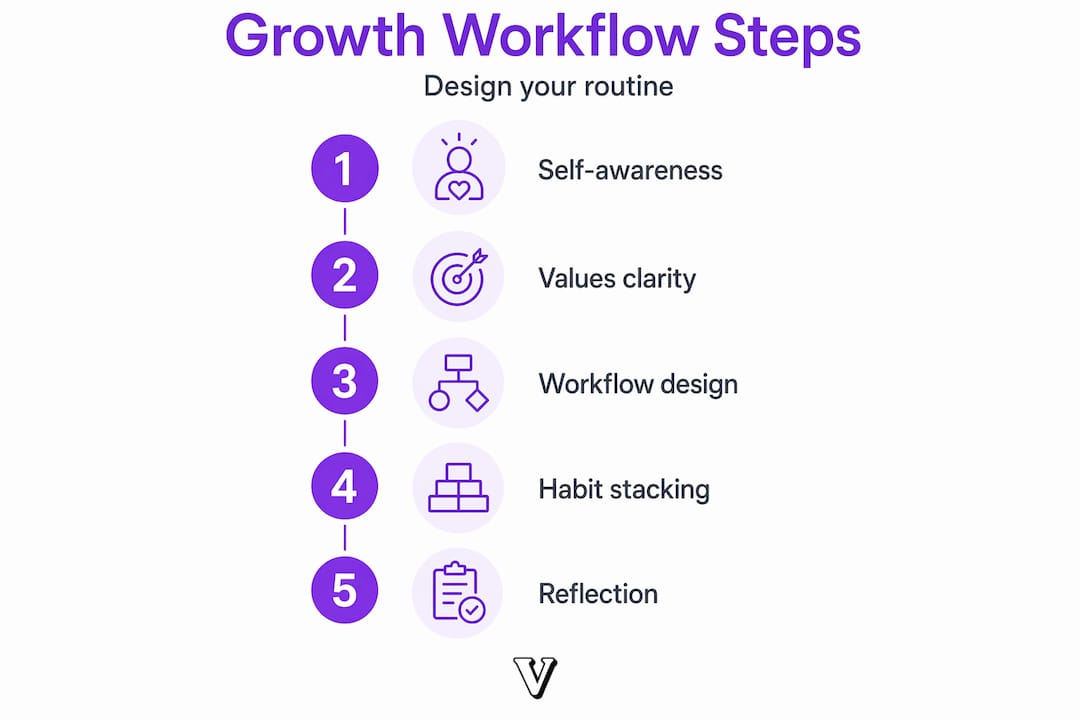
Before you design anything, you need two prerequisites: self-awareness and values clarity. Self-awareness tells you where you actually are, not where you think you are. Values clarity tells you where you genuinely want to go, not where you think you should want to go. Without both, you'll build a beautiful system pointed in the wrong direction.
The tools you'll need at the start are simpler than most productivity gurus suggest. A journaling method, a basic time-tracking practice (even just one week of honest logging), and a reflection framework. Here's how common journaling methods compare for workflow purposes:
| Journaling style | Best for | Workflow fit |
|---|---|---|
| Gratitude journaling | Emotional reset, positivity anchoring | Daily check-in, pairs well with morning routine |
| Shadow work journaling | Deep self-discovery, pattern recognition | Weekly or monthly reflection sessions |
| Goal-focused journaling | Progress tracking, accountability | Weekly review and planning cycles |
| Free-writing | Cognitive offloading, creative problem-solving | Flexible use during transitions or stress |
| Prompted journaling | Beginners, structured self-reflection | Daily habit, especially with an AI-guided platform |
The mindset shift that matters most here is this: stop trying to feel your way into growth and start designing your way into it. Motivation is a visitor. Systems are residents.
How to build your personal growth workflow step by step
This is where most guides go abstract. Here is a concrete sequence you can follow.
-
Run a self-assessment. Before setting any goals, audit your current life across four or five domains: health, relationships, work, learning, and emotional well-being. Be honest about where the real gaps are, not just the socially acceptable ones.
-
Apply a priority filter. The Priority Filter Method scores each growth area on three criteria: impact, gap severity, and values fit. Rate each on a scale of 1 to 5. Areas scoring 12 or above belong in your workflow. Everything else waits.
-
Set SMART goals with behavioral proxies. A goal like "get healthier" is useless in a workflow. A behavioral proxy turns it into something trackable: "Walk for 20 minutes after lunch four days a week." The goal is the destination. The behavioral proxy is the daily driving.
-
Map your workflow. For each priority area, define the habit, the journaling touchpoint, the reflection cadence, and the review checkpoint. A mapped workflow makes the invisible visible.
-
Design tiered habits. Every habit you build should have three versions: a minimum (one minute of journaling), a medium (ten minutes), and a full version (thirty minutes). Tiered habit design prevents the all-or-nothing thinking that kills most self-improvement workflows.
-
Block your calendar. Reflection doesn't happen if it isn't scheduled. Block 15 minutes for a daily check-in and 45 minutes for a weekly review. Treat these blocks like meetings you cannot cancel on yourself.
Pro Tip: Use habit stacking to anchor new practices to existing routines. If you already make coffee every morning, attach your journaling to that cue. The established behavior does the heavy lifting of triggering the new one.
One more thing worth noting: starting with one to three habits from the same life domain before expanding gives you far better odds than spreading across five categories at once. Depth before breadth.
Common pitfalls and how to troubleshoot them
Even a well-designed workflow runs into friction. Knowing the common failure points ahead of time is what separates people who sustain growth from those who quit after three weeks.
The most frequent mistake is overloading the system. You identify six growth areas, map twelve habits, and schedule daily journaling across four different formats. Within two weeks, the cognitive weight alone buries you. Keep the starting load small and resist the urge to add more until your current habits feel automatic.
Here is a quick troubleshooting checklist when your workflow stalls:
- Motivation dropped? Check whether your goals still align with your current values. Misalignment kills drive faster than busyness.
- Skipping journaling? Shorten the format. One sentence beats zero sentences. Your minimum viable habit exists exactly for this moment.
- Feeling overwhelmed? Temporarily drop to the minimum tier of every habit. Maintain the identity, not the performance.
- Lost track of progress? That's a signal to schedule your quarterly audit. Quarterly reviews prevent wasted effort by ensuring your plan stays relevant to where you actually are now.
- Bored or uninspired? The workflow may have grown stale. Inject a new prompt style or shift your journaling focus for a month.
Pro Tip: Schedule a habit sunset review every quarter alongside your goal audit. Deliberately remove any habit that no longer serves your current priorities. A lean workflow beats an impressive-looking one you don't follow.
Recovery after a missed day is simple: do not try to double up. Just return to the minimum version of your practice the next day. Streaks are motivating, but continuity of identity matters far more than an unbroken chain.
Integrating journaling and self-reflection into your workflow
Journaling is not therapy, and it is not a diary. In the context of a personal growth workflow, it is your data collection and processing system. It captures what happened, how you felt, what you learned, and what needs to change. Reflection and journaling are documented catalysts for emotional well-being and deeper self-awareness, which means they are not a "nice to have" in your workflow. They are structural.
The most effective daily reflection routine takes about ten minutes. In the morning, write two or three sentences about your intention for the day and one thing you're grateful for. In the evening, write two or three sentences reviewing what happened and one thing you'd do differently. That's it. Short, consistent, and tied directly to your workflow goals.

Weekly reflection runs deeper. Spend 20 to 30 minutes reviewing your progress across your priority areas, checking in on your emotional state, and adjusting next week's plan. A useful set of self-reflection techniques makes this process feel less like homework and more like a genuine conversation with yourself.
Here's how different journaling styles map to different growth personalities:
| Growth personality | Recommended style | Why it fits |
|---|---|---|
| Analytical thinker | Goal-focused + data logging | Satisfies the need for measurement and visible progress |
| Emotional processor | Shadow work + free-writing | Creates space to examine patterns without judgment |
| Creative self-starter | Free-writing + prompted prompts | Maintains flexibility while adding enough structure |
| Habit-focused achiever | Gratitude + tiered habit tracking | Reinforces positive behavior loops daily |
| Exploration-oriented | Prompted journaling (AI-guided) | Provides direction without rigid constraints |
High performers also integrate what might seem like "unproductive" time into their workflows. Unstructured thinking for 30 to 60 minutes at least twice a week actually boosts cognitive output. That's not downtime. That's a feature of the system.
One more truth about journaling: it compounds. The insight you capture in week one becomes context for week four. Over three months, you can see your own patterns in ways that no one-time reflection can reveal. That's where the real self-discovery happens.
My honest take on what actually sustains a growth workflow
I've watched a lot of people build elaborate personal development plans that collapse within 60 days. The common thread isn't laziness. It's identity mismatch. The plan was designed around who they wanted to be, not who they currently are.
What I've found actually works is starting from a brutally honest picture of your present self and building toward the identity you want, one small behavior at a time. Habits take a median of 59 to 66 days to form. That's not a bug in the system. It's just how human behavior works. The people who internalize this stop expecting transformation in three weeks and start playing a longer, more patient game.
The other thing I'd push back on is the idea that you need more tools. Most people don't need a new app, a new planner, or a new framework. They need fewer things, done consistently. Embedding learning into your daily life, as agile professionals build development into daily work, is far more effective than treating growth as a weekend project.
Your identity is not fixed. But it also doesn't change from a single decision. It changes from repeated small decisions that accumulate proof. Every time you do the minimum version of a habit on a hard day, you're casting a vote for who you're becoming. That's not motivational language. That's just how it works.
— Voisley
Start your workflow with Voisley

Building a personal growth workflow from scratch is one thing. Sustaining it when life gets complicated is another. Voisley was designed specifically to close that gap. With guided journaling formats, AI-powered reflection prompts, mood tracking, and progress visualizations, Voisley gives your workflow a home. You don't have to track everything manually or design prompts from scratch. The platform handles the structure so you can focus on the growth. Whether you're working through an emotional well-being workflow or building your first serious reflection practice, Voisley meets you where you are. Explore what's possible at voisley.com.
FAQ
What is a personal growth workflow?
A personal growth workflow is a repeatable system connecting your values, goals, daily habits, and reflection practices into one structured process. Unlike ad hoc efforts, it runs consistently by design, not by motivation.
How long does it take to build a working growth workflow?
Expect two to three months before the workflow feels natural. Research shows habits form in 59 to 66 days on average, so patience with the early phase is part of the process.
How many habits should I include in my workflow?
Start with one to three habits from the same life domain. Adding too many at once dilutes your focus and significantly reduces the likelihood that any of them stick.
How does journaling improve a personal growth workflow?
Journaling creates a feedback loop between action and reflection. It captures patterns, tracks emotional trends, and surfaces insights that inform smarter adjustments to your goals and habits over time.
What should I do when my workflow breaks down?
Drop to the minimum tier of each habit rather than abandoning the workflow entirely. A one-minute version of any practice preserves your habit identity and makes it far easier to rebuild momentum the next day.