

TL;DR:
- Clear, challenging personal growth goals should be specific, measurable, and aligned with values. Limiting focus to three to five goals per quarter helps prevent burnout and maintains progress. Regular tracking, reviews, and honest self-assessment support sustained improvement and emotional well-being.
Personal growth goals are defined as specific, measurable objectives that drive meaningful improvement in your skills, habits, mindset, or emotional well-being. Knowing how to set personal growth goals separates people who make real progress from those who repeat the same vague resolutions every year. Locke and Latham's research confirms that clear, challenging goals consistently outperform "do your best" intentions. The SMART framework (Specific, Measurable, Achievable, Relevant, Time-bound) is the industry standard for translating those intentions into results. This article walks you through every step, from defining your goals to tracking them with tools built for self-awareness and emotional well-being.
What are personal growth goals and why does specificity matter?
Personal growth goals are targets you set across four core areas: skills, habits, mindset, and emotional health. A goal in any of these areas only works when it is specific enough to measure. "Be more confident" is not a goal. "Practice one feedback conversation per week for eight weeks" is a goal.
Specific, challenging goals consistently produce higher performance than vague intentions. That finding holds across decades of behavioral research. The reason is simple: your brain cannot track progress toward a target it cannot define.
The SMART framework gives you the structure to build goals that hold up:
- Specific: Name the exact skill, habit, or behavior you want to change.
- Measurable: Attach a number, frequency, or observable outcome.
- Achievable: Set a target that stretches you without being unrealistic.
- Relevant: Connect the goal to something you genuinely care about.
- Time-bound: Give it a deadline, whether weekly, monthly, or quarterly.
Identity statements like "I will be more confident" must transform into behavioral proxies to measure progress. Without that translation, you have no way to know if you are moving forward.
Pro Tip: Write your goal as a complete sentence: "I will [specific action] [frequency] by [date]." That format forces clarity before you even start.
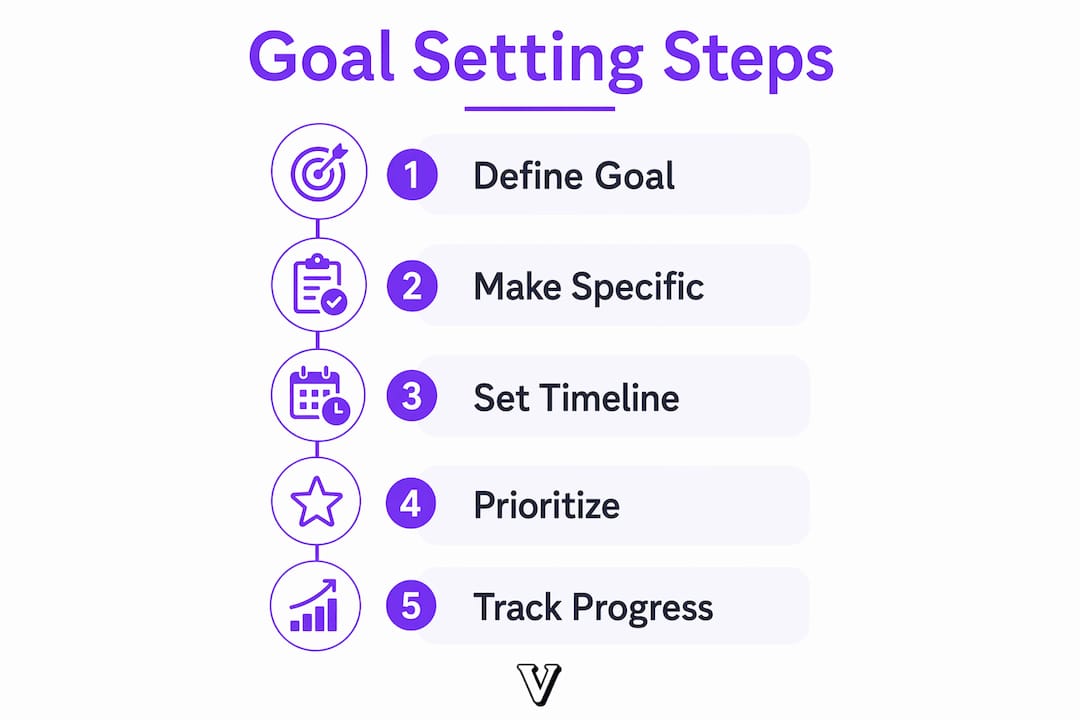
The most common mistake people make is treating personal development goals as aspirations rather than plans. Aspirations inspire. Plans produce results.
How do you prioritize personal growth goals without burning out?
Prioritization is where most personal growth planning breaks down. People list ten goals, feel excited for two weeks, then abandon everything by the end of the first month.
Research recommends limiting active goals to 3–5 per quarter to maintain focus and reduce cognitive overload. That limit is not a suggestion. It reflects how much sustained attention the human brain can realistically direct at meaningful change.
A practical method for choosing which goals make the cut is the Priority Filter. It scores each potential goal across three dimensions:
- Impact: How significantly will achieving this goal change your life or well-being?
- Gap severity: How large is the distance between where you are now and where you want to be?
- Values fit: Does this goal align with what you genuinely care about, not what you think you should care about?
The Priority Filter ensures you focus on high-leverage goals and avoid wasting effort on areas that sound productive but do not move the needle for you personally.
Goals that score low across all three dimensions should be dropped or postponed. Dropping unattainable goals is a strategic decision, not a failure. Psychologists consistently find that people who disengage from impractical goals tend to be mentally healthier than those who cling to them out of stubbornness.
Pro Tip: Run every goal through the Priority Filter before committing. If a goal scores low on values fit, it will drain your motivation within weeks regardless of how "important" it looks on paper.
Aligning goals with your core values is not a soft, feel-good exercise. It is the mechanism that keeps you motivated when the initial enthusiasm fades.
How to set and plan personal growth goals step by step
A clear process removes the guesswork from personal growth planning. Follow these six steps to build a plan that holds up past the first week.
-
Identify your "why." Before writing a single goal, ask what you want your life to look like in 90 days. Your answer anchors every decision that follows and gives you a reason to keep going when progress slows.
-
Apply the SMART framework. Take each priority area and write a goal that is specific, measurable, achievable, relevant, and time-bound. "Read more" becomes "Read 20 pages of a nonfiction book every weekday for 12 weeks."
-
Break goals into milestones. Large goals feel abstract. A 12-week goal becomes manageable when you identify three monthly checkpoints. Each checkpoint is a smaller, concrete outcome that confirms you are on track.
-
Build if-then plans. If-then planning (also called implementation intentions) is one of the most research-supported tools in behavioral science. The format is simple: "If [situation], then I will [action]." For example: "If I finish dinner, then I will open my journal for 10 minutes." This removes the need for willpower in the moment.
-
Track progress in writing. A written log, whether on paper or in a digital tool, creates a record that your brain cannot distort. Journaling strategies enhance self-awareness and emotional clarity, reinforcing the habits that support your goals.
-
Schedule weekly and quarterly reviews. Planning weekly reviews and quarterly audits improves goal completion rates. A weekly review takes 15 minutes. A quarterly audit takes one hour. Both are non-negotiable if you want to course-correct before a small drift becomes a full derailment.
The table below shows how leading indicators (daily and weekly actions) connect to lagging indicators (quarterly results) for a sample personal development goal.
| Goal area | Leading indicator | Lagging indicator |
|---|---|---|
| Emotional regulation | 10-minute journaling session, 5 days per week | Reduced stress response by end of quarter |
| Communication skills | One feedback conversation per week | Completed 12 conversations over 12 weeks |
| Physical health | 30-minute walk, 4 days per week | Consistent energy levels tracked monthly |
| Self-awareness | Weekly reflection using structured prompts | Identified 3 recurring emotional patterns |
Tracking both types of indicators gives you early warning when a plan is slipping, long before the quarterly result confirms it.
What are the most common pitfalls in setting life goals?
Even well-designed goals fail when common traps go unaddressed. Knowing the pitfalls in advance is the fastest way to avoid them.
- Goal overload: Limiting growth focus to 1–3 major areas per quarter and maintaining minimum viable habits sustains momentum even under stress. Most people abandon goals not because they lack discipline, but because they took on too much at once.
- Vague identity goals: "Be more disciplined" gives your brain nothing to act on. Translate every identity statement into a specific, observable behavior before you commit to it.
- All-or-nothing thinking: Missing one journaling session does not erase a week of progress. Treating a single miss as total failure is the fastest route to quitting entirely.
- No review system: Goals without scheduled check-ins drift silently. You do not notice the problem until the quarter is over and nothing has changed.
"Small, consistent progress leads to lasting personal growth rather than intense one-time efforts. Presence is a practice." Behavioral design experts make this point clearly: the person who improves 1% each day builds more than the person who overhauls everything for two weeks and burns out.
Psychological flexibility is the skill of adjusting your goals when circumstances change, without treating the adjustment as defeat. The goal is growth, not adherence to a plan that no longer fits your life.
What tools and habits actually support personal development goals?
The right tools reduce friction between intention and action. The wrong ones add steps that make it easier to quit.
Journaling as a reflective practice reinforces growth by creating a structured space to process emotions, track patterns, and reconnect with your goals. It is not a passive activity. Done consistently, it sharpens self-awareness in ways that no productivity app alone can replicate.

Pro Tip: Pair journaling with a specific trigger, such as morning coffee or the end of your workday, to make it a habit that does not require a decision each time.
Habit stacking is another high-leverage method. You attach a new behavior to an existing one, so the existing habit acts as the cue. "After I make my morning coffee, I write three lines in my growth log" is far more reliable than "I will journal sometime today."
Environment design works at a different level. It removes the need for motivation by making the desired behavior the easiest option available. Keeping your journal on your desk, not in a drawer, is a small change with a measurable effect on consistency.
The table below compares four common growth-supporting methods by their primary benefit and the effort required to sustain them.
| Method | Primary benefit | Effort to sustain |
|---|---|---|
| Guided journaling | Self-awareness, emotional clarity | Low, 10–15 minutes daily |
| Habit stacking | Behavior consistency | Low, once set up |
| Accountability partner | External motivation, honest feedback | Medium, requires scheduling |
| Weekly written review | Progress tracking, course correction | Low, 15 minutes per week |
Accountability also matters. Sharing your goals with one trusted person who will ask about your progress creates a social commitment that internal motivation alone cannot replicate. The key word is "trusted." Sharing with someone who will not follow up is the same as not sharing at all.
Key Takeaways
Setting personal growth goals requires specific, measurable objectives built on the SMART framework, limited to 3–5 priorities per quarter, and supported by consistent tracking and regular review.
| Point | Details |
|---|---|
| Specificity drives results | Vague goals fail. Write every goal as a specific, measurable, time-bound action. |
| Limit active goals | Focus on 3–5 goals per quarter to prevent cognitive overload and burnout. |
| Use the Priority Filter | Score goals by impact, gap severity, and values fit before committing to them. |
| Track leading indicators | Daily and weekly actions predict quarterly results. Log them consistently. |
| Drop goals strategically | Disengaging from unfit goals protects mental health and frees effort for what matters. |
The part of goal setting nobody talks about enough
The personal growth advice I see repeated most often focuses on ambition: set bigger goals, push harder, do more. That advice misses something fundamental.
The people who make the most consistent progress are not the most ambitious. They are the most honest. They know what they actually value, not what they think they should value. They set goals that fit their real life, not an idealized version of it. And when a goal stops serving them, they let it go without guilt.
Values alignment is the piece that most goal-setting frameworks underemphasize. SMART goals are a solid structure, but a perfectly formatted goal built on someone else's definition of success will drain you every single day. The fix is not a better framework. It is a more honest conversation with yourself about what you actually want.
Emotional well-being is not a byproduct of achieving your goals. It is a prerequisite for achieving them. When you are emotionally depleted, your capacity for sustained effort collapses. That is why self-reflection practices belong inside your growth plan, not outside it.
Progress over perfection is not a motivational slogan. It is a description of how lasting change actually works. One feedback conversation per week, one journal entry per day, one honest quarterly review. Those small, repeated actions compound into something significant. The dramatic overhaul rarely does.
— Voisley
Voisley: a structured space for your growth goals
Personal growth planning works best when you have a dedicated space to think, reflect, and track what matters.

Voisley is built for exactly that. The platform combines guided journaling with mood tracking, personalized prompts, and AI-powered insights that help you spot emotional patterns before they derail your progress. Whether you are working through a future goals journal, a gratitude practice, or a shadow work session, Voisley gives your growth plan a home that goes beyond a notes app. The weekly and quarterly review process becomes easier when your reflections, mood data, and goal entries are all in one place. If you are ready to move from intention to consistent progress, Voisley is where that work happens.
FAQ
What is the SMART framework for personal growth goals?
SMART stands for Specific, Measurable, Achievable, Relevant, and Time-bound. It is the industry-standard method for turning vague intentions into clear, trackable personal development goals.
How many personal growth goals should I set at once?
Research recommends limiting active goals to 3–5 per quarter. Focusing on fewer goals reduces cognitive overload and significantly improves the likelihood of completing them.
What should I do when a personal growth goal stops working?
Drop it or postpone it. Psychologists find that disengaging from unattainable goals protects mental health and frees your energy for goals that are a better fit for your current life.
How does journaling support personal development goals?
Journaling builds self-awareness and emotional clarity, both of which reinforce the habits and mindset shifts that personal growth goals require. Consistent reflection also helps you catch drift early before it becomes a full setback.
What is the difference between an identity goal and a behavioral goal?
An identity goal is a vague aspiration like "be more confident." A behavioral goal is a specific, measurable action like "practice one feedback conversation per week." Behavioral goals are trackable. Identity goals are not.