

TL;DR:
- Personal growth journaling improves self-awareness, emotional clarity, and mindfulness through consistent reflective writing. Using simple tools like notebooks or apps, with guided prompts and regular review, helps build habits and reveals meaningful patterns over time. It activates brain pathways, reinforcing new behaviors and identities, but should be paired with other self-care practices for lasting growth.
Personal growth journaling is a structured reflective writing practice that builds self-awareness, emotional clarity, and mindfulness through consistent, intentional entries. Unlike casual diary writing, it follows deliberate personal growth journaling steps designed to shift how you think, feel, and behave over time. Research backs this up: journaling activates memory, emotional regulation, and decision-making regions of the brain simultaneously. Tools like notebooks, digital apps, and platforms like Voisley make starting this practice more accessible than ever. The payoff is real and measurable, and the process is simpler than most people expect.
What tools and prerequisites do you need to start personal growth journaling?
Starting a growth journal requires almost nothing. A basic notebook or a free app is enough. Most beginners over-invest in tools before writing a single word, and that investment becomes a reason to delay. Starting simple with a notebook or basic app at a realistic pace consistently outperforms elaborate setups.
Paper vs. digital: which format works better?
Both formats work, but they produce different results. Handwriting makes it easier to reach a flow state compared to typing on a phone or computer. That flow state matters because it lowers your internal editor and lets honest thoughts surface. Digital apps like Voisley add structure through guided prompts, mood tracking, and pattern visualizations, which is especially useful if you are new to reflective writing.
How long and how often should you journal?
Research points to 15–20 minute sessions at a frequency of 3–4 times per week as the sweet spot. Daily journaling sounds disciplined, but it creates pressure that pushes beginners to quit. Shorter, frequent sessions deliver more benefit with less burnout risk. If even 15 minutes feels like too much at first, use a timer set to 3–5 minutes. That small commitment builds the habit without the resistance.
Pro Tip: Set your journal and pen on your pillow each morning. The visual cue removes the decision of whether to journal and makes the habit automatic.
Here is a simple setup checklist to get started:
- A notebook (any size) or a journaling app like Voisley
- A quiet space with no phone notifications for the session
- A consistent time slot, either morning or evening
- A loose topic or prompt to start each session
- A timer to keep sessions focused and bounded
| Setup element | Recommended choice |
|---|---|
| Format | Paper notebook or guided app |
| Session length | 15–20 minutes |
| Frequency | 3–4 times per week |
| Environment | Quiet, uninterrupted space |
| Starting aid | Timer or structured prompt |
What are the key journaling steps for personal growth and how do they work?
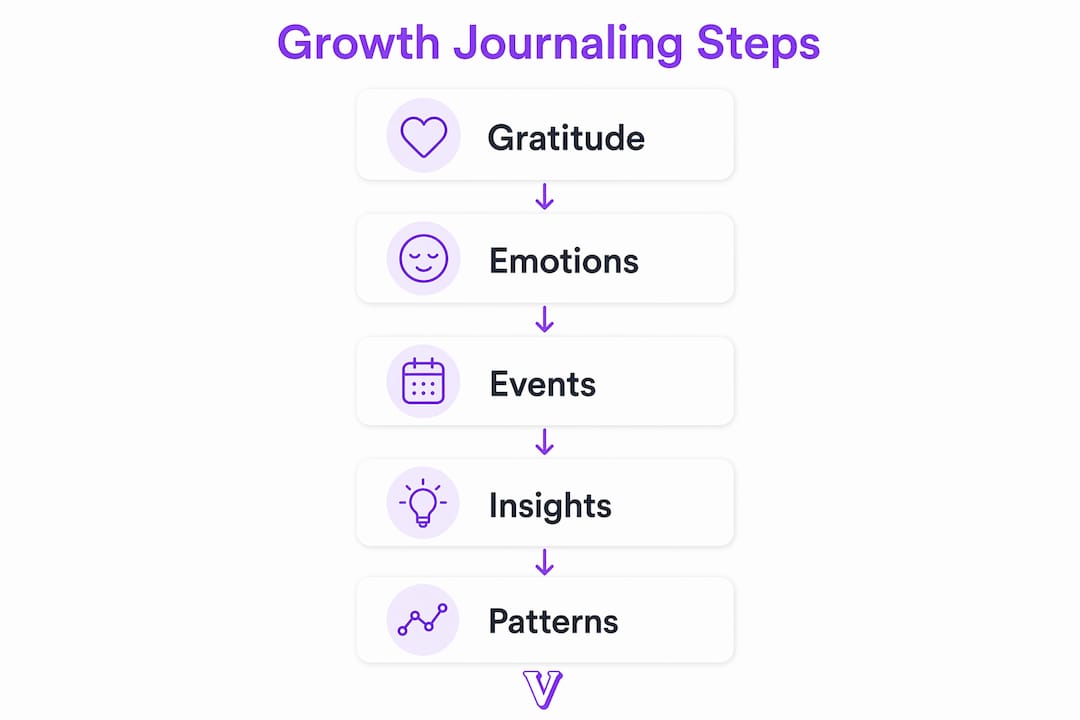
The steps to personal development journaling follow a clear sequence. Each step builds on the last, moving you from surface-level observation to deep behavioral change. Here is the core process:
-
Start with specific gratitude. Write down one positive event and explain why it happened. Specific gratitude journaling produces sustained well-being improvements beyond two weeks. Listing items without reasons does not produce the same effect. The "why" forces you to connect events to your values and actions.
-
Write expressively about emotions. Spend 15–20 minutes writing freely about a feeling, situation, or experience that is weighing on you. Do this across 3–4 sessions. Expressive writing helps you process difficult emotions rather than suppress them. The goal is not to solve the problem but to articulate it clearly.
-
Shift to third-person perspective. Write about yourself as if you are describing a character in a story. "She noticed she felt anxious before every meeting" is more revealing than "I feel anxious." This analytical journaling approach promotes forward-looking thinking and reduces emotional reactivity.
-
Write to your future self. Describe who you want to be in 6 or 12 months. Include specific behaviors, not just outcomes. Future-self journaling clarifies goals and builds motivation by making abstract ambitions concrete and personal.
-
Review entries every 2–4 weeks. Read back through your entries and look for repeating themes. Naming patterns as clear declarative statements, such as "I avoid conflict when I feel unheard," makes insights harder to ignore and easier to act on.
-
Use targeted prompts. Rotate prompts across categories: emotional expression, values clarification, mindfulness, and future goals. Prompts prevent the blank page problem and keep sessions productive.
Pro Tip: After each review session, write one declarative sentence that names a pattern you noticed. "I procrastinate most when the task feels tied to my self-worth" is far more useful than a vague sense that something is off.
| Step | Core purpose |
|---|---|
| Specific gratitude | Builds sustained positive emotion and perspective |
| Expressive writing | Processes difficult emotions safely |
| Third-person journaling | Creates distance for clearer self-analysis |
| Future-self writing | Clarifies goals and builds identity |
| Pattern review | Converts observations into actionable insight |

How to use prompts effectively in your personal growth journaling?
Guided personal growth prompts solve the most common barrier to reflective writing: not knowing what to say. A blank page invites avoidance. A specific question invites honesty. Structured prompts encourage healthier mental processing than unguided emotional venting, which can actually worsen mood if left without direction.
The most effective prompt categories for self-discovery journaling include:
- Gratitude prompts: "What went well today, and why did it happen?" This builds positive attribution habits.
- Reflection prompts: "What did I avoid this week, and what does that tell me?" This surfaces avoidance patterns.
- Future-self prompts: "What would the version of me I want to become do in this situation?" This builds identity-based motivation.
- Values prompts: "When did I feel most like myself this week?" This clarifies what matters most to you.
- Mindfulness prompts: "What am I feeling right now, and where do I feel it in my body?" This builds present-moment awareness.
Rotate prompt categories across sessions rather than using the same type every time. If gratitude prompts feel easy and automatic, that is a signal to shift toward reflection or values prompts where the resistance is higher. Resistance often points to the most productive territory.
Pro Tip: Keep a short list of 5–10 favorite prompts inside the front cover of your journal or saved in your app. On low-motivation days, pick one from the list instead of starting from scratch.
Prompts also create emotional safety. When you write in response to a question, you are not just venting. You are processing with structure. That structure is what separates journaling for emotional clarity from simply complaining on paper.
What common mistakes should you avoid in a personal growth journaling practice?
The most damaging mistake is treating journaling as a daily obligation. Pressure to journal daily is the top reason beginners quit. A relaxed schedule of 3–4 sessions per week builds a more durable habit than a rigid daily rule that collapses under a busy week.
Other common pitfalls include:
- Unstructured venting. Writing about frustration without any guiding question can reinforce negative thought loops rather than resolve them. Always pair emotional writing with a prompt or a closing reflection.
- Skipping the review. Many people write entries but never read them back. The real insight comes from reviewing entries every 2–4 weeks and naming what you see.
- Expecting immediate results. Journaling builds self-awareness gradually. Most meaningful patterns take weeks to become visible. Expecting clarity after three sessions leads to disappointment and abandonment.
- Treating journaling as therapy. Journaling is a powerful tool for self-reflection, but it is not a substitute for professional support. If you are experiencing severe distress, anxiety, or depression, a licensed therapist is the right resource.
"Journaling is powerful but not a cure-all. Combining it with other measures like adequate sleep improves outcomes, and professional support is advised for severe distress." — Clear head, full page
Journaling works best as one part of a broader self-care routine. Pair it with sleep, movement, and social connection for the strongest results.
How does journaling create lasting personal growth through brain changes?
Journaling changes the brain through neuroplasticity. Turning scattered thoughts into structured narratives reinforces new neural pathways that support behavior change. This is not a metaphor. Writing activates memory consolidation, emotional regulation, and decision-making regions at the same time. That simultaneous activation is what makes journaling more effective than simply thinking through a problem.
Repetition is the mechanism. Each time you write about a desired behavior or identity, you rehearse it mentally. That rehearsal makes the behavior more accessible in real life. Future-self journaling works precisely because it gives the brain a concrete narrative to move toward, not just an abstract goal.
"Journaling shapes the brain by turning scattered thoughts into meaningful, rehearsed narratives that promote behavior change." — The Good Trade
Journaling also works well alongside mindfulness and emotional self-care practices. Mindfulness sharpens present-moment awareness, and journaling gives that awareness a place to land and develop into insight. Together, they accelerate the self-awareness gains that either practice produces alone.
Pro Tip: After writing a future-self entry, read it aloud once. Hearing your own words activates a different processing channel and makes the narrative feel more real and motivating.
Pattern identification is the final piece. Naming patterns as declarative statements converts vague feelings into clear, specific knowledge about yourself. That specificity is what makes journaling a tool for lasting change rather than just a record of your days.
Key Takeaways
Consistent, structured journaling practice is the most direct path to self-awareness, emotional clarity, and lasting personal growth.
| Point | Details |
|---|---|
| Start simple | A notebook or basic app at 3–4 sessions per week beats any elaborate system. |
| Use structured prompts | Guided prompts prevent venting loops and produce healthier emotional processing. |
| Review entries regularly | Reading back every 2–4 weeks reveals patterns that single sessions cannot show. |
| Name patterns clearly | Declarative statements like "I avoid X when Y" make insights concrete and usable. |
| Combine with other practices | Journaling paired with sleep, mindfulness, and movement produces the strongest results. |
What Voisley has learned about journaling for real growth
The most common mistake people make with journaling is waiting until they feel ready. They buy the beautiful notebook, download the app, and then wait for the right moment or the right mood. That moment rarely arrives on its own. The practice creates the clarity, not the other way around.
Flexibility matters more than consistency in the early weeks. Writing three honest sentences on a hard day is worth more than skipping a session because you cannot fill a full page. The format, length, and frequency should serve you, not the other way around.
The self-awareness gains from journaling are real, but they are slow. Most people notice a shift after 4–6 weeks of regular practice. The shift is not dramatic. It shows up as a slightly faster recognition of your own patterns, a bit more space between a trigger and your reaction, and a clearer sense of what you actually value versus what you think you should value.
Journaling works best when it is honest rather than polished. Write what is true, not what sounds good. The entries no one else will read are usually the most useful ones.
— Voisley
Voisley: a structured space for your personal growth practice

Voisley is built for people who want more from their journaling than a blank page. The platform combines guided prompts, mood tracking, and AI-powered pattern analysis to give your reflective writing real structure and direction. Whether you are working through gratitude journaling, shadow work, or future-goals writing, Voisley provides the framework that makes each session count. Mood visualizations show you emotional trends over time, so the patterns you are working to identify become visible. If you are ready to build a journaling habit that actually produces self-awareness and emotional clarity, start with Voisley and see what structured reflection can do.
FAQ
How long should a personal growth journaling session be?
Research recommends 15–20 minute sessions at a frequency of 3–4 times per week. This length is enough to produce meaningful reflection without creating the pressure that causes people to quit.
Is handwriting better than typing for journaling?
Handwriting tends to produce a stronger flow state than typing, which makes honest, unfiltered writing easier. Digital apps add structure through prompts and tracking, so the best format depends on whether you need flow or guidance more.
What should I write about if I have no idea where to start?
Start with one specific question: "What went well today, and why did it happen?" That single prompt activates gratitude and causal thinking at the same time. Voisley's guided personal growth prompts offer a full library of starting points organized by category.
How soon will I see results from journaling?
Most people notice meaningful shifts in self-awareness after 4–6 weeks of consistent practice. Journaling builds insight gradually through pattern recognition, not through single breakthrough sessions.
Can journaling replace therapy?
Journaling is a tool for self-reflection, not a clinical treatment. For severe distress, anxiety, or depression, a licensed mental health professional is the appropriate resource. Journaling works best as a complement to professional support, not a substitute for it.