
TL;DR:
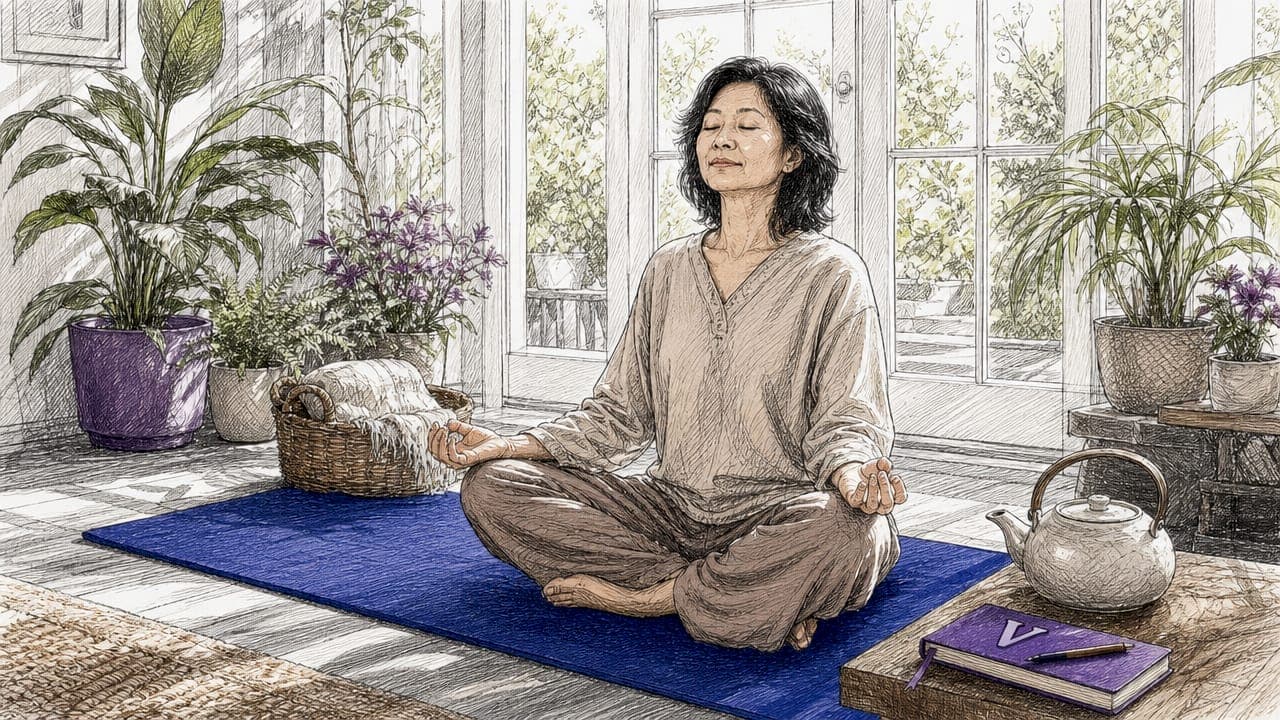
- Mindfulness involves deliberate, nonjudgmental awareness of the present moment, noticing thoughts, feelings, and sensations without trying to change them. Regular practice over 8 to 12 weeks can significantly reduce stress, anxiety, and depression while enhancing emotional regulation and productivity. It trains attention and acceptance, changing neural activity and reducing emotional reactivity through simple exercises like breath awareness and mindful walking.
Mindfulness is defined as the deliberate, nonjudgmental awareness of the present moment as it unfolds. You are not clearing your mind or achieving a state of bliss. You are simply noticing what is happening right now, in your thoughts, your body, and your surroundings, without labeling any of it as good or bad. Research from Johns Hopkins Medicine and Mindful.org confirms that this practice is accessible to anyone, at any time, without special equipment or training. A 2026 systematic review published in MDPI Healthcare found that 8 to 12 weeks of consistent practice produces the most reliable benefits for stress, anxiety, and depression. That is a short investment for a measurable return on your emotional well-being.
What is mindfulness and how does it actually work?
Mindfulness works by training two mental capacities at once: attention and acceptance. You learn to notice what is happening in your mind without immediately reacting to it. That sounds simple, but it runs counter to how most people operate. The default mode is to judge every thought, resist every uncomfortable feeling, and mentally rehearse every worry. Mindfulness interrupts that cycle.

The neuroscience behind the practice
Brain imaging studies confirm that mindfulness increases prefrontal cortex activity while simultaneously decreasing amygdala activity. The prefrontal cortex governs rational thinking and decision-making. The amygdala drives fear and emotional reactivity. When mindfulness shifts the balance between these two regions, you become less likely to be hijacked by stress and more capable of responding thoughtfully. This is not a metaphor. It is a measurable neurological change documented in research from Johns Hopkins Medicine.
The "second arrow" concept
Buddhist psychology describes a concept that modern mindfulness researchers have adopted: the second arrow. The first arrow is the painful experience itself, a difficult emotion, physical pain, or a stressful event. The second arrow is the suffering you add by fighting it, resenting it, or catastrophizing about it. Mindfulness reduces emotional reactivity by teaching acceptance, which pulls out that second arrow. You still feel the first arrow. You just stop driving it deeper.
"Mindfulness works by stymieing emotional reactivity, allowing people to shift how they experience pain and stress instead of escaping it." — Johns Hopkins Medicine research summary
Pro Tip: When a difficult thought arises during practice, try labeling it silently. "Worry." "Judgment." "Memory." Labeling activates the prefrontal cortex and creates a small but real distance between you and the thought.
What are the proven benefits of mindfulness?
The evidence base for mindfulness has grown substantially. A 2026 systematic review found moderate anxiety reductions with effect sizes of Hedges' g approximately negative 0.25 to negative 0.30. That is a statistically meaningful shift, comparable to the effect of some low-dose pharmacological interventions for mild anxiety. It means that for many people, a consistent mindfulness practice produces real, quantifiable relief.
The benefits extend well beyond anxiety. Here is what the research supports:
- Reduced depression symptoms. Mindfulness-based cognitive therapy, developed by researchers Zindel Segal, Mark Williams, and John Teasdale, is now recommended by the UK's National Institute for Health and Care Excellence for recurrent depression.
- Better emotional regulation. Mindfulness strengthens your ability to regulate emotional responses, reducing the intensity and duration of negative emotional states.
- Pain management. Johns Hopkins research shows mindfulness helps people shift their relationship to chronic pain rather than simply tolerating it.
- Improved sleep. Reduced rumination at bedtime is one of the most consistent self-reported benefits among regular practitioners.
- Productivity gains. Regular practice results in a gain of roughly 62 minutes of productivity per week per person. That figure comes from workplace studies and reflects the compounding effect of reduced distraction and better focus.
| Benefit | What the evidence shows |
|---|---|
| Anxiety reduction | Hedges' g of approximately negative 0.25 to negative 0.30 in 2026 systematic review |
| Depression management | Mindfulness-based cognitive therapy recommended for recurrent depression |
| Productivity | Roughly 62 additional minutes of focused work per week |
| Pain management | Shifts the experience of pain through acceptance, not suppression |
| Emotional regulation | Decreases intensity and duration of negative emotional states |
One critical nuance: mindfulness complements professional care but does not replace it. For serious mental health conditions, it works best alongside therapy or medical treatment, not instead of it.
What are common mindfulness practices and exercises?
Mindfulness practice falls into two broad categories: formal and informal. Formal practice means setting aside dedicated time. Informal practice means bringing deliberate awareness to activities you already do. Both matter, and brief mindful moments throughout the day are just as important as longer meditation sessions.
Formal mindfulness exercises
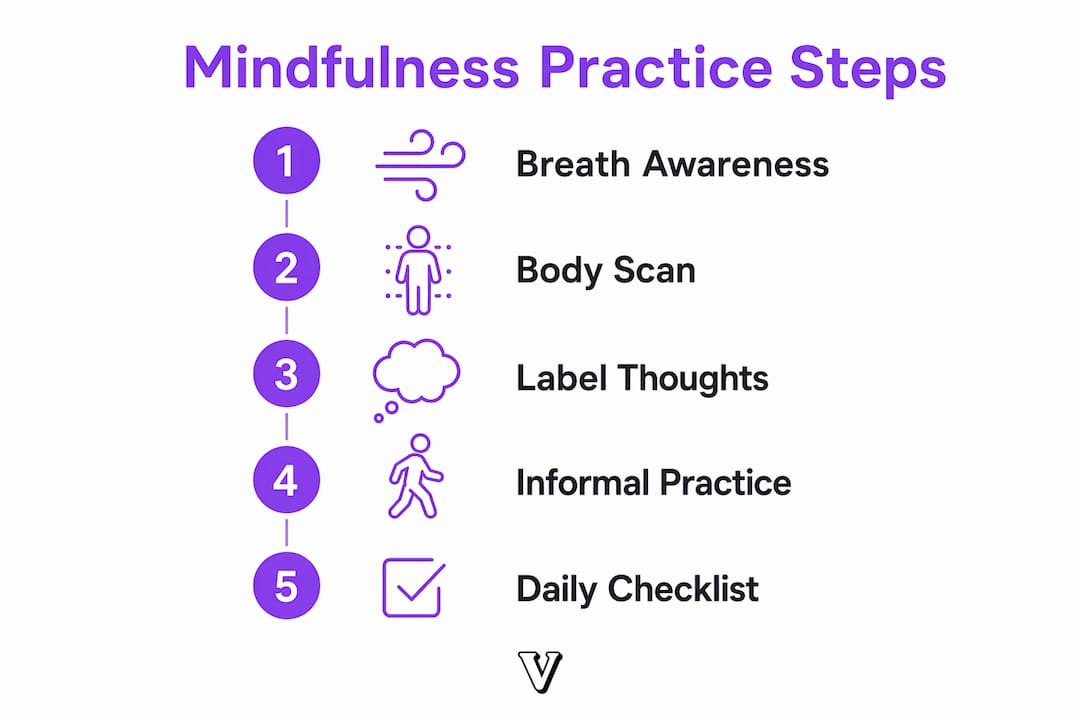
Breath awareness meditation. Sit comfortably, close your eyes, and focus entirely on the physical sensation of breathing. Notice the rise and fall of your chest, the temperature of the air, the pause between inhale and exhale. When your mind wanders, which it will, gently return attention to the breath. Start with five minutes and build from there.
Body scan. Lie down and move your attention slowly through each part of your body, from your toes to the top of your head. Notice sensations without trying to change them. This practice is particularly effective for stress-related physical tension and sleep difficulties.
Guided imagery. Use a recorded guide to direct your attention through a calming mental scenario. Apps and platforms like those available through Voisley's mindfulness resources can structure this experience for beginners.
Informal mindfulness practices
- Mindful eating. Eat one meal per day without screens. Focus on taste, texture, temperature, and the act of chewing.
- Mindful walking. During a walk, notice the sensation of your feet on the ground, the sounds around you, and the movement of your arms. Treat it as a moving meditation.
- Single-tasking. Choose one task and give it your complete attention for a defined period. No switching, no checking notifications.
Pro Tip: You do not need 30 minutes to practice mindfulness. Three deliberate breaths before a meeting, or one minute of focused attention while washing dishes, counts. Consistency across small moments builds the skill faster than occasional long sessions.
For a structured daily approach, Voisley's daily mindfulness checklist offers a practical framework you can follow without prior experience.
What are the biggest misconceptions about mindfulness?
Misunderstanding what mindfulness is leads to frustration and early dropout. These are the most common misconceptions, and correcting them will save you significant time and discouragement.
-
"Mindfulness means emptying your mind." This is the most widespread myth. Mindfulness involves noticing thoughts as they arise without judgment, not suppressing them. A busy mind during meditation is not a failed meditation. It is a normal mind being observed.
-
"It should feel relaxing immediately." Some sessions feel calm. Others feel restless, frustrating, or emotionally stirring. Both are valid. The goal is awareness, not comfort.
-
"It works the same for everyone." Mindfulness effectiveness varies by individual, and different approaches suit different people. If breath-focused meditation increases your anxiety, try a body scan or mindful walking instead. The practice is flexible by design.
-
"More is always better." Longer sessions do not automatically produce better results. The research consistently points to regularity over duration. Ten minutes daily outperforms 70 minutes once a week.
-
"If it's not working, I'm doing it wrong." Mindfulness is a skill that requires ongoing practice, not a technique you master in a week. Difficulty is not failure. It is the practice itself.
If you find that mindfulness consistently triggers distressing memories or worsens your mental state, consult a mental health professional. For most people, this is not the case. But the practice is a tool, not a universal solution.
Key takeaways
Mindfulness is a trainable mental skill that reduces anxiety, improves emotional regulation, and produces measurable neurological changes through consistent, nonjudgmental attention to the present moment.
| Point | Details |
|---|---|
| Core definition | Mindfulness is deliberate, nonjudgmental awareness of the present moment, not thought suppression. |
| How it works neurologically | It increases prefrontal cortex activity and decreases amygdala reactivity, reducing emotional hijacking. |
| Proven benefits | Consistent practice reduces anxiety and depression symptoms and adds roughly 62 minutes of weekly productivity. |
| Best practice approach | Brief daily moments of awareness combined with formal sessions of 8 to 12 weeks produce the strongest results. |
| Important boundary | Mindfulness complements professional mental health care but does not replace it for serious conditions. |
Why mindfulness changed how I think about emotional health
At Voisley, we have worked with thousands of people trying to build healthier emotional habits. The pattern we see most often is this: people come in expecting mindfulness to make them feel better immediately, and they leave disappointed when it does not. What they miss is that mindfulness does not make difficult feelings disappear. It changes your relationship to them.
The readers who see the most lasting change are not the ones who meditate for an hour every morning. They are the ones who pause for three breaths before responding to a stressful message, who notice when they are spiraling and name it without shame, who treat their own minds with the same patience they would offer a friend. That is the practice. It is not glamorous, and it does not always feel like progress.
What I have observed consistently is that the people who stick with mindfulness do so because they stop trying to be good at it. They approach each session with curiosity rather than judgment. That shift, from performance to observation, is where the real benefit lives. Mindfulness is not a destination you reach. It is a way of paying attention that you practice every day, imperfectly, and that is exactly the point.
— Voisley
Start your mindfulness practice with Voisley
Voisley is built for exactly this kind of work. The platform combines guided journaling, mood tracking, and AI-powered insights to help you build self-awareness and emotional clarity over time. Whether you are exploring mindfulness for the first time or deepening an existing practice, Voisley gives you a private, structured space to notice your patterns and understand what drives your emotional states.

The emotional well-being tools on Voisley include personalized prompts, gratitude and shadow work journals, and visualizations that show your emotional trends across days and weeks. You can also explore mindfulness for stress through curated resources that complement the platform's self-reflection features. If you are ready to move from understanding mindfulness to actually practicing it, Voisley is where that habit takes root.
FAQ
What is the simplest mindfulness definition?
Mindfulness is the practice of paying deliberate, nonjudgmental attention to the present moment. It involves noticing your thoughts, feelings, and sensations as they arise without trying to change or suppress them.
How long does it take to see benefits of mindfulness?
Research shows that 8 to 12 weeks of consistent mindfulness practice produces the most reliable reductions in anxiety, depression, and stress. Shorter periods can still produce noticeable shifts in emotional reactivity.
What is mindful breathing?
Mindful breathing is the practice of focusing your full attention on the physical sensations of each breath, the rise and fall of your chest, the temperature of the air, and the rhythm of each inhale and exhale. It is one of the most accessible entry points for mindfulness beginners.
Can mindfulness replace therapy or medication?
Mindfulness should complement professional care, not replace it. For serious mental health conditions, it works best alongside therapy or medical treatment as a supportive tool, not a standalone solution.
How do I start mindfulness practice as a beginner?
Start with five minutes of breath awareness each day. Focus on the sensation of breathing, and when your mind wanders, gently return your attention without judgment. Consistency matters more than duration, and brief daily moments of awareness build the skill faster than occasional long sessions.