
TL;DR:
- A mindfulness checklist consists of simple, daily habits like breath awareness and gratitude reflection to build emotional resilience. Tracking stress triggers and combining scheduled practices with in-the-moment micro-techniques over 8 to 12 weeks yields measurable improvements in anxiety and stress. Customizing the checklist based on personal patterns prevents overwhelm and sustains long-term mindfulness habits.
A mindfulness checklist is a structured set of brief, repeatable daily habits designed to build emotional resilience and self-awareness through consistent practice. Unlike vague intentions to "be more present," a checklist gives you concrete steps to follow at specific points in your day. Research confirms that structured mindfulness programs lasting 8 to 12 weeks produce moderate improvements in anxiety, depression, and stress. That means the format matters as much as the intention. The practices themselves, including breath awareness, body scans, and gratitude reflection, are evidence-based techniques drawn from Mindfulness-Based Stress Reduction (MBSR) and Mindfulness-Based Cognitive Therapy (MBCT). You do not need hours of free time or a meditation cushion. You need a clear list and the willingness to start small.
1. What belongs on a daily mindfulness checklist
A well-built mindfulness checklist covers three time windows: morning, midday, and evening. Each window serves a different psychological function, and skipping one creates gaps in your emotional regulation throughout the day.
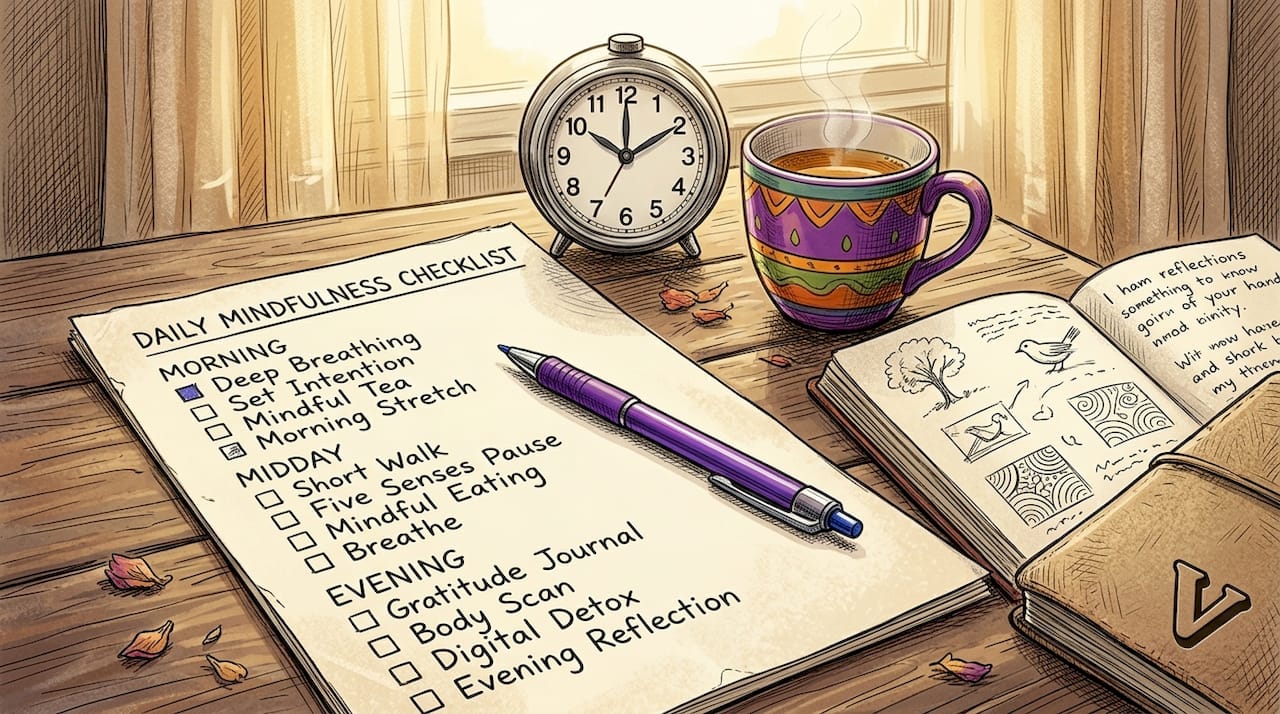
Morning practices set the tone before external demands take over. A practical daily checklist includes morning meditation, gratitude reflection, and intention setting as its first layer. Even two minutes of focused breathing before checking your phone shifts your nervous system out of reactive mode. Writing down one thing you are grateful for activates positive emotional processing before stress has a chance to accumulate.
Midday practices interrupt the autopilot cycle. A mindful break does not require leaving your desk. It means pausing for 60 seconds to notice your breath, your posture, and your emotional state. Mindful communication, which means listening fully before responding, is a midday practice most people overlook entirely. It costs nothing and changes the quality of every conversation.
Evening practices close the loop. A body scan before sleep, combined with brief journaling about what triggered stress during the day, builds the self-awareness that makes tomorrow's checklist more targeted. Repetition across all three windows is what creates emotional resilience over time, not any single technique.
Pro Tip: Start with just one practice per time window. Three habits total. Once those feel automatic, add one more. A modular checklist design prevents overwhelm and dramatically improves long-term adherence.
2. How to track your progress and adapt over time
Tracking is the feature most mindfulness guides skip, and it is the reason most people quit after two weeks. Without measurement, you cannot see growth, and without visible growth, motivation fades.
The most effective tracking method records more than whether you completed a practice. Stress trigger logs capture the time, situation, thought, emotion intensity, body signals, and your response style. This transforms vague feelings into readable patterns. When you notice that your tension spikes every Tuesday before team meetings, you can place a specific micro-practice right before that recurring trigger.
Use a simple daily tracking table like this one:
| Time | Situation | Emotion | Intensity (1-10) | Body signal | Response: mindful or automatic |
|---|---|---|---|---|---|
| 8:00 AM | Morning commute | Anxious | 6 | Tight chest | Automatic |
| 12:30 PM | Lunch break | Calm | 2 | Relaxed shoulders | Mindful |
| 6:00 PM | Work email after hours | Frustrated | 7 | Clenched jaw | Automatic |
Filling this in for one week reveals your personal stress map. You will see which situations consistently pull you out of awareness and which practices are actually working. From there, you adjust your checklist to target your real patterns rather than generic advice.
Morning check-ins and evening reviews also serve as bookends for this data. A 60-second morning check-in asks: "How am I feeling right now, and what might challenge me today?" An evening review asks: "Where did I respond automatically, and what would I do differently?" These two questions, practiced daily, build the self-awareness muscle that mindfulness is actually training.
Pro Tip: When a practice feels ineffective, do not drop it immediately. The VA's mindfulness guidance notes that initial lack of effect is normal. Treat early practice as planting seeds, not harvesting results.
3. Beginner-friendly techniques to add to your checklist
The best mindfulness techniques for beginners share one quality: they require no prior experience and produce noticeable results within the first session. Here are the techniques worth including in any starter checklist.
- Focused breath awareness. Starting with 1 to 5 minutes of focused breathing daily is the single most accessible entry point into mindfulness practice. Sit comfortably, breathe slowly, and count each exhale up to ten. When your mind wanders, start the count again without judgment. This builds concentration and activates the parasympathetic nervous system.
- Body scan. Sit or lie down, close your eyes, and move your attention slowly from the top of your head to your feet. Notice sensations without trying to change them. A beginner body scan takes three to five minutes and is especially effective before sleep to release physical tension.
- The STOP method. STOP stands for Stop, Take a breath, Observe, Proceed. This micro-practice for stress takes under 60 seconds and can be used anywhere, at your desk, in traffic, or mid-conversation. It interrupts automatic emotional reactions before they escalate.
- Mindful walking. Walk slowly for five minutes and focus entirely on the physical sensations of each step. Notice the ground beneath your feet, the movement of your arms, and the rhythm of your breath. This works indoors or outdoors and doubles as light movement.
- Grounding with the 5-4-3-2-1 technique. Name five things you can see, four you can hear, three you can touch, two you can smell, and one you can taste. This technique anchors attention to the present moment and is particularly effective during acute anxiety.
Start with one technique from this list. Practice it daily for one week before adding another. Complexity grows naturally once the foundation is solid.
4. Scheduled routines vs. in-the-moment micro-practices
A complete mindfulness checklist uses two distinct layers of practice, and understanding the difference between them helps you build a more resilient daily routine.
Scheduled practices are planned sessions with a fixed time and duration. Morning meditation, evening journaling, and weekly body scan sessions fall into this category. They build the baseline skill and emotional vocabulary you draw on throughout the day. The limitation is that they happen in controlled conditions. Real stress does not wait for your morning meditation slot.
In-the-moment micro-practices are brief, spontaneous interventions triggered by stress or emotional intensity. The STOP method, a single deep breath before responding to a difficult message, or a 30-second grounding exercise during a tense meeting are all micro-practices. A dual-layer approach combines both types to maintain skills during calm periods and deploy them during stress.
| Approach | Best used for | Duration | Example |
|---|---|---|---|
| Scheduled practice | Building baseline skill and self-awareness | 5 to 20 minutes | Morning breath meditation |
| Micro-practice | Real-time emotional regulation | Under 2 minutes | STOP method during conflict |
| Evening review | Reflection and habit adjustment | 5 to 10 minutes | Journaling stress triggers |
| Gratitude practice | Positive emotional processing | 2 to 5 minutes | Writing three specific gratitudes |
The most common mistake beginners make is treating mindfulness as only a scheduled activity. When stress hits at 2 PM, a 6 AM meditation session is not accessible. Micro-practices fill that gap. Your checklist should include at least one scheduled practice and at least one micro-practice you can deploy on demand. Combining gratitude with mindfulness within your scheduled sessions further amplifies emotional benefits beyond what either practice achieves alone.
Key takeaways
A consistent mindfulness checklist built on morning, midday, and evening practices, combined with stress trigger tracking and in-the-moment micro-techniques, produces measurable emotional resilience over 8 to 12 weeks of sustained use.
| Point | Details |
|---|---|
| Structure your checklist by time of day | Cover morning, midday, and evening to regulate emotions across the full day. |
| Track stress triggers, not just completions | Log emotion intensity and body signals to identify patterns and adjust your practice. |
| Start with one technique per window | A modular approach prevents overwhelm and builds lasting habits more reliably. |
| Combine scheduled and micro-practices | Scheduled sessions build skill; micro-practices like STOP handle real-time stress. |
| Expect 8 to 12 weeks for measurable results | Consistent practice over weeks, not days, produces moderate improvements in anxiety and stress. |
What Voisley has learned about building a mindfulness checklist that actually sticks
The most common reason people abandon a mindfulness checklist is not lack of motivation. It is perfectionism. They miss one morning session and decide the whole practice is broken. This is the exact opposite of what mindfulness teaches, and yet it is the trap nearly every beginner falls into at least once.
What actually works is treating your checklist as a living document rather than a pass-fail test. The days you skip a body scan are data points, not failures. When you notice you skipped it three days in a row, that tells you something about your current stress load or the placement of that habit in your day. Adjust the checklist. Move the practice to a different time. Shorten it to 90 seconds. The goal is contact with the practice, not perfection of execution.
Gratitude deserves special mention here. Most mindfulness guides treat it as optional, a nice add-on after the "real" practices. In our experience working with emotional well-being tools, gratitude reflection consistently produces the fastest shift in emotional tone, especially on difficult days. Pairing it with breath awareness in the morning creates a combination that is greater than either practice alone. The breath calms the nervous system; gratitude redirects attention toward what is working. Together, they set a foundation that holds up better under daily stress.
The other insight worth naming is this: your checklist will look different from someone else's, and that is correct. A person managing work anxiety needs different midday micro-practices than someone processing grief or navigating relationship stress. The emotional self-care principles that matter most are the ones you actually use. Customize without guilt.
— Voisley
Build your mindfulness practice with Voisley

Voisley is built for exactly this kind of structured, personal emotional work. The platform combines guided journaling, mood tracking, and AI-powered insights to help you build and maintain a daily mindfulness routine that adapts to your patterns. Whether you are starting with a single breathing exercise or ready to track stress triggers across the week, Voisley gives you the tools to make it measurable and meaningful. Explore gratitude and mindfulness journaling inside the app, or visit Voisley to start your personalized emotional well-being practice today.
FAQ
What is a mindfulness checklist?
A mindfulness checklist is a structured list of brief, daily practices, such as breath awareness, body scans, and gratitude reflection, designed to build emotional resilience and self-awareness through consistent repetition.
How long does it take to see results from a mindfulness checklist?
Structured mindfulness programs require 8 to 12 weeks of consistent practice to produce moderate improvements in anxiety, depression, and stress. Early sessions plant the foundation even when results are not yet visible.
What mindfulness techniques work best for beginners?
Focused breath awareness starting at 1 to 5 minutes per day is the most accessible entry point, followed by the STOP method and basic body scans. All three require no equipment and can be practiced anywhere.
How do I stay consistent with a daily mindfulness routine?
Start with one practice per time window, morning, midday, and evening, and track your stress triggers weekly to see real patterns. A modular checklist that grows gradually prevents the overwhelm that causes most people to quit.
Can mindfulness help with stress at work?
The STOP method, which takes under 60 seconds, is specifically designed for in-the-moment stress regulation during work situations. Combined with a scheduled morning practice, it gives you both a daily foundation and a real-time tool for workplace stress.