

TL;DR:
- Future self journaling connects present actions to future identity by creating vivid, effort-based visions. It enhances goal commitment and emotional clarity through regular, compassionate reflections. Practicing two to three times weekly yields better results than daily journaling to foster genuine self-growth.
Future self journaling is defined as a reflective writing practice where you write intentionally from the perspective of, or directly to, your future self to clarify goals, build self-awareness, and strengthen emotional well-being. Psychologists call the underlying concept "future self-continuity," the degree to which you feel connected to the person you will become. Research by Hal Hershfield and neuroscientist Erin Clabough shows that this connection predicts how consistently people pursue long-term goals over short-term comfort. Unlike wishful thinking or vague affirmations, future self journaling works because it creates a specific, vivid identity you are already growing into.
What is future self journaling, and what makes it work psychologically?
Future self journaling works because the brain treats your future self much like a stranger. Hershfield's research shows that reducing this psychological distance makes long-term goals feel as real and urgent as present-day needs. That shift changes behavior in measurable ways, from saving more money to making more ethical decisions.
Three psychological principles explain why this practice produces results:
- Future self-continuity: The stronger your sense of connection to your future self, the more you prioritize decisions that benefit that person. Writing in the voice of your future self builds that connection directly.
- Vividness and identity: A 2026 randomized controlled trial with university students found that interventions fostering vivid future self-identification significantly improved long-term goal pursuit. Vividness, not just positive emotion, is the active ingredient.
- Narrative therapy and identity-based habits: Writing a coherent story about who you are becoming creates cognitive dissonance between your current behavior and your stated identity. That tension motivates change without external pressure.
"Keeping intentions compassionate and open-ended helps maintain psychological flexibility and emotional resilience." Neuroscientist Erin Clabough emphasizes that mindset flexibility is not optional. It is the mechanism that keeps future self writing from becoming rigid self-criticism.
Digital and VR interventions that visualize the future self show similar results, increasing both vividness and goal commitment. That finding confirms the core principle: the more real your future self feels, the more your present behavior aligns with it.
How to practice future self journaling effectively

The format matters as much as the intention. Short, focused sessions outperform long, unfocused ones. Brief sessions of 1–5 minutes that focus on one specific behavior and use present tense are the most effective for engaging the brain's identity systems. Writing "I am someone who prioritizes sleep" signals current identity cultivation, not future fantasy.
A practical starting framework looks like this:
- Choose a time anchor. Pick a specific point in the future, six months, one year, or five years out. Specificity makes the scenario feel real rather than abstract.
- Write in present tense. Describe your future life as if it is already happening. "I wake up at 6:00 AM and feel rested" beats "I hope to wake up early someday."
- Ground it in effort, not luck. Describe what you did to get there. Plausible, effort-based scenarios activate optimism and goal clarity far better than vague affirmations or pure fantasy.
- Use a letter format when stuck. Writing "Dear Future Me" or "Dear Present Me" lowers the barrier to starting and creates an emotional connection that abstract goal-setting does not.
- Schedule a review session. Set a recurring reminder to reread past entries. Reviewing past entries creates a feedback loop that reveals unnoticed patterns and measures real progress.
- Try a day-in-the-life description. Write out one ordinary Tuesday in your future life in full sensory detail. What do you eat for breakfast? Who do you talk to? This exercise builds vividness faster than any list of goals.
Pro Tip: Write your future self entry immediately after a values check-in. Ask yourself, "What do I care most about right now?" then let that answer shape the scenario you describe. This keeps your future narrative grounded in what actually matters to you, not what you think you should want.
Frequency matters too. Evidence shows that 2–3 sessions per week with a 10-minute Evidence-Action Loop yields higher goal achievement than daily journaling. Daily writing can tip into rumination. Spacing sessions promotes genuine reflection.
What are the benefits of future self journaling for emotional well-being?
The benefits of future self journaling span psychology, behavior, and emotional health. They are not abstract. Research links this practice to concrete, measurable outcomes.
- Stronger goal commitment: Vivid future self-identification, confirmed in a 2026 randomized trial, directly predicts sustained goal pursuit. People who can picture their future self in detail follow through more consistently.
- Reduced maladaptive behavior: Greater future orientation reduces impulsive decisions. People who feel connected to their future self make better financial, health, and relationship choices.
- Self-compassion and motivation: Open-ended, compassionate journaling builds self-belief without the pressure of rigid prediction. Erin Clabough's work shows this open-ended approach sustains motivation longer than strict goal contracts.
- Emotional clarity: Writing about your future self forces you to name what you actually want, which is a form of emotional processing. That clarity reduces anxiety about the unknown.
- Ethical decision-making: Future self journaling closes the gap between present and future identity, which research links to more ethical choices and better long-term savings behavior.
The practice also functions as an identity-based habit-building exercise. It is not manifestation. It creates cognitive dissonance between who you are today and who you are writing yourself into being. That dissonance is productive. It drives growth.
How does future self journaling compare with other journaling styles?
Future self journaling occupies a distinct space among reflective writing practices. Understanding where it fits helps you use it alongside other methods rather than replacing them.
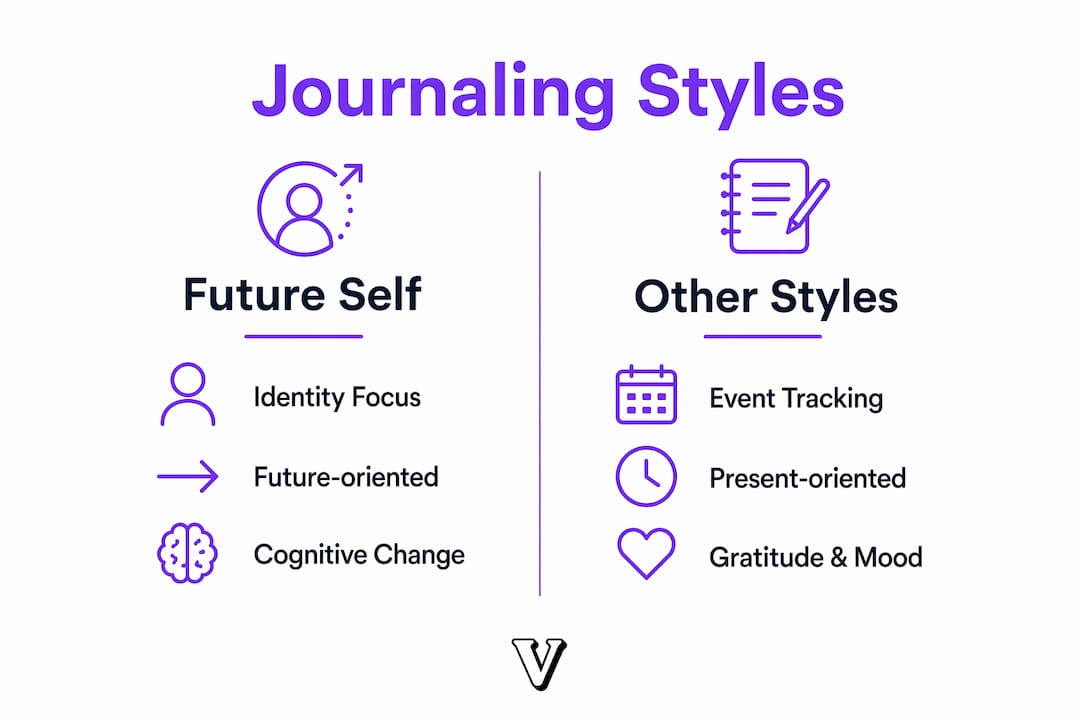
| Journaling style | Primary focus | Time orientation | Core benefit |
|---|---|---|---|
| Daily journaling | Events and feelings | Present | Emotional processing |
| Gratitude journaling | Appreciation | Present/past | Positive affect, mood lift |
| Shadow work journaling | Unconscious patterns | Past | Self-understanding, healing |
| Future self journaling | Identity and goals | Future | Goal commitment, self-belief |
| Mindfulness journaling | Sensory awareness | Present | Stress reduction, calm |
Traditional daily journaling captures what happened. Gratitude journals shift attention toward what is good right now. Future self journaling does something different. It constructs a narrative identity you are actively growing into. That forward orientation makes it uniquely suited for goal-setting and emotional wellness.
The two approaches work well together. A morning gratitude entry grounds you in the present. An evening future self entry connects that present to a meaningful direction. Digital tools that support multiple journal types make this kind of layered practice easier to sustain. AI-assisted prompts can also increase vividness by asking follow-up questions that push past surface-level responses.
Common challenges and how to overcome them
Most people hit the same three walls: unrealistic scenarios, inconsistent practice, and anxiety instead of motivation. Each one has a direct fix.
- Overly idealized futures: If your future self is a billionaire with perfect health and zero conflict, your brain will reject the narrative as fiction. Effort-based, plausible scenarios are what generate real cognitive continuity. Write about a better version of your current life, not a completely different one.
- Inconsistent practice: Motivation alone does not sustain a journaling habit. Attach your sessions to an existing routine, morning coffee, a Sunday evening wind-down, or a lunch break. Treat the 2–3 weekly sessions as fixed appointments.
- Rumination and anxiety: Excessive daily journaling can increase rumination rather than reduce it. If a session starts to spiral into worry, shift from open-ended writing to a structured prompt. "What one thing can I do this week that my future self would thank me for?" is specific enough to break the loop.
- Stale narratives: Your future self should evolve as you do. Schedule a quarterly review to update your entries. What felt true six months ago may no longer fit your values or circumstances.
- Self-criticism disguised as ambition: Future self writing can become a vehicle for harsh self-judgment if you focus on what you lack. Keep the tone compassionate. Write to your future self the way you would write to a close friend you believe in.
Pro Tip: If you feel stuck or anxious during a session, switch to a values letter. Write about what you want to stand for, not what you want to achieve. Values are more stable than goals and easier to connect with emotionally.
Key Takeaways
Future self journaling is the most direct method for closing the psychological gap between who you are today and who you intend to become, because it builds identity before behavior changes.
| Point | Details |
|---|---|
| Core definition | Future self journaling is a reflective writing practice that builds identity-based connection to your future self. |
| Psychological engine | Future self-continuity and vividness, not positive thinking, drive real goal commitment and behavior change. |
| Optimal frequency | Two to three sessions per week with scheduled reviews outperforms daily journaling for goal achievement. |
| Effort-based scenarios | Plausible, effort-grounded future narratives activate the brain; unrealistic fantasies do not generate cognitive continuity. |
| Emotional benefit | Compassionate, open-ended writing builds self-belief, reduces maladaptive behavior, and improves emotional clarity. |
What I have learned from watching people use future self journaling
The most common mistake is treating future self journaling like a vision board in text form. People write about outcomes: the job title, the body, the relationship. Then they wonder why nothing changes. What actually moves the needle is writing about identity. Not "I will have a successful career" but "I am someone who does the hard work even when it is uncomfortable." That shift from outcome to character is where the practice gets real.
At Voisley, we have seen this pattern repeatedly. People who write vivid, effort-based entries and review them consistently report something specific: they start making small decisions differently. They choose the salad not because of willpower but because it matches who they are writing themselves into being. That is cognitive dissonance working exactly as it should.
The other thing worth saying plainly is that imperfection in this practice is not a failure. A messy, honest entry beats a polished, performative one every time. The brain responds to authenticity. If your future self entry sounds like a press release, it will not move you. If it sounds like a real conversation with someone you trust, it will.
Give yourself permission to write badly, to change your mind, and to update your future self as your values shift. The practice is not a contract. It is a conversation.
— Voisley
Structured journaling tools that support future self practice
Knowing what future self journaling is and actually building the habit are two different challenges. Voisley is built for people who want the second one solved.

Voisley offers a dedicated future goals journal with AI-powered prompts that push past surface-level responses and help you write the kind of vivid, effort-based entries that research links to real goal commitment. Mood tracking and emotional trend visualizations let you see how your mindset shifts over time, turning your entries into a feedback loop rather than a private archive. The platform also includes journaling workflows for mental clarity that make the 2–3 weekly session habit easy to maintain. If you are ready to move from understanding the practice to actually doing it, Voisley gives you the structure to start and the tools to keep going.
FAQ
What is future self journaling in simple terms?
Future self journaling is a writing practice where you write from the perspective of, or directly to, your future self to build a stronger sense of who you are becoming. It works by reducing the psychological distance between your present and future identity.
How often should you do future self journaling?
Two to three sessions per week is the research-supported frequency. Daily journaling can increase rumination, while spaced sessions promote genuine reflection and higher goal achievement rates.
What are the best future self journaling prompts to start with?
Strong starting prompts include writing a letter from your future self one year from now, describing one ordinary day in your future life in full detail, or writing about the values your future self lives by. Present-tense, effort-based prompts produce the most vivid and useful entries.
How is future self journaling different from goal-setting?
Goal-setting focuses on outcomes. Future self journaling focuses on identity. Writing about who you are becoming, rather than what you want to achieve, creates the cognitive dissonance that drives consistent behavior change.
Can future self journaling improve emotional well-being?
Research links future self journaling to reduced maladaptive behavior, greater self-compassion, and improved emotional clarity. Open-ended, compassionate entries build psychological flexibility and sustain motivation longer than rigid goal contracts.