

TL;DR:
- Voice journaling allows faster emotional insight and mood improvement compared to traditional writing. AI-enhanced apps enable deeper self-awareness by identifying patterns, triggers, and reframing challenges through voice recordings. Building a consistent habit relies on simple routines, frictionless entry, and choosing user-friendly apps that support long-term engagement and privacy.
A voice journal is the practice of speaking your thoughts and feelings into a recording device instead of writing them down, and research shows it delivers measurable mental health results faster than traditional text journaling. Apps like Echo Journal, ThinkAloud, Acuity, and Voca have made audio journaling accessible to anyone with a smartphone. After just 30 days of consistent practice, 73% of users report better mood regulation. That number alone makes the case for giving your voice a role in your self-reflection routine.
What are the main benefits of voice journaling for mental well-being?
Voice journaling produces concrete psychological benefits that go beyond simply venting. Users who practice daily voice reflections report 63% better stress management and a 61% reduction in anxiety episodes after one month. Those are not marginal gains. They reflect how speaking out loud activates a different kind of emotional processing than typing or writing.

The key difference between a personal voice diary and a written journal is friction. When you write, your brain edits in real time. You choose words, correct grammar, and self-censor. When you speak, raw emotions surface more naturally, with less mental filtering. That unguarded expression is where the real insight lives.
AI makes the process even more powerful. Apps like ThinkAloud act as a calm, wise companion, reflecting your spoken thoughts back to you in structured form. This mirroring helps you spot emotional triggers and recurring thought patterns you would never notice in the moment. Psychology-based reflections embedded in these tools transform raw audio into guided insights.
"The voice is the most direct path from thought to record. Writing slows that path down. Speaking keeps it honest."
Compared to written journaling, audio journaling shows significantly higher long-term engagement. The reason is simple: speaking is faster, more natural, and requires less setup. When the barrier to entry drops, the habit sticks.
Pro Tip: Set a recurring reminder for the same time each day, ideally right after waking or before bed. Consistency matters more than session length. Even three minutes of daily voice reflections compounds into meaningful self-awareness over weeks.
How do popular voice journaling apps differ?
Choosing the right voice recording journal depends on which features align with how you actually want to reflect. The market has matured quickly, and the differences between apps are now meaningful.
Echo Journal focuses on habit formation and frictionless entry. ThinkAloud leans into psychology-based reflection prompts. Acuity generates weekly life summaries across categories like Career, Health, and Relationships. Voca adds perspective-shifting tools and light cognitive behavioral techniques. Audionotes positions itself as a personal podcast for your inner life.
Here is how the leading apps compare across the features that matter most:
| App | AI Features | Guided Prompts | Mood Tracking | Privacy | Pricing |
|---|---|---|---|---|---|
| Echo Journal | Transcription, pattern detection | Yes | Yes | Cloud-based | Free / Premium |
| ThinkAloud | Psychology-based reflection | Yes | Limited | Cloud-based | Free / Subscription |
| Acuity | Weekly summaries, life matrix | Yes | Yes | Local processing | ~$3.00–$4.99/month |
| Voca | Perspective shifting, CBT tools | Yes | Yes | Cloud-based | Free / Premium |
| Audionotes | Transcription, tagging | Limited | No | Cloud-based | Free / Premium |
Acuity stands out for users who want structured self-awareness. It delivers 400-word weekly summaries and full life audits after 30 days, covering every major area of your life in one view. Sessions can run up to 60 minutes, which supports deep reflection rather than quick check-ins.
Privacy is a real differentiator. Acuity performs all processing locally on your device, meaning your reflections never leave your phone unless you choose to share them. You can delete individual recordings or your entire account at any time. For anyone sharing sensitive thoughts, that level of data control matters.
The biggest mistake people make when choosing a voice journal app is prioritizing features over feel. An app loaded with dashboards and analytics means nothing if you dread opening it. The best app is the one you actually use every day.
How do you build a consistent voice journaling habit?
Habit formation is where most journaling attempts fail. The practice itself is simple. The challenge is showing up every day without relying on motivation.
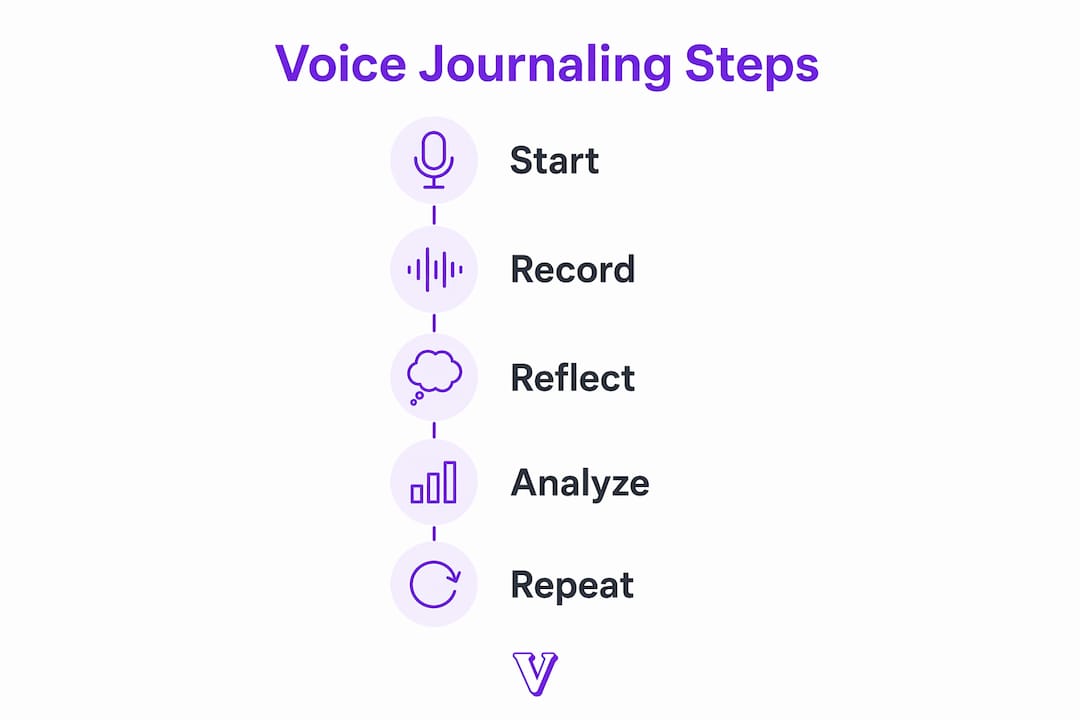
Follow these steps to build a voice journaling routine that lasts:
- Pick one fixed time. Morning works well for setting intentions. Evening works well for processing the day. Choose one and protect it.
- Create a quiet space. You do not need a studio. A parked car, a bathroom, or a bedroom with the door closed all work. The goal is privacy, not perfection.
- Use a widget or shortcut. Frictionless entry is the single biggest predictor of retention. Add your app to your home screen so recording starts in one tap.
- Start with a prompt. Open with a question like "What am I carrying right now?" or "What surprised me today?" Audio diary prompts remove the blank-slate paralysis that kills new habits.
- Keep sessions short at first. Three to five minutes is enough to build the habit. Longer sessions come naturally once the routine is established.
- Review weekly. Listening back to your own recordings once a week reveals patterns you missed in the moment. This is where the growth happens.
Retention data supports the friction argument directly. Voice journaling apps with one-tap recording report 89% user retention compared to 23% for traditional journaling apps. That gap is not about motivation. It is about design.
Pro Tip: If you miss a day, do not skip the next one. A single missed session does not break a habit. Two in a row does. Treat your voice journal like a daily conversation with yourself, not a performance.
How can AI maximize the personal growth potential of your voice journal?
AI transforms a voice recording journal from a passive archive into an active growth tool. The difference is what happens after you speak.
Here is what AI-powered voice journaling tools do that manual journaling cannot:
- Pattern recognition. AI identifies recurring words, themes, and emotional tones across dozens of entries. You see your own thought cycles from the outside.
- Emotional trigger mapping. Tools like ThinkAloud flag the specific topics or situations that consistently spike your stress or anxiety. Knowing your triggers is the first step to managing them.
- Perspective shifting. Voca uses light cognitive behavioral tools to help you reframe challenges. Instead of just recording a problem, you leave with a different way of seeing it.
- Personalized prompts. AI learns your patterns and adjusts its questions over time. The prompts you get after 60 days of use are more targeted than the ones you started with.
- Informal coaching. AI summarization and pattern recognition can identify negative thought cycles and reinforce positive habits through prompts that feel tailored to you.
The mental wellness space is integrating voice journaling into broader self-care ecosystems. Platforms that combine AI journaling insights with mood tracking and emotional trend analysis give you a fuller picture of your mental health over time. That integration is where audio journaling moves from a nice habit to a genuine wellness practice.
Privacy remains a legitimate concern when AI processes personal data. Look for apps that offer local processing, clear data deletion policies, and transparent terms. Your most honest thoughts deserve the most careful protection.
Key takeaways
Voice journaling is the most effective low-barrier practice for building emotional self-awareness, with AI-powered apps delivering measurable mood and stress improvements within 30 days.
| Point | Details |
|---|---|
| Measurable mental health gains | 73% of users report better mood regulation after 30 days of consistent voice journaling. |
| Frictionless entry drives retention | One-tap recording apps retain 89% of users versus 23% for traditional journaling apps. |
| AI deepens self-awareness | Tools like ThinkAloud and Voca identify emotional triggers and reframe challenges automatically. |
| Privacy matters when choosing an app | Apps like Acuity process data locally, giving you full control over your most personal reflections. |
| Habit consistency beats session length | Three to five minutes daily builds stronger results than occasional long sessions. |
Why speaking freely changed how i think about journaling
The most underrated thing about a voice journal is what it removes. There is no cursor blinking at you. No backspace key. No temptation to sound articulate. You just talk, and the truth comes out faster than you expect.
At Voisley, we have seen this pattern repeatedly. Users who switch from written to audio journaling often describe the first week as uncomfortable. They feel exposed, even when speaking to a private recording. That discomfort is the point. It means the filter is coming down.
The apps that work best are the ones that get out of the way. A complicated onboarding flow or a cluttered interface kills the impulse to record before it starts. The moment between "I want to journal" and "I am recording" needs to be as short as possible. That is not a design preference. It is the difference between a habit and an intention.
What surprises most people is how quickly AI reflections start to feel useful rather than gimmicky. When an app surfaces a pattern you have been living inside for months, the reaction is rarely "that's obvious." It is usually "I never said that out loud before." That recognition is where personal growth through journaling actually begins. Not in the recording, but in the review.
The honest advice is this: pick the simplest app that you will actually open tomorrow morning. Start there. The sophistication can come later.
— Voisley
Start your voice journaling practice with Voisley
Voisley is built for exactly the kind of self-reflection this article describes. It combines AI-powered emotional insights with guided prompts, mood tracking, and multiple journal types including gratitude, shadow work, and future goals. Every feature is designed to help you understand your emotional patterns, not just record them.

Voisley processes your reflections through science-backed frameworks and delivers personalized insights that grow more accurate the longer you use it. Privacy is built into the platform from the ground up. Your thoughts stay yours. If you are ready to turn daily voice reflections into real emotional clarity, visit Voisley and start your first session today. The best AI mental wellness tools are the ones you actually use, and Voisley is designed to be exactly that.
FAQ
What is a voice journal?
A voice journal is a self-reflection practice where you speak your thoughts and emotions into a recording app instead of writing them down. It captures raw, unfiltered expression and is often paired with AI tools that analyze patterns and generate insights.
How long should a voice journal entry be?
Three to five minutes is enough for a daily entry, especially when starting out. Longer sessions of up to 60 minutes are supported by apps like Acuity for deeper reflection when you need it.
Is voice journaling more effective than written journaling?
Audio journaling produces easier emotional clarity with less effort than written journaling for many users. Retention rates for voice apps also run significantly higher, at 89% versus 23% for text-based journaling apps.
Are voice journal apps private and secure?
Privacy varies by app. Acuity performs all processing locally on the device and allows users to delete recordings or their entire account at any time. Always review an app's privacy policy before recording sensitive personal content.
What audio diary prompts work best for beginners?
Start with simple questions like "What am I feeling right now?" or "What was the hardest moment of my day?" Structured prompts remove the blank-slate barrier and help you build the habit of honest, consistent daily voice reflections.