

TL;DR:
- Scientific frameworks in mental health organize research and guide clinical practice through evidence-based models. They range from traditional concepts like the biopsychosocial model to newer systems like AIERR, P3, and the Watershed Framework. These models help clinicians provide stage-specific, personalized care and address the field’s terminology inconsistencies.
Scientific frameworks in mental health are structured conceptual models that organize research, guide clinical practice, and explain psychological phenomena through evidence-based methods. The field now includes both foundational models like George L. Engel's biopsychosocial model and newer systems such as the AIERR framework, Precision Predictive Priors (P3), and the Watershed Framework. Each model addresses a different layer of mental health, from service access to brain-level prediction errors. Researchers and clinicians who understand these frameworks can move beyond symptom checklists toward evidence-based practices that treat the whole person. The challenge, as the GALENOS project highlights, is that terminology inconsistency across the literature still fragments the field and slows progress.
What are the scientific frameworks in mental health?
Scientific frameworks in mental health are not theories in the traditional sense. They function as meta-theoretical scaffolds that organize diverse clinical data, connect competing theories, and create a shared language for researchers and practitioners. A theory explains why something happens. A framework tells you where to look and how to structure what you find.

The biopsychosocial model, introduced by Engel in 1977, remains the most widely taught framework in clinical training programs. It integrates biological, psychological, and social factors into a single explanatory structure. The problem is that most clinicians apply it as a static checklist rather than a dynamic, causal system. That gap between theory and practice is exactly what newer frameworks are designed to close.
Contemporary psychological frameworks push toward measurable, predictive systems. They incorporate digital phenotyping, computational modeling, and stage-based service design. The result is a generation of mental health models that are both more specific and more practical than their predecessors.
How does the AIERR model shape mental health service use?
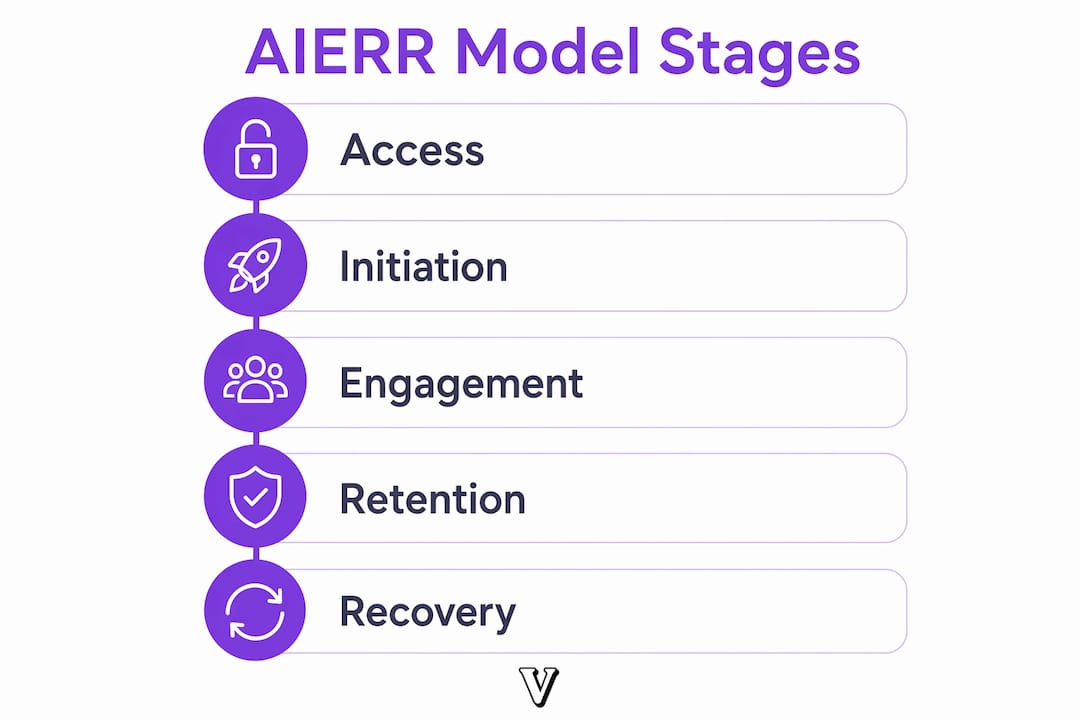
The AIERR model defines five sequential stages of mental health service utilization: Access, Initiation, Engagement, Retention, and Recovery. Each stage carries its own structural and individual barriers. A person who cannot afford a therapist faces an Access barrier. A person who books an appointment but cancels faces an Initiation barrier. These are different problems requiring different solutions.
The five stages work as follows:
- Access covers awareness, affordability, and geographic availability of services.
- Initiation addresses the decision to begin treatment, including stigma and readiness.
- Engagement focuses on active participation once treatment has started.
- Retention concerns sustained involvement over time, including dropout prevention.
- Recovery extends beyond symptom reduction to long-term wellbeing and relapse prevention.
What makes AIERR significant is that it unifies previously siloed frameworks into one coherent model. Earlier models focused on one or two stages in isolation. AIERR treats the care continuum as a whole system, which means clinicians can identify exactly where a person is dropping out and intervene at that specific point.
The model also has strong equity implications. Structural barriers at the Access stage disproportionately affect low-income and minority populations. Naming those barriers explicitly within a framework creates accountability for health systems to address them.
Pro Tip: When reviewing a client's treatment history, map their experience onto the five AIERR stages before selecting an intervention. A person who has repeatedly dropped out at the Retention stage needs a different approach than someone who has never initiated care at all.
How does the P3 framework advance personalized mental health care?
Precision Predictive Priors, or P3, is a transdiagnostic framework that classifies brain function across four domains using smartphone data and computational methods. It moves mental health care away from symptom-based diagnosis and toward individualized brain-level profiles. This matters because two people with identical depression scores can have completely different underlying neurobiology.
P3 profiles each person's predictive coding patterns as one of three types:
- Hyper-precise priors: The brain over-weights prior beliefs, leading to rigid thinking and conditions like OCD or paranoia.
- Hypo-precise priors: The brain under-weights prior beliefs, producing unstable perception and conditions like psychosis.
- Flexible priors: The brain adapts appropriately, representing the target state for intervention.
The framework integrates with digital phenotyping tools, including passive smartphone data like typing speed, sleep patterns, and social interaction frequency. AI agents then use this data to recommend micro-interventions tailored to the individual's current profile. This is a significant departure from one-size-fits-all treatment protocols.
P3 also addresses the symptom overlap problem that plagues current diagnostic systems. Anxiety and depression share many symptoms, which makes differential diagnosis difficult. P3 bypasses that problem by focusing on brain function domains rather than symptom clusters. For researchers, this opens new pathways for digital mental health tools that can track and respond to neurobiological profiles in real time.
Pro Tip: P3 is still an emerging framework, but its core logic applies now. When a standard intervention is not working, ask whether the problem is rigidity (hyper-precise) or instability (hypo-precise). That distinction often points toward a more targeted approach.
What is the Watershed Framework and how does it organize wellbeing?
The Watershed Framework organizes mental health into three interdependent layers containing nine hallmarks of wellbeing. The name reflects the model's core logic: improvements at the foundational layer flow upward, just as water flows downstream. Neglect the foundation, and the upper layers suffer regardless of what interventions you apply there.
| Layer | Hallmarks | Example |
|---|---|---|
| Foundational Elements | Circadian rhythms, social connections | Consistent sleep schedule, close relationships |
| Wellbeing Catalysts | Stress resilience, vitality, purpose | Regular exercise, meaningful work |
| Thriving Factors | Cognitive performance, positive emotionality | Sharp focus, sustained optimism |
The interdependency between layers is the framework's most practical insight. Mindfulness practice, for example, improves sleep and social connections, which then cascade upward to enhance stress resilience, vitality, and cognitive performance. A single well-placed intervention at the foundational layer can produce improvements across multiple domains simultaneously.
This makes the Watershed Framework especially useful for lifestyle medicine and community mental health programs. Rather than targeting symptoms directly, practitioners can identify which foundational element is weakest and address it first. Sleep and social connection are the two most powerful entry points because they sit at the base of the entire structure.
How does the dimensional model connect psychological theories?
The Dimensional Model of the Psyche provides a meta-theoretical language that links five nested psychological dimensions: action, thought, emotion, experience, and being. Each dimension operates according to its own principles, but they interact in predictable ways. The model does not replace existing theories. It creates a common structure that lets different theories talk to each other.
The clinical applications of the Dimensional Model are direct:
- Therapy planning: Clinicians can identify which dimension is most disrupted and select interventions accordingly. A person stuck at the action dimension needs behavioral activation. A person struggling at the experience dimension may benefit from mindfulness or somatic work.
- Supervision: Supervisors can use the five dimensions as a shared vocabulary to discuss case conceptualization across different therapeutic orientations.
- Research: The model provides a structure for operationalizing psychological constructs that currently lack consistent definitions.
The fragmentation problem in psychotherapy is real. Hundreds of therapeutic models exist, and they rarely share terminology. The Dimensional Model addresses this by functioning as a translation layer. A cognitive behavioral therapist and a psychodynamic therapist may describe the same client very differently. The Dimensional Model gives them a shared map.
This is the direction the field needs to move. Integrative meta-models reduce the confusion that comes from competing schools of thought and make it easier to build cumulative knowledge across studies.
Key Takeaways
The most effective approach to mental health practice combines stage-specific service models, neurobiologically informed precision frameworks, and integrative meta-theoretical structures to address the full complexity of psychological wellbeing.
| Point | Details |
|---|---|
| AIERR stages guide intervention | Match your intervention to the specific stage where a person is struggling, not just their diagnosis. |
| P3 moves beyond symptoms | Brain function profiles (hyper-precise, hypo-precise, flexible) target treatment more accurately than symptom clusters. |
| Watershed layers are interdependent | Strengthening foundational elements like sleep and social connection produces cascading gains in wellbeing. |
| Dimensional Model bridges theories | Five nested dimensions create a shared language across different therapeutic orientations and research traditions. |
| Biopsychosocial model needs updating | Applying it as a dynamic, causal framework rather than a checklist unlocks its full clinical value. |
What I have learned from watching frameworks evolve
The field has a framework problem that nobody talks about openly. Researchers produce new models faster than clinicians can absorb them. The biopsychosocial model is still being taught as if Engel published it last year, while precision psychiatry frameworks like P3 are already integrating smartphone data and AI agents. That gap is not a failure of clinicians. It is a failure of translation.
What I find most promising about the current generation of models is their specificity. The AIERR framework does not just say "access is a barrier." It names five distinct stages and forces you to locate the exact breakdown point. The Watershed Framework does not just say "lifestyle matters." It tells you which layer to target first and why. That level of precision is what separates a useful framework from an academic exercise.
The harder truth is that most practitioners will never read the original papers behind these models. The frameworks that actually change clinical practice are the ones that get embedded in tools, training programs, and platforms that people use every day. That is why the integration of scientific frameworks into digital wellness platforms matters more than it might seem. When a mood tracking app is built on the Watershed Framework's logic, or when a journaling prompt reflects AIERR's stage-specific thinking, the science reaches people who would never encounter it in a journal article.
The next decade will belong to frameworks that are both scientifically rigorous and practically accessible. The ones that stay locked in academic literature will have limited impact, no matter how elegant their structure.
— Voisley
How Voisley applies these frameworks to your mental wellness
Voisley is built on the same evidence-based principles that drive the frameworks covered here. The platform's guided journaling, mood tracking, and AI-powered insights reflect the logic of stage-specific care, foundational wellbeing, and personalized reflection.

Whether you are a student trying to understand psychological frameworks, a researcher looking for practical applications, or someone working on your own mental wellness, Voisley gives you structured tools grounded in real science. The platform's mental wellness resources connect the research to your daily practice, making it easier to build the habits that foundational models like the Watershed Framework identify as most impactful. Visit Voisley to see how science-backed journaling and self-reflection can support your mental health goals.
FAQ
What are scientific frameworks in mental health?
Scientific frameworks in mental health are structured models that organize research, guide clinical practice, and explain psychological phenomena. They range from stage-based service models like AIERR to integrative structures like the biopsychosocial model.
What is the AIERR model?
The AIERR model is a five-stage framework covering Access, Initiation, Engagement, Retention, and Recovery in mental health service use. It helps clinicians identify where people drop out of care and design stage-specific interventions.
How does the Watershed Framework apply to daily mental health?
The Watershed Framework organizes wellbeing into three layers, with foundational elements like sleep and social connection at the base. Strengthening these foundational elements produces cascading improvements across stress resilience, cognition, and positive emotion.
What makes the P3 framework different from standard diagnosis?
P3 classifies brain function patterns rather than symptom clusters, using smartphone data to build individualized neurobiological profiles. This approach targets treatment more precisely than traditional diagnostic categories allow.
Why do mental health frameworks matter for researchers and students?
Frameworks provide a shared vocabulary and structure for building cumulative knowledge across studies. The GALENOS project's work on standardizing mental health terminology shows how much the field still needs that common language.