

TL;DR:
- AI journaling analyzes emotional patterns and offers personalized prompts by maintaining historical memory of entries. It enhances self-reflection through structured prompts, real-time pattern recognition, and adaptive feedback, surpassing traditional journaling methods. Consistent, specific daily entries are essential for unlocking meaningful insights and long-term emotional awareness.
An AI journal is a digital journaling tool powered by artificial intelligence that analyzes your emotional patterns, generates personalized prompts, and delivers structured feedback to deepen self-reflection. Unlike a blank notebook or a basic notes app, platforms like Voisley and other AI journaling tools use machine learning to track what you feel, when you feel it, and why those patterns keep repeating. Users report a 40–50% increase in identifying repetitive emotional triggers over 30–90 day periods. That number matters because most people journal for weeks without ever connecting the dots between their entries. AI does that connecting automatically.
What is an AI journal and how does it work?
An AI journal combines natural language processing with stateful memory to turn your daily writing into a living emotional record. The term "stateful" is the key distinction here. Standard chat tools forget your last conversation the moment you close the window. AI journaling tools maintain historical memory of past entries to identify emotional patterns across weeks and months. That is the difference between a tool that responds to you and one that actually knows you.

The process works in three layers. First, you write a daily entry, typically spending 5–15 minutes on it. Second, the AI categorizes your input into themes like gratitude, stressors, and future goals. Third, it surfaces patterns you would likely miss on your own, such as a recurring spike in anxiety every Sunday evening or a consistent drop in mood after certain social interactions.
Agentic AI systems take this further. They proactively connect past entries to your current emotional state, performing complex pattern analysis faster than a human coach could. Think of it as having a therapist who has read every journal entry you have ever written and can recall all of them instantly.
How AI journaling compares to traditional methods
Traditional journaling is valuable, but it has a structural limitation. You can only see what you already know to look for. AI journaling removes that ceiling by analyzing your language for emotional signals you did not consciously flag.
Structured AI prompts improve the quality of self-reflective outputs by 60% compared to open-ended writing. That improvement comes from specificity. When an AI asks "What physical sensation did you notice when that conversation ended?" instead of "How was your day?", your answer carries far more emotional data.
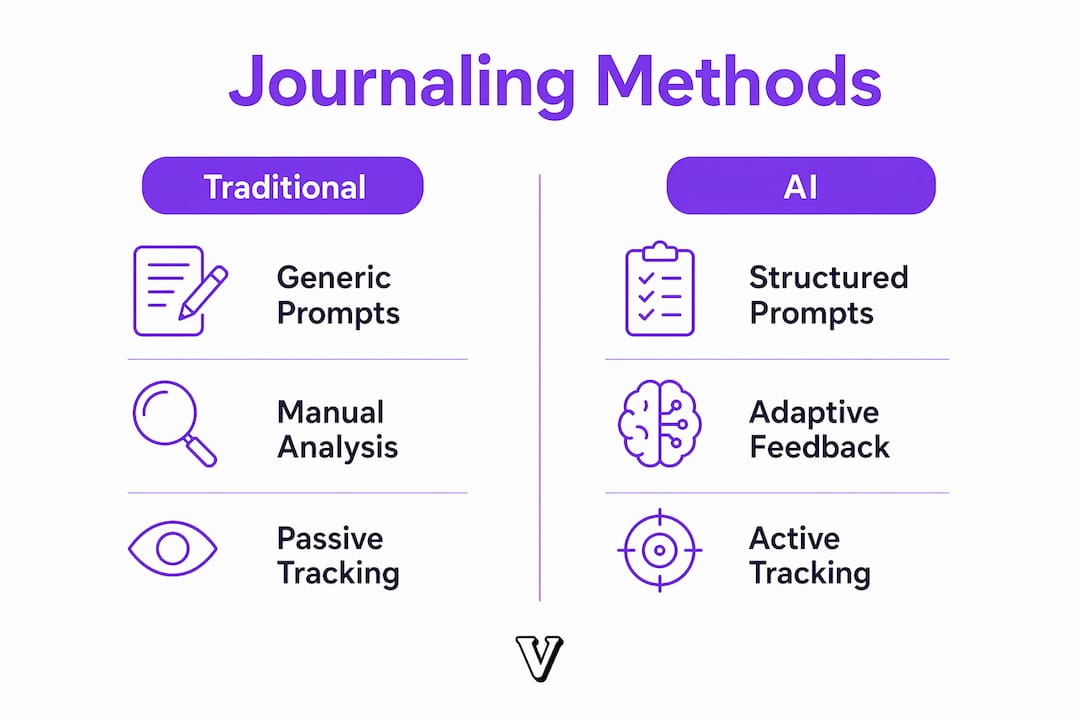
| Feature | Traditional journaling | AI journaling |
|---|---|---|
| Prompt quality | Generic or self-generated | Personalized and adaptive |
| Pattern recognition | Manual, limited by memory | Automated across 30–90 days |
| Emotional trend tracking | Requires re-reading entries | Real-time visualizations |
| Feedback depth | None | Calibrated to user preference |
| Context retention | Physical pages only | Stateful memory across sessions |
Controllable reasoning is another feature worth understanding. It refers to the AI's ability to adjust how deeply it explains its analysis. Controllable reasoning reduces unnecessary output by 30–40% and improves relevance. In practice, this means you can tell the AI to give you brief summaries or detailed breakdowns depending on what you need that day.
Pro Tip: Spend the first two weeks of using any AI journal writing longer entries than you think you need. The AI calibrates its feedback based on the volume and specificity of your inputs. Thin entries produce thin insights.
What features do the best AI journaling tools offer?
The best AI journaling tools share a core set of features, but the most effective ones go beyond basic logging. Here is what separates a genuinely useful tool from a glorified text box.
- Stateful context retention. The AI remembers your previous entries and references them when relevant. Voisley uses this to surface connections between entries you wrote weeks apart, which is where the most meaningful patterns live.
- Mood visualizations. Mood tracking visualizations translate your written entries into charts and trend lines. Seeing your emotional state as a graph over 30 days is qualitatively different from reading back through old entries.
- Adaptive prompts. The AI adjusts its questions based on what you wrote yesterday, last week, and last month. If you have been writing about work stress for three consecutive days, it will probe that thread rather than ask a generic gratitude question.
- Multiple journal types. Platforms like Voisley offer structured formats including gratitude journals, shadow work prompts, and future goals tracking. Each format targets a different layer of self-awareness.
- Agentic feedback loops. Agentic AI systems do not wait for you to ask questions. They flag patterns, suggest connections, and prompt you to examine areas you might be avoiding.
AI journaling also fits naturally into personalized wellness strategies that combine behavioral data with emotional tracking. The result is a feedback loop that gets more accurate the longer you use it.
Pro Tip: Turn on mood tracking from day one, even if it feels redundant. The visualization data becomes your most reliable progress indicator after 30 days.
What challenges come with AI journaling?
AI journaling has real limitations, and knowing them upfront prevents frustration and misuse.
Hallucinated empathy is the most common one. AI outputs can sound emotionally attuned while lacking any genuine understanding of your situation. AI-generated empathic responses require manual validation against your lived reality. If the AI tells you that your anxiety seems connected to a fear of failure, that might be accurate or it might be a statistically plausible guess. You are the only one who can verify it.
The cold start problem catches most beginners off guard. Many users quit within 7–14 days if they do not provide granular context to the AI early on. The AI needs material to work with. Vague entries like "bad day" give it almost nothing. Specific entries like "I felt dismissed in the team meeting when my suggestion was ignored without comment" give it the emotional texture it needs to build a useful model of your patterns.
Here are four strategies to work through these challenges:
- Write with specificity from the start. Name the people, situations, and physical sensations involved. The AI cannot infer what you do not tell it.
- Cross-check AI insights with your own gut. If a pattern the AI identifies does not resonate, say so in your next entry. That disagreement is itself useful data.
- Use AI feedback as a hypothesis, not a verdict. Treat every AI observation as a question worth sitting with, not a conclusion to accept.
- Pair AI journaling with other inputs. AI tools work best as part of a balanced approach to psychological insight, not as the sole source. Therapy, conversation, and physical self-awareness all feed into emotional clarity in ways AI cannot replicate.
How to build a daily AI journaling routine
Starting an AI journaling practice is straightforward. Sustaining it requires a bit more structure.
- Choose the right tool for your goals. Voisley suits people who want structured journal types, mood tracking, and community features. If you are primarily focused on emotional regulation, look for a platform that offers shadow work and stressor categorization specifically.
- Commit to 5–15 minutes daily. That is the average time investment that produces consistent results. Longer sessions are fine, but shorter ones below five minutes rarely give the AI enough to analyze.
- Calibrate the AI over the first 2–4 weeks. Users adapt AI calibration over the first few weeks to find the right feedback depth. Experiment with how much explanation you want. Some people prefer brief summaries; others want detailed breakdowns of their emotional language.
- Set a monthly review checkpoint. At the end of each month, read the AI's pattern summaries and compare them against your own sense of how the month went. Discrepancies are often the most revealing part of the process.
- Use insights to set concrete goals. If the AI identifies that your mood consistently drops on days without physical activity, that is not just an observation. It is a data point you can act on.
Pro Tip: Write your entry at the same time each day, ideally in the evening. Evening entries capture the full emotional arc of the day and give the AI richer data than morning entries written before events unfold.
AI algorithms transforming health show the same pattern across wellness applications: consistency of input determines the quality of output. AI journaling is no different.
Key takeaways
AI journaling works because stateful memory, structured prompts, and adaptive feedback turn daily writing into a measurable emotional record that improves over time.
| Point | Details |
|---|---|
| Stateful memory is the core differentiator | AI journals track patterns across 30–90 days, unlike basic chat or note apps. |
| Structured prompts outperform open writing | Categorized prompts improve self-reflective output quality by 60% over open dialogue. |
| Cold start is the biggest early risk | Provide specific, detailed entries in the first two weeks to avoid early dropout. |
| Hallucinated empathy requires your verification | Always cross-check AI insights against your own lived experience before acting on them. |
| Consistency drives results | Daily entries of 5–15 minutes produce the data volume AI needs to generate accurate insights. |
Why AI journals are more than a digital diary
At Voisley, we have watched users treat AI journaling the same way they treat a fitness tracker in the first month: they check it obsessively, then ignore it when the novelty fades. The ones who get lasting value from it make one mental shift. They stop seeing the AI as a mirror and start treating it as a thinking partner that synthesizes emotional data into real life changes.
The uncomfortable truth is that most people do not journal deeply enough to benefit from AI analysis. They write surface-level entries and then wonder why the insights feel generic. The AI is only as good as what you give it. When you write with honesty and specificity, the feedback quality jumps noticeably.
We also believe the end-to-end reflection that links journal entries to behavior patterns is where AI journaling earns its place in a mental wellness routine. That is not something a blank notebook can do. But it is also not a replacement for human intuition, therapy, or the kind of insight that only comes from sitting quietly with your own thoughts. The best use of an AI journal is as a structured layer on top of your existing self-awareness practice, not a substitute for it. Start specific, stay consistent, and verify what the AI tells you against what you actually know to be true.
— Voisley
Start your AI journaling practice with Voisley
Voisley is built specifically for people who want more from their journaling practice than a blank page. The platform combines mood tracking, structured journal types including gratitude, shadow work, and future goals, with AI-powered insights that surface emotional patterns over time.

Every entry you write in Voisley feeds into a personalized emotional picture that grows more accurate with each session. The AI prompts adapt to your history, the visualizations show you trends you would otherwise miss, and the structured formats keep your reflection focused rather than scattered. If you are ready to turn daily writing into genuine self-knowledge, start with Voisley and see what 30 days of consistent AI journaling reveals about your emotional patterns.
FAQ
What is an AI journal?
An AI journal is a digital journaling tool that uses artificial intelligence to analyze your entries, identify emotional patterns, and generate personalized prompts. Platforms like Voisley combine mood tracking, stateful memory, and adaptive feedback to deepen self-reflection over time.
How long does it take to see results from AI journaling?
Most users begin identifying meaningful emotional patterns within 30 days of consistent daily entries. Users who write specific, detailed entries from the start see faster pattern recognition than those who write vague or brief notes.
Is AI journaling a replacement for therapy?
AI journaling is not a replacement for therapy. AI tools work best alongside other sources of psychological insight, including professional support, rather than as a standalone mental health solution.
Why do beginners quit AI journaling so quickly?
The cold start problem causes many beginners to quit within 7–14 days because they do not provide enough context for the AI to generate useful feedback. Writing specific, detailed entries from day one is the most effective way to move past this stage.
What makes AI journaling different from writing in a regular notebook?
AI journaling uses stateful memory to track your emotional patterns across months, while a notebook requires you to manually re-read and connect your own entries. The AI also generates adaptive prompts based on your history, which improves self-reflective output quality in ways open-ended writing cannot match.