

TL;DR:
- Shared journaling involves two people collaboratively recording their thoughts and feelings, fostering emotional intimacy. Starting small with regular, honest entries enhances connection and long-term relationship growth. It complements private journaling and should not be used for conflict resolution or therapy.
Shared journaling is defined as a collaborative writing practice where two people contribute to the same journal, creating a written record of their inner lives, thoughts, and feelings over time. This practice builds emotional intimacy in a way that everyday conversation rarely achieves, because it removes the pressure of immediate response and replaces it with honest, reflective communication. Why shared journaling matters becomes clear quickly: couples who journal together report feeling more known and understood by their partners, with deeper empathy developing through the accumulation of small daily truths. Voisley, a guided journaling platform built on science-backed frameworks, recognizes this practice as one of the most accessible tools for relationship growth available today.
Why shared journaling matters for emotional intimacy
Shared journaling works at the neurobiological level, not just the emotional one. Writing in a shared journal activates the prefrontal cortex, the part of the brain responsible for measured, thoughtful communication. This prefrontal cortex processing creates a psychological buffer, so you articulate your feelings more clearly and your partner reads them without the heat of a live conversation. The result is calmer, more receptive responses on both sides.
The physical act of reading a partner's handwritten entry triggers something even deeper. Neural mirroring and oxytocin release occur when reading handwritten journal entries, deepening emotional bonding and trust. Handwriting carries social cues that digital text cannot replicate. It signals effort, presence, and care, which the brain reads as connection.
Shared journaling creates what relationship researchers call a "Slow Conversation." It is a space separated from daily logistics, free from the attentional capture of phones, schedules, and unresolved tasks. This separation maintains novelty and emotional safety in long-term partnerships, giving both people a place to be honest without consequence.
Researchers describe the shared journal as a "Third Place" for emotional safety, distinct from the home's functional demands and the outside world's noise. This concept matters because most couples communicate reactively, responding to logistics, stress, and conflict. The shared journal creates a proactive channel, one where vulnerability is the norm rather than the exception.
Pro Tip: If you and your partner are new to shared journaling, treat the journal as a "no-agenda zone." Write what you noticed, felt, or wondered about today. The goal is presence, not performance.

Journaling's narrative identity function also plays a long-term role. Maintaining a shared record of growth and positive patterns is a strong predictor of relationship satisfaction. Revisiting past entries lets partners track progress and catch recurring issues before they escalate into conflict.
How to build sustainable shared journaling habits
The most common reason shared journaling fails is unrealistic expectations. Couples start with ambitious daily multi-paragraph entries and abandon the practice before the end of the first month. The fix is simple: start smaller than feels meaningful.
Starting with 1–2 sentences per person, once a week or one thought per day, is the most sustainable rhythm for shared journaling. Small, consistent actions build long-term connection far more effectively than sporadic intense sessions. The goal in the early weeks is not depth. The goal is showing up.
Here is a practical framework for building the habit:
- Choose one low-friction moment. Pair journaling with an existing routine, such as after dinner or before bed. Creating a brand-new habit slot in an already full day usually fails.
- Use a ritual anchor. Placing the journal on the dinner table or another visible shared space signals that it is part of daily life, not an optional add-on.
- Write one honest thought. Not a summary of the day. Not a letter. One real thought, feeling, or observation. That is enough.
- Read with curiosity, not critique. When you read your partner's entry, your only job is to understand. Questions are welcome. Corrections are not.
- Use prompts when you feel stuck. Optional prompts like "What made me feel safe today?" or "What do I wish you knew about this week?" remove the blank-page pressure without forcing a topic.
Pro Tip: Treat "boring" entries as wins. Successful practitioners report that mundane entries, like noting what you ate or how tired you felt, are crucial for consistency and intimacy. They remove the performance pressure that kills the habit.
Consistency matters more than profundity. A journal full of small, honest entries builds a richer relationship narrative than a journal of occasional grand revelations. The everyday experiences captured in shared journaling form the texture of a relationship's inner life.
Shared vs. private journaling: which one does what?
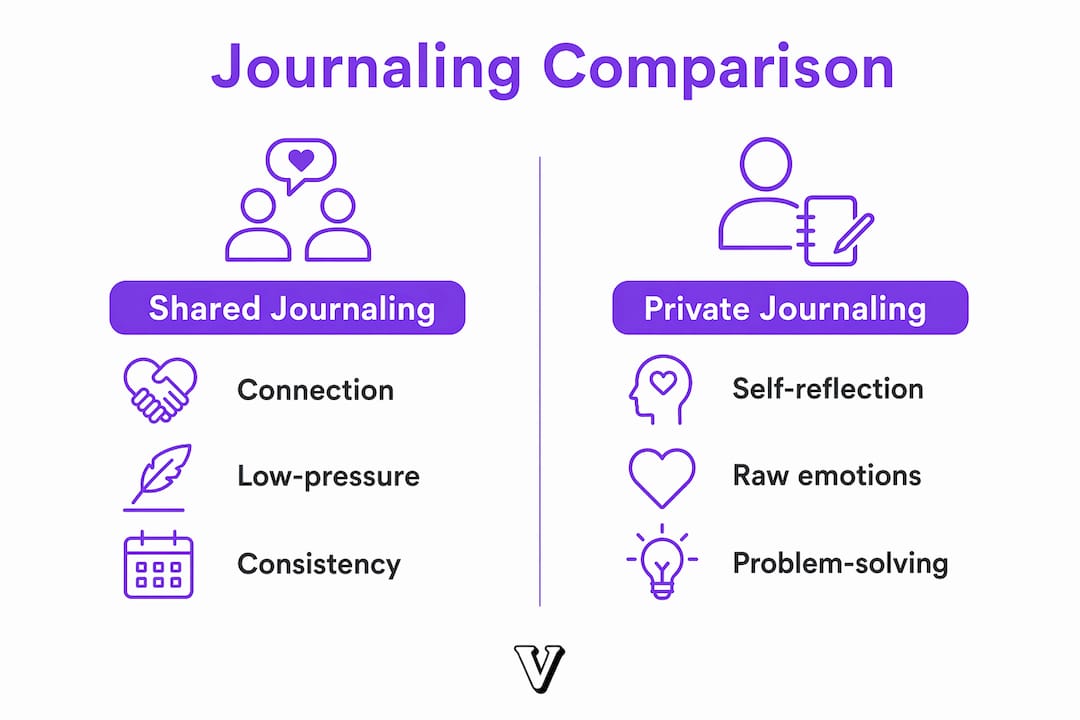
Both forms of journaling serve your relationship, but they serve different functions. Confusing them is where most people run into trouble.
Private journaling is for self-processing. You use it to work through raw emotions, sort out confusion, and arrive at clarity before you share anything. It is the space where you can be messy, contradictory, and unresolved. Keeping both shared and private journals supports relationship health by enabling connection and personal emotional processing respectively.
Shared journaling is for connection. It works best when both people write from a place of relative clarity, not in the middle of conflict or emotional flooding. Using the shared journal to vent or resolve arguments tends to backfire, because the written format removes tone and context, making misreads more likely.
| Format | Primary purpose | Best used when | Avoid using it for |
|---|---|---|---|
| Private journaling | Self-processing and emotional clarity | Sorting through raw or complex feelings | Replacing therapy or professional support |
| Shared journaling | Connection and mutual understanding | Building everyday intimacy and shared narrative | Conflict resolution or emotional venting |
| Combined use | Personal and relational growth | Supporting both individual and couple well-being | Substituting for direct conversation on urgent issues |
The shared space works best for connection, not conflict resolution or venting, which is better handled face-to-face or in therapy. Think of private journaling as the drafting room and shared journaling as the gallery. You process privately, then share what is ready to be seen. For a deeper look at how these two practices complement each other, the [private vs. shared journaling guide](https://blog.voisley.com/blog/private-journaling-vs-shared-journaling-which-is-better-for your-relationship) on the Voisley blog breaks down the decision clearly.
Common misconceptions about collaborative journaling
Most people who hesitate to start shared journaling are held back by myths, not facts. Clearing those up makes the practice far less intimidating.
- "Entries need to be deep to matter." This is the most damaging misconception. The main value of shared journaling lies in capturing everyday experiences, not high-stakes revelations. A note about a song you heard or a moment that made you laugh is exactly the kind of entry that builds intimacy over time.
- "I'll be judged for what I write." Establishing a no-judgment zone before you start is the single most important agreement you can make. Both people commit to reading entries with curiosity, not evaluation. Awkwardness at the start is normal and fades within a few weeks.
- "It takes too much time." One sentence takes under two minutes. The journaling for emotional well-being research is consistent: frequency matters far more than length. Two minutes a day beats two hours once a month.
- "Shared journaling replaces therapy." Shared journaling is not a substitute for therapy or conflict resolution. It excels at the everyday work of understanding each other through small, consistent honesty. For deeper mental health needs, professional support remains the right tool.
- "If we miss a day, we've failed." Missing a day is not failure. Treating a missed day as a reason to quit is. The practice is cumulative. One skipped entry changes nothing. Three skipped weeks change the habit.
The awkwardness of early entries is real, but it is also temporary. Most couples report that the first few entries feel stilted and that the practice becomes natural within a month. That initial discomfort is not a sign that shared journaling is wrong for you. It is a sign that you are doing something new.
Key Takeaways
Shared journaling builds emotional intimacy through consistent, low-pressure written communication that activates empathy, oxytocin release, and a shared narrative of growth.
| Point | Details |
|---|---|
| Start small and stay consistent | Write 1–2 sentences per person, once a week, to build a habit that lasts beyond the first month. |
| Use ritual anchors | Place the journal in a visible shared space to integrate it into daily life without extra effort. |
| Keep private and shared journals | Use private journaling for self-processing and shared journaling for connection, not conflict resolution. |
| Mundane entries have real value | Everyday observations build intimacy more reliably than occasional deep revelations. |
| Shared journaling is not therapy | It supports everyday understanding and closeness, but professional support handles deeper mental health needs. |
What I've learned from watching couples journal together
The couples who stick with shared journaling longest are not the ones who write the most. They are the ones who write the most honestly. There is a difference. Length and eloquence are easy to perform for a few weeks. Honesty about small things, like admitting you felt lonely on a Tuesday or that you appreciated a specific moment, is harder to sustain but far more connecting.
What surprises most people is how much they learn about their partner through the mundane entries. You start to notice your partner's inner rhythm: what drains them, what lights them up, what they notice in the world. That knowledge does not come from one big conversation. It comes from reading a hundred small ones.
The balance between shared and private journaling is something I encourage every couple to find deliberately. The shared journal is not the place to process everything. Some feelings need to be worked through privately first. When you bring a clearer version of your inner life to the shared space, the writing lands differently for both of you.
For anyone starting out, my strongest advice is this: lower the bar so far that you cannot fail. One sentence. Once a week. Read it together or separately. That is the whole practice at the start. The depth comes later, on its own, because you showed up consistently. View the journal as an investment in understanding each other, not as a task to complete.
— Voisley
Voisley supports your shared journaling practice
Voisley is built for exactly this kind of intentional, consistent journaling. The platform combines guided prompts, mood tracking, and AI-powered insights to help you and your partner build a journaling habit that actually sticks.

Whether you are starting your first shared journal or looking to deepen an existing practice, Voisley's guided journaling tools give you the structure to write with purpose and the flexibility to make it your own. The platform's personalized prompts remove the blank-page problem, while its emotional trend visualizations help you see patterns in your inner life over time. Voisley also supports private journaling alongside shared reflection, so both forms of the practice can grow together. Start building your shared narrative at voisley.com.
FAQ
What is shared journaling?
Shared journaling is a collaborative practice where two people write in the same journal, building a mutual record of their thoughts, feelings, and daily experiences to deepen emotional connection.
How often should couples journal together?
Starting with 1–2 sentences per person, once a week, is the most sustainable rhythm. Consistency matters more than frequency or length.
Is shared journaling the same as couples therapy?
Shared journaling is not a substitute for therapy. It supports everyday emotional understanding and closeness, while therapy addresses deeper mental health and conflict resolution needs.
What should you write in a shared journal?
Write one honest thought, observation, or feeling from your day. Mundane entries are just as valuable as deep ones and are actually better for building a consistent habit.
Can shared and private journaling work together?
Yes. Private journaling supports personal emotional processing, while shared journaling builds connection. Using both gives you a complete practice that serves your individual and relational well-being.