

TL;DR:
- Shadow work involves consciously integrating repressed traits to develop greater self-awareness and authenticity.
- Practiced through journaling, trigger tracking, dream analysis, and active imagination, it promotes personal growth.
Shadow work is defined as a therapeutic practice rooted in Carl Jung's analytical psychology that involves identifying and integrating repressed or hidden personality aspects to achieve greater self-awareness and wholeness. The goal is not to fix yourself. The goal is to accept the full picture of who you are, including the parts you have long denied, judged, or buried. What is shadow work at its core? It is the deliberate process of bringing unconscious material into conscious awareness so it no longer controls your behavior from the shadows.
What is shadow work rooted in psychologically?
Carl Jung introduced the concept of the "shadow" as the unconscious repository of traits, emotions, and impulses that the ego rejects. Every person develops a persona, the version of themselves they present to the world. The shadow holds everything that does not fit that persona.
The shadow contains both negative and positive repressed traits, such as assertiveness, ambition, or creativity, often rejected due to social conditioning. That last part surprises most people. You may have suppressed your confidence because a parent called you arrogant. You may have buried your anger because it was labeled unacceptable. Both the "ugly" and the powerful get pushed down together.
One of the most revealing mechanisms in shadow work is projection. Projection transfers unconscious traits onto other people, showing up as irrational emotional reactions. When someone irritates you in a way that feels disproportionate, that intensity is often a signal. The trait you cannot stand in them is frequently one you have disowned in yourself.
"The shadow is not a problem to be solved but a territory to be explored. Jung's concept of individuation, the lifelong process of becoming a whole self, depends entirely on integrating what the shadow holds."
The ultimate aim of this inner work is individuation: the psychological process of becoming a unified, authentic self. Shadow work is the primary vehicle for that process. Without it, the unconscious continues to drive behavior, relationships, and emotional reactions without your awareness or consent.
How to practice shadow work step by step safely and effectively
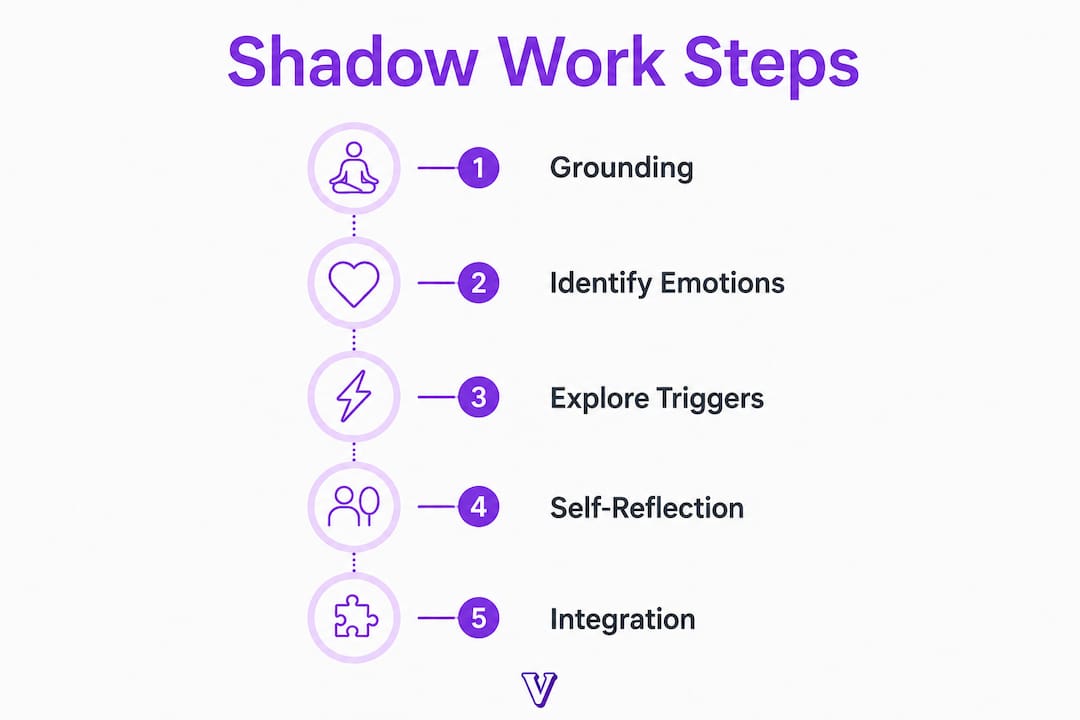
A structured approach to shadow work prevents the practice from becoming either intellectually shallow or emotionally destabilizing. The recommended starting point is 15–30 minutes per session, at least three times per week. Consistency matters more than duration.
The four core techniques are:
- Journaling. Write without editing. Ask yourself what triggered you today, what you felt in your body, and what that feeling reminds you of from earlier in your life. Shadow work journal ideas can help you move past surface-level reflection into genuine unconscious material.
- Trigger tracking. Keep a running log of moments when your emotional reaction felt bigger than the situation warranted. These disproportionate reactions are direct signals of shadow content. External triggers often reveal personal shadow parts projected onto others.
- Dream analysis. Jung considered dreams the primary language of the unconscious. Note recurring symbols, characters, or emotions in your dreams. Threatening or strange figures in dreams frequently represent shadow aspects seeking recognition.
- Active imagination. Sit quietly and allow an image, figure, or feeling from your unconscious to emerge. Engage with it mentally, ask it questions, and listen. This technique requires some practice but produces direct access to shadow material.
Before beginning, emotional grounding is non-negotiable. People with active symptoms of panic, anxiety, or depression should stabilize those symptoms first. Shadow work stirs intense emotions unexpectedly, and doing it without a stable foundation can worsen distress rather than relieve it.
Pro Tip: Pay attention to physical sensations during your sessions. Somatic responses like tension or heat indicate that genuine unconscious material is surfacing. If you feel nothing in your body, you may be intellectualizing rather than truly engaging.
Therapist support adds a layer of safety that self-directed practice cannot fully replicate. A trained professional provides an objective perspective and can help you process material that feels too large to hold alone. Think of a therapist as a guide for the territory, not a requirement, but a significant advantage.
What are common challenges and emotional risks in shadow work?
Shadow work is not comfortable, and expecting it to be sets you up for discouragement. The most common challenges include:
- Ego resistance. The ego's primary function is to protect the persona. When shadow work threatens that structure, the ego pushes back through avoidance, distraction, rationalization, or sudden disinterest in the practice.
- Overwhelming emotions. Repressed material carries emotional charge. When it surfaces, the feelings can be intense, including grief, rage, shame, or fear. This is normal, but it requires a grounded container.
- Self-judgment. Beginners commonly mistake shadow work for self-criticism. Effective practice demands observing traits neutrally rather than attacking them. Judging the shadow reinforces the persona and blocks integration.
- Ego inflation. The opposite error is also real. Some practitioners over-identify with newly discovered shadow material and swing into grandiosity or moral superiority. Integration requires balance, not replacement.
- Moral and emotional crises. Discovering that you carry traits you have condemned in others can produce genuine distress. This is part of the process, but it needs to be paced carefully.
Signs that professional support is needed include persistent intrusive thoughts after sessions, inability to function in daily life, or a sense that the emotional material is escalating rather than settling. Emotional processing is a skill that develops over time. Pushing too hard too fast produces the opposite of healing.
The antidote to most of these risks is curiosity. Shadow work requires a curious, non-judgmental stance that opens the door to self-integration. Curiosity keeps you engaged without tipping into crisis. It treats every discovery as information rather than verdict.
How does shadow work lead to real-life transformation?
Integration is the point where shadow work stops being a mental exercise and starts changing your actual life. Integration is defined as the capacity to hold opposing truths about yourself without collapsing into shame or denial. You can be both generous and selfish. You can be both loving and capable of cruelty. Holding that without judgment is what wholeness actually looks like.
The shift from insight to behavior is where most people stall. Successful integration occurs when unconscious insights lead to concrete behavior changes, not just intellectual understanding. A person who discovers suppressed anger does not just understand it intellectually. They start setting boundaries they previously could not access.
Real-life examples of integration moments include:
- Pausing before reacting to a colleague who irritates you, recognizing the projection, and choosing a measured response instead.
- Saying no to a request without excessive guilt, because you have integrated the part of you that was allowed to have needs.
- Feeling envy toward a friend and, instead of suppressing it, using it as a signal to identify what you actually want for yourself.
Pro Tip: After each shadow work session, write one sentence describing a specific behavior you want to try differently this week. Linking insight to a concrete action is what separates reflection from transformation.
Shadow work is a long-term process that cannot be rushed. The unconscious reveals material at its own pace. Integration is a direction, not a destination. The measure of progress is not how much you have uncovered but how differently you move through your life as a result.
Mindfulness practices support this ongoing work by keeping you present to your reactions rather than swept away by them. Mindfulness techniques that build daily self-awareness create the stable ground shadow work needs to take root.
Key Takeaways
Shadow work is the ongoing practice of integrating unconscious personality traits, both difficult and positive, into conscious awareness to produce lasting behavioral change and emotional wholeness.
| Point | Details |
|---|---|
| Core definition | Shadow work integrates repressed traits, not just negative ones, to build a complete, authentic self. |
| Starting safely | Begin with 15–30 minute sessions, three times per week, and stabilize any active mental health symptoms first. |
| Primary techniques | Journaling, trigger tracking, dream analysis, and active imagination are the four core methods. |
| Biggest beginner mistake | Judging shadow material reinforces the persona. Neutral observation is the only path to integration. |
| Integration standard | Real change shows up in behavior, such as setting boundaries, not just in intellectual understanding. |
The part nobody warns you about
Most people come to shadow work expecting a kind of emotional spring cleaning. They imagine uncovering a few difficult memories, processing them, and emerging lighter. What they actually find is that the work has no clear endpoint, and that discovery can feel disorienting at first.
At Voisley, we have watched many people begin this practice with genuine motivation and then quietly abandon it after the first few uncomfortable sessions. The discomfort is not a sign that something is wrong. It is a sign that something real is happening. The ego resists precisely because the material matters.
The most common mistake I see is people treating shadow work like a performance review. They catalog their flaws, assign blame, and try to "fix" what they find. That approach produces shame, not integration. The practice only works when you approach your shadow the way you would approach a frightened child: with patience, without judgment, and with the genuine intention to understand rather than correct.
The nonlinear nature of this work is also worth naming directly. You will revisit the same material multiple times, at different depths, across months and years. That is not failure. That is how the unconscious works. Each pass reveals a layer the previous one could not reach.
Balance matters enormously here. Shadow work done in isolation, without grounding activities, community, or professional support, can become a loop of rumination rather than a path toward healing. Pair your sessions with physical movement, creative expression, or time in nature. These are not distractions from the work. They are part of it.
— Voisley
Voisley and your shadow work practice
Shadow work is most effective when it has a consistent, private space to unfold. Voisley provides exactly that: a structured digital environment built for guided journaling, mood tracking, and self-reflection across multiple journal types, including a dedicated shadow work format.

The platform's AI-powered prompts adapt to your emotional patterns over time, surfacing questions that go deeper than generic reflection. Voisley's shadow work journaling tools give you a structured place to track triggers, record dreams, and document integration moments, all in one private space. Whether you are just beginning this practice or deepening an existing one, Voisley supports the kind of consistent, grounded inner work that produces real change.
FAQ
What is shadow work in simple terms?
Shadow work is the practice of identifying and accepting the parts of yourself you have repressed or denied, including both difficult traits and positive ones, to become more self-aware and emotionally whole.
How often should you do shadow work?
The recommended frequency is at least three sessions per week, with each session lasting 15–30 minutes. Consistency over time produces deeper results than occasional intensive sessions.
Can shadow work be harmful?
Shadow work can stir intense emotions and should be approached carefully. People with active symptoms of anxiety, panic, or depression should stabilize those symptoms first and consider working with a therapist.
What are the best shadow work techniques for beginners?
Journaling and trigger tracking are the most accessible starting points. Writing about disproportionate emotional reactions and what they remind you of from your past is a direct and safe entry into shadow material.
How do you know if shadow work is actually working?
Integration shows up in behavior, not just insight. Signs of progress include setting boundaries more naturally, reacting less intensely to triggers, and feeling greater compassion toward yourself and others.