

TL;DR:
- Reflective writing involves critically examining a specific personal experience to understand its meaning and plan future growth.
- It emphasizes analysis over description, connecting insights to theory or evidence and fostering self-awareness and emotional clarity.
Reflective writing is defined as the structured process of critically examining a personal experience to understand its meaning and plan future growth. Unlike a diary entry or a simple recap of events, it requires you to analyze what happened, why it happened, and what you will do differently. Rooted in the work of Donald Schön and Chris Argyris in the 1980s, reflective practice is now a required skill in fields like teaching, nursing, and social work. For anyone seeking self-awareness and emotional clarity, it is one of the most direct tools available.
What is reflective writing, and how is it different from other writing?
Reflective writing is not the same as descriptive writing. Descriptive writing tells you what happened. Reflective writing asks why it happened and what it means. That shift from narration to analysis is the defining feature of the practice.
The three qualities that separate reflective writing from other styles are:
- First-person perspective with critical distance. You write from your own point of view, but you treat your thoughts and reactions as data to examine, not just feelings to express. Researchers call this the "dual persona" approach: you are both the participant in the experience and the objective observer analyzing it.
- Analysis over description. A reflective piece does not stop at "this is what happened." It pushes into "this is what it revealed about my assumptions, habits, or beliefs."
- Connection to theory or evidence. In academic and professional settings, reflective writing integrates personal experience with broader frameworks or research to produce rigorous insight, not just personal opinion.
The result is a form of writing that is simultaneously personal and intellectual. You bring your full emotional experience to the page, then step back and interrogate it.
Pro Tip: If your writing reads like a summary of events, you are describing, not reflecting. Add one sentence after each observation that starts with "This revealed that I..." to shift into genuine analysis.

What frameworks make reflective writing more effective?
Frameworks give structure to a process that can otherwise feel vague. Two of the most widely used models are Gibbs Reflective Cycle and the 5R Framework.
Gibbs Reflective Cycle moves through six stages: description, feelings, evaluation, analysis, conclusion, and action plan. Each stage builds on the last. You start by describing the event plainly, then name your emotional response, then evaluate what went well or poorly, then analyze why, then draw a conclusion, and finally commit to a specific action. The cycle prevents you from stopping at "I felt bad about that" and pushes you toward "here is what I will do next time."
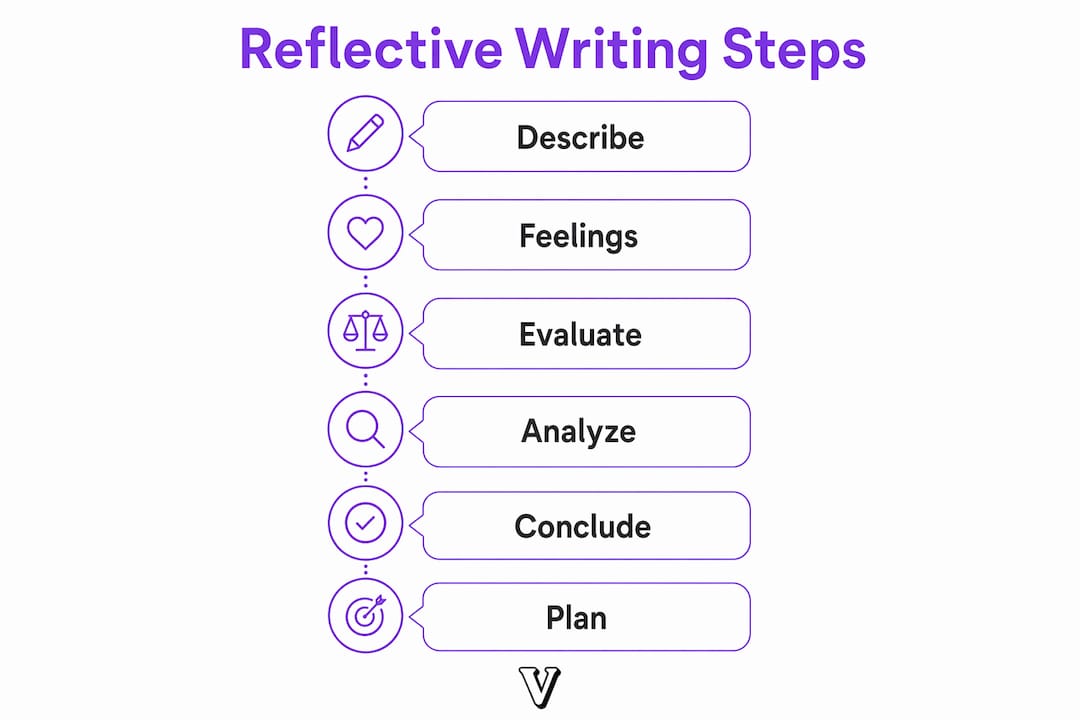
The 5R Framework uses five steps: Report, Respond, Relate, Reason, and Reconstruct. It is particularly useful for professional development because the "Relate" and "Reason" steps explicitly ask you to connect your experience to theory or prior knowledge. The 5R framework and Gibbs Cycle both improve learning outcomes by guiding writers through stages they would otherwise skip.
| Model | Steps | Best used for |
|---|---|---|
| Gibbs Reflective Cycle | Description, Feelings, Evaluation, Analysis, Conclusion, Action Plan | Academic assignments, professional portfolios |
| 5R Framework | Report, Respond, Relate, Reason, Reconstruct | Professional development, linking experience to theory |
| Three-Part Structure | Describe, Analyze, Apply | Personal journaling, quick structured reflection |
The three-part structure (describe, analyze, apply) is the most accessible starting point. Effective reflective writing always moves raw events into embedded learning through exactly this sequence. The framework you choose matters less than the commitment to completing every stage.
Pro Tip: Print the stages of your chosen model and keep them visible while you write. Most people skip the "action" or "reconstruct" stage because they feel done after the analysis. The final stage is where the real growth lives.
How does reflective writing build self-awareness and emotional clarity?
Reflection transforms experience into learning. Without it, you repeat the same patterns because you never interrogate them. With it, you begin to see the gap between how you think you behave and how you actually behave.
The specific benefits for personal growth include:
- Clarifying emotions. The act of writing slows down an experience and forces you to name what you felt. Writing reflectively helps people understand their emotions more clearly and identify better ways to respond in the future.
- Questioning assumptions. Reflective writing surfaces the beliefs you hold without realizing it. When you write "I assumed my colleague was being dismissive," you can then ask whether that assumption was accurate or a projection.
- Improving decision-making. Once you understand why you reacted a certain way, you can choose a different response next time. This is the core mechanism behind emotional regulation through writing.
- Tracking growth over time. A consistent reflective writing practice creates a record of your thinking. Reading entries from three months ago shows you concretely how your perspective has shifted.
Reflection often begins with surprise. An unexpected outcome or a moment that felt wrong triggers the kind of discomfort that deepens learning and growth. That discomfort is not a problem to avoid. It is the signal that genuine reflection is possible.
What are the most common mistakes in reflective writing?
The most common mistake is treating reflective writing as journaling. Personal journaling is valuable, but it does not require critical analysis or a plan for change. Reflective writing does. The difference is not the format. It is the depth of thinking.
The second most common mistake is reflecting too broadly. Writing about "how my whole year went" produces vague insight. Focusing on a single specific incident produces far deeper analysis. A five-minute conversation that went badly teaches you more than a month-long project if you examine it closely enough.
The steps most frequently skipped are "so what?" and "now what?" These two questions are the difference between reflection and transformation. Here is a numbered process to avoid the most common pitfalls:
- Choose one specific event. Not a theme, not a period of time. One incident you can describe in a paragraph.
- Describe it plainly. What happened, who was involved, what was said or done.
- Name your emotional response. Be honest. Vague language like "I felt uncomfortable" is a starting point, not an endpoint.
- Ask "so what?" Why does this matter? What does it reveal about your values, habits, or assumptions?
- Ask "now what?" What will you do differently? What will you practice, read, or try next?
- Maintain critical distance. Read your entry as if someone else wrote it. Does the analysis hold up, or is it just emotional venting?
Pro Tip: Set a timer for 20 minutes and write about one moment from the past week that surprised you or made you uncomfortable. Discomfort is the most reliable entry point for quality reflection.
How can you build a consistent reflective writing practice?
Starting a reflective writing practice requires two things: a reliable prompt and a regular time. Without both, the habit collapses under the weight of a busy schedule.
Effective prompts to begin with include:
- What happened today that I did not expect?
- Where did I feel resistance, and why?
- What assumption did I make that turned out to be wrong?
- How did I respond to a difficult moment, and what does that reveal?
- What would I do differently if I faced the same situation tomorrow?
These questions move you past description and into analysis from the first sentence. They also keep your reflection specific, which is the single most important factor in writing with depth.
Consistency matters more than length. A focused 15-minute session three times a week produces more growth than an occasional two-hour writing marathon. Pair your writing with a fixed trigger, such as after your morning coffee or before bed, to build the habit reliably. As your practice matures, you can introduce theory or external feedback to deepen your analysis. Reading about cognitive bias, emotional intelligence, or communication patterns gives you new lenses to apply to your own experiences.
Key Takeaways
Reflective writing is the practice of analyzing a specific experience through description, critical examination, and planned action, and it is the most direct method for turning lived experience into lasting personal growth.
| Point | Details |
|---|---|
| Definition of reflective writing | It is a structured, analytical process, not a diary or summary of events. |
| Core structure | Every effective reflection moves through describe, analyze, and apply. |
| Best frameworks | Gibbs Reflective Cycle and the 5R Framework guide writers through all critical stages. |
| Most common mistake | Reflecting too broadly; one specific incident produces deeper insight than a general review. |
| Key growth mechanism | The "so what?" and "now what?" questions convert reflection into changed behavior. |
Reflective writing as a mindset, not a task
At Voisley, we have seen one pattern repeat itself across thousands of reflective writing sessions: people treat reflection as something they do when they have time, rather than as a core thinking skill. That framing is the problem. Reflection is not a task you complete. It is a way of processing experience that, once practiced regularly, changes how you think in real time.
The writers who grow fastest are not the ones who write the most. They are the ones who write with the most specificity and the most honesty. They pick one uncomfortable moment, sit with it, and refuse to let themselves off the hook with vague language. They ask "why did I react that way?" until they reach an answer that actually surprises them.
The discomfort that triggers reflection is not a sign that something went wrong. It is the signal that your current model of the world does not match reality. That gap is where learning lives. The writers who embrace that discomfort, rather than smooth it over with reassuring language, are the ones who develop genuine self-awareness.
Reflective writing is also not a one-size-fits-all skill. It requires building a personal disposition toward continuous self-examination. That takes time. The goal is not a perfect entry. The goal is a slightly more honest one than the last.
— Voisley
Voisley: a structured space for reflective writing
Reflective writing works best when you have a structure that holds you accountable to the full process, not just the comfortable parts.

Voisley is built for exactly that. The platform offers guided journaling with science-backed prompts, mood tracking, and AI-powered insights that help you move from surface-level description to genuine analysis. Whether you are working through a difficult week, building emotional clarity, or developing a long-term self-awareness practice, Voisley provides the structure to make reflection consistent and meaningful. The guided journaling tools at Voisley are designed to take you through every stage of the reflective process, including the "so what?" and "now what?" steps that most people skip on their own.
FAQ
What is the definition of reflective writing?
Reflective writing is the structured process of describing a personal experience, analyzing its meaning, and identifying what you will do differently as a result. It goes beyond recording events by requiring critical examination and a plan for future action.
How is reflective writing different from journaling?
Journaling captures thoughts and feelings without requiring critical analysis or a plan for change. Reflective writing uses a structured process, including the "so what?" and "now what?" stages, to convert experience into learning.
What are the best models for reflective writing?
Gibbs Reflective Cycle and the 5R Framework (Report, Respond, Relate, Reason, Reconstruct) are the most widely used models. Both guide writers through all critical stages, including analysis and future action planning.
Why is reflective writing important for personal growth?
Reflection transforms experience into learning by surfacing assumptions, clarifying emotions, and identifying patterns in behavior. Without reflection, experience alone does not produce lasting change.
How often should you practice reflective writing?
A focused session three times a week is more effective than occasional long sessions. Consistency and specificity, choosing one incident per session, produce deeper insight than frequency alone.