

Personalized journaling is the intentional practice of recording your thoughts, feelings, and experiences in a format that fits your life, not someone else's template. Unlike a traditional diary that follows dates chronologically, personalized journaling lets you choose the structure, style, and focus that actually serve your emotional needs. Research shows that writing expressively for 15–20 minutes over 3–4 days reduces distress and supports emotional regulation. That's the core promise: a practice shaped around you, backed by real science.
Key characteristics of personalized journaling:
- Flexible format: text, art, photos, or a mix of all three
- Self-directed focus: goals, emotions, gratitude, or daily reflection
- Private and judgment-free: no audience, no performance pressure
- Customizable products: platforms like Snapfish let you build photo journals, while The Custom Journal offers fully personalized covers and layouts
- Guided or freeform: structured prompts or open-ended writing, depending on your needs
What types and formats can a personalized journal take?
The format you choose shapes the entire experience, so picking one that fits your habits matters more than picking the "right" one.
- Text journaling: the most common starting point, stream-of-consciousness or structured entries
- Art journaling: blends writing, drawing, collage, and mixed media into a single expressive space, with no rules about what belongs on the page
- Photo journals: Snapfish lets you print and bind personal photos into a physical journal, turning memories into a tangible record
- Prompt-based journals: The Custom Journal offers pre-designed prompts built into the layout, useful for people who freeze at a blank page
- Digital journals: apps with mood tracking, AI-generated prompts, and visual trend data
- Hybrid formats: a physical notebook for morning writing, a digital app for mood logs throughout the day
The format affects more than aesthetics. Prompt-based journals tend to keep writing focused and forward-looking, while freeform text journals give you more room to process complex emotions without guardrails.
Pro Tip: If you've tried journaling before and quit, the format was probably wrong for you, not the habit. Try a prompt-based or photo journal before giving up on the practice entirely.
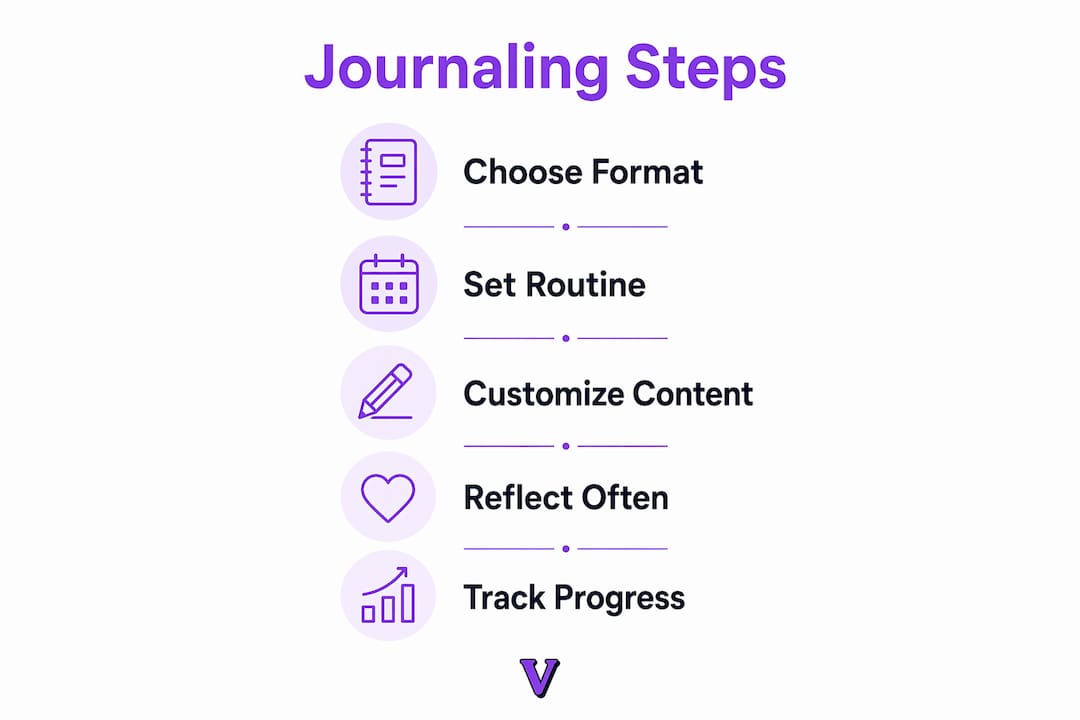
How do you creatively customize a journal to make it your own?
Customization is what separates a personalized journal from a generic notebook. The goal is to build a space that you actually want to return to.
Common creative elements to try:
- Color coding: assign colors to moods, themes, or life areas so patterns become visible at a glance
- Collage and clippings: magazine images, ticket stubs, or printed photos add texture and visual memory
- Doodles and sketches: creative journaling doesn't require artistic skill; rough drawings carry emotional weight that words sometimes can't
- Mood tracking spreads: a simple grid or color chart at the top of each entry creates a visual record over time
- Themed sections: dedicate pages to goals, gratitude lists, or recurring questions you want to sit with
- Washi tape and stickers: low-effort ways to mark entries or create visual breaks between sections
The single biggest mistake new journalers make is treating the journal like a performance. Writing quality has no effect on journaling's benefits. A messy, half-finished page works just as well as a polished one.
Pro Tip: Start with a $2 notebook. Expensive supplies create pressure to "do it right." Once the habit sticks, upgrade if you want to.

What does research say about the benefits of personalized journaling?
The benefits of personalized journaling are well-documented, but the type of journaling matters as much as the act itself.

Expressive writing studies, pioneered by psychologist James Pennebaker at the University of Texas at Austin, found that writing about emotional experiences for 15–20 minutes over 3–4 days produced measurable improvements: fewer doctor visits, reduced anxiety and depression symptoms, and stronger immune markers in some replications. A separate study found that writing a to-do list before bed for just 5 minutes helped people fall asleep 9 minutes faster by offloading mental clutter.
Not all journaling produces the same results, though. Research published in Behaviour Change found that unstructured self-reflection can tip into rumination, actually increasing distress. Structured prompts that guide writing toward positive themes consistently outperform open-ended venting.
Key insight: Journaling works best when it moves you from "this happened" to "this is what it reveals about me." That shift from event-recording to pattern-recognition is where the real emotional benefit lives. Kaiser Permanente mental health experts describe this as "brain dumping," a way to externalize stressors so you can observe them with more distance and less reactivity.
Practical benefits backed by research:
- Reduced anxiety and distress through expressive writing
- Improved sleep onset with brief pre-bed writing
- Greater self-awareness and emotional regulation over time
- Clearer goal-tracking and accountability
- Confidence from seeing documented progress
Short, consistent sessions outperform sporadic long ones. Anchoring a brief writing session to an existing routine, like morning coffee or an evening wind-down, builds the habit without burnout risk. Voisley supports exactly this pattern, offering guided journaling prompts alongside mood tracking and AI-powered insights that help you spot emotional trends you'd otherwise miss. For people who struggle with blank-page anxiety, that structure removes the biggest barrier to starting.
A gratitude journal is one of the simplest entry points, with strong evidence behind it, especially when entries name specific reasons rather than generic lists.
Key Takeaways
Personalized journaling works because it matches the format and structure to your emotional needs, and research confirms that structured, expressive writing produces real, measurable benefits for mental well-being.
| Point | Details |
|---|---|
| Format shapes the habit | Choosing the right format (text, art, prompts, digital) determines whether the habit sticks. |
| Structure beats venting | Guided prompts reduce rumination risk and produce better emotional outcomes than freeform venting. |
| Short sessions are enough | Writing for 15–20 minutes over 3–4 days produces documented mental health benefits. |
| Customization removes friction | Color coding, collage, and mood tracking make journaling personal and worth returning to. |
| Voisley adds structure and insight | AI-powered prompts and mood tracking help you build the habit and understand your emotional patterns. |