

TL;DR:
- Tracking your mood over time helps identify emotional patterns and triggers that can impact mental well-being.
- Using simple, consistent tools—digital or analog—ensures you build a sustainable habit that provides valuable insights.
Most people can name their mood when asked, but far fewer can explain why it shifted three times before noon. Learning how to track your mood, what researchers formally call mood monitoring or ecological momentary assessment, gives you a record that your memory alone never could. This article walks you through exactly what mood tracking is, which tools and methods work best, a practical step-by-step process to get started, and how to turn your logged data into real insights that improve your mental well-being.
Table of Contents
- Key takeaways
- How to track your mood: the basics first
- Choosing the right mood tracking tools
- Step by step: starting your mood tracking practice
- Common challenges in mood tracking
- Interpreting your mood data for real insights
- My honest take on mood tracking
- Start tracking smarter with Voisley
- FAQ
Key takeaways
| Point | Details |
|---|---|
| Mood tracking defined | Regular mood recording helps you spot emotional patterns before small struggles grow larger. |
| Track multiple dimensions | Log mood, energy, and stability together for a clearer picture than a single number provides. |
| Start simple and stay consistent | A brief daily check-in beats an elaborate system you abandon within two weeks. |
| Interpret data, then act | Reviewing your logs weekly reveals triggers and lifestyle links that drive meaningful habit changes. |
| Right tool, right fit | Choose a method that matches your lifestyle, whether digital or analog, so the habit actually sticks. |
How to track your mood: the basics first
Mood tracking is the regular recording of your mood over time, either digitally through apps or manually with pen and paper. The formal term used in clinical research is ambulatory assessment, which simply means capturing emotional states in real life, outside of a therapist's office, as close to the moment as possible.
Why does that timing matter? Digital methods collecting real-time entries provide significantly better data than retrospective summaries because memory smooths over emotional peaks and valleys. You rarely remember how irritable you were Tuesday afternoon when Saturday rolls around.
The benefits of mood tracking go well beyond having a diary. Regular logging helps you:
- Recognize emotional patterns and recurring triggers before they escalate
- Spot links between your mood and lifestyle factors like sleep, exercise, and social contact
- Identify early warning signs that something in your environment or routine needs attention
- Build a concrete record to share with a therapist, doctor, or trusted support person
There are also different types of mood tracking to consider. Active tracking means you intentionally log your mood at set times. Passive tracking uses wearable devices to collect physiological data like sleep quality and heart rate variability as indirect indicators of emotional state. Combining active self-reports with wearable data improves both insight and accuracy compared to either method alone.
Pro Tip: Don't wait until the end of the day to log your mood. Capturing it in the moment, even with a single word or emoji, is far more accurate than a bedtime summary.
Choosing the right mood tracking tools
The best tool is the one you actually use. That sounds obvious, but plenty of people download a sophisticated mood app, feel overwhelmed by the setup, and abandon it by day four. Here is a realistic look at your options.
Digital tools include dedicated mood tracking apps, journaling platforms, and wearable integrations. Their advantages are hard to ignore: push notification reminders, automatic data visualization, and the ability to log entries in seconds. AI-powered mental wellness tools add another layer by identifying patterns you might miss manually.

Analog methods include paper journals, mood charts printed from templates, and bullet journal spreads. The tactile experience of writing slows you down and can deepen reflection. Many people find that pen-and-paper logging feels less performative than typing on a screen. For a structured journaling approach, journaling for emotional well-being offers practical frameworks.
Here is a comparison of the most common mood tracking approaches:
| Method | Best for | Effort level | Key advantage |
|---|---|---|---|
| Mood tracking app | On-the-go, tech-comfortable users | Low | Reminders, visualizations, trend reports |
| Paper mood journal | Reflective writers, low-tech preference | Medium | Flexible, no battery needed |
| Bullet journal spread | Creative, visual thinkers | Medium to high | Fully customizable layout |
| Wearable device | Passive data enthusiasts | Very low | Continuous, automatic data collection |
| Journaling platform (e.g., Voisley) | Users wanting prompts plus mood logs | Low to medium | AI insights plus structured reflection |
Apps that minimize required daily input are the ones people actually keep using. Ease and brevity matter more than features you never open.
Pro Tip: If you are new to mood tracking, start with a single dedicated app for two weeks before adding a journal. Building one habit at a time is more sustainable than combining multiple systems from day one.
Step by step: starting your mood tracking practice
Getting started does not require a perfect system. It requires a consistent one. Here is a practical, step-by-step mood tracking process you can launch today.
-
Decide your tracking frequency. Twice-daily check-ins using push notifications have strong research support for feasibility. Morning and evening entries capture how your mood shifts across the day without becoming a burden.
-
Select what you will track. Mood alone is not enough. Tracking multiple dimensions like mood, energy, and stability gives you far more useful information than a single number on a scale of one to ten. Add irritability as a fourth dimension if mood swings are a concern.
-
Choose a simple rating system. Options include numbered scales (1 to 5 or 1 to 10), emoji sets, color codes, or single descriptive words. The format is less important than consistency. Use the same system every time so your data stays comparable over weeks and months.
-
Log related context. After rating your mood, spend thirty seconds noting contributing factors. Hours slept, exercise done, major stressors, social interactions, and notable events all help explain the numbers when you review them later.
-
Set reminders you will actually follow. A notification that fires at a time you are always free, say right after lunch or just before bed, is worth more than one that interrupts a meeting you silence without responding.
-
Keep brief written notes. Even two or three words describing what happened or how you felt adds enormous interpretive value. "Argument with coworker. Drained afterward." tells you far more than a 3 out of 10 ever could.
-
Review weekly, not daily. Looking at one day's entries rarely reveals anything. Weekly reviews are where the patterns appear.
Pro Tip: On days when you feel terrible and the last thing you want to do is log your mood, log it anyway. Bad days hold some of the most useful data you will ever collect.
Common challenges in mood tracking
Staying consistent is the hardest part. Life gets busy, you miss a check-in, and suddenly three days have passed. The fix is not willpower. It is reducing the friction. Pare your system down to its minimum viable form: one tap, one number, one word. Done.
Another common frustration is staring at your data and seeing nothing useful. Patterns take time to emerge. Two weeks of entries usually produce the first recognizable trends. If your logs still feel murky after a month, the issue is often that you are only tracking mood and missing the context that would explain it.
Some people also struggle with the feeling that a single number cannot possibly capture what they are actually feeling. That frustration is valid and important. It is why separating mood from energy, stability, and irritability matters so much. One dimension is a rough sketch. Four dimensions start to look like a real portrait.
"Mood tracking is not about judging yourself for where the number lands. It is about giving yourself enough data to understand why it landed there."
Finally, avoid turning mood tracking into self-punishment. If your scores are consistently low, that is not a report card. It is useful information about something in your life that deserves attention and care. Adjust your methods as your needs shift. A rigid system you resent will always fail eventually.
Interpreting your mood data for real insights
Reviewing your logs regularly is what turns raw entries into self-awareness that drives real growth. Here is what to look for when you sit down with your data.
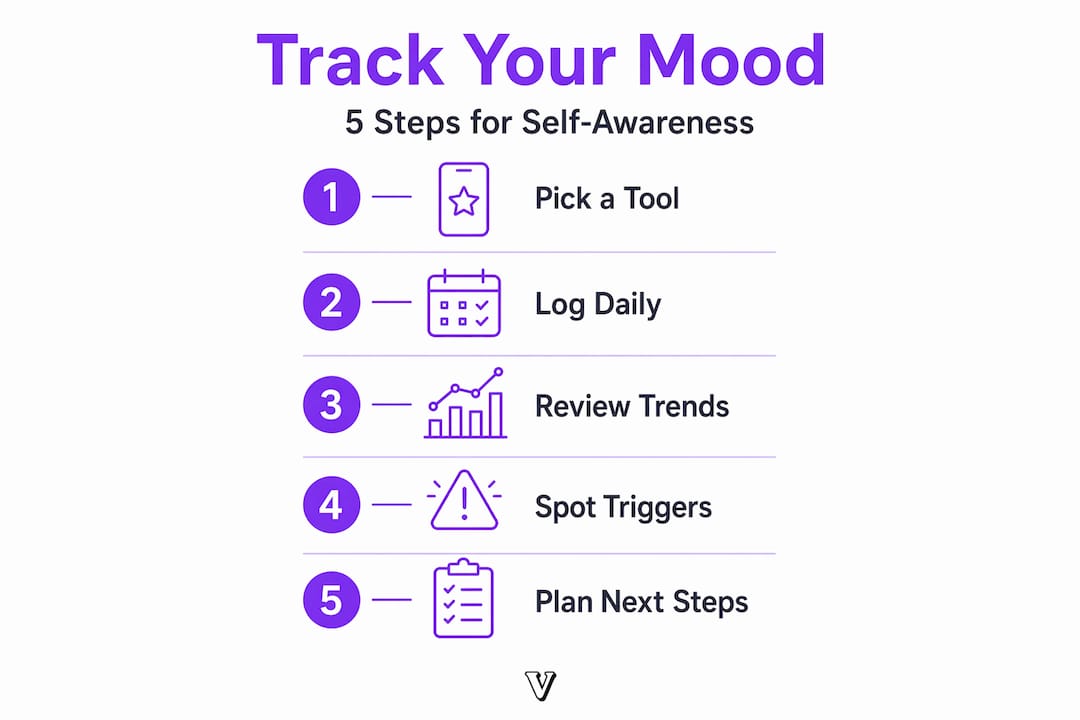
Emotional trends over time. Are your scores generally rising, falling, or staying flat? A two-week downward trend is worth investigating and possibly worth mentioning to a professional.
Trigger patterns. Mood tracking can reveal links between mood and specific triggers like poor sleep, skipped meals, social isolation, or high-pressure workdays. Once you see those links clearly in your data, you can address the root cause rather than just the mood itself.
Here is a simple framework for interpreting your weekly data:
| What to look at | What to ask yourself | What to do next |
|---|---|---|
| Overall mood average | Is this higher or lower than last week? | Note the trend; investigate context |
| Energy patterns | Does energy dip at specific times of day? | Adjust sleep, nutrition, or rest breaks |
| Trigger frequency | Which stressors appear most often? | Create a plan to reduce or respond differently |
| Mood and sleep correlation | Do low scores follow poor sleep nights? | Prioritize sleep hygiene for one week and recheck |
For a deeper look at this process, the guide on analyzing mood patterns for growth covers both digital and manual interpretation techniques. Mood visualizations also make trends far easier to spot than scrolling through rows of numbers, and many platforms now include automatic graphs for exactly this reason.
Use your data when talking to a therapist or doctor. Digital tracking enables structured reports for healthcare conversations that a verbal summary of "I've been kind of off lately" simply cannot match. That specificity changes the quality of care you receive.
My honest take on mood tracking
I have seen people approach mood tracking the way they approach a new fitness routine: intense for two weeks, then nothing. What I have learned is that the people who stick with it are not more disciplined. They are more honest about their starting point.
Before I understood mood monitoring deeply, I noticed that a number felt reductive. How do you compress a complicated, emotionally layered day into a five? What surprised me most, once I committed to tracking multiple dimensions, was realizing that my "mood" and my "energy" were often moving in completely opposite directions. High energy but terrible mood. Low energy but oddly content. That separation revealed things about my lifestyle patterns I genuinely had not noticed.
The other lesson I would pass along: the data does not care about your self-image. It just shows you what is happening. Some of the most useful entries I have encountered are the ones where someone logs a 2 on a day they thought they were "fine." The gap between perceived state and actual state is often where the most important work lives.
Do not let perfect be the enemy of useful. A simple, personal, consistently maintained system will always outperform a sophisticated one you use twice a month.
— Voisley
Start tracking smarter with Voisley

If you are ready to move from occasional reflection to a real practice, Voisley gives you the structure to make it sustainable. The platform combines mood tracking with personalized prompts and AI-powered insights that help you understand your emotional patterns, not just record them. Whether you prefer gratitude journaling, shadow work, or straightforward mood logs, Voisley brings it all into one private, organized space.
The built-in mood visualizations show you trends across days and weeks without requiring you to analyze spreadsheets. The AI tools surface connections between your entries and your emotional state that are easy to miss when you are reading log by log. And the structured journal types mean you always have a starting point, even on days when you do not know what you want to say. Try Voisley and see what your patterns have been trying to tell you.
FAQ
What is mood tracking exactly?
Mood tracking, clinically called ambulatory assessment or ecological momentary assessment, is the regular recording of your emotional state over time using apps, journals, or wearables. The goal is to identify patterns and triggers that are invisible without consistent data.
How often should I track my mood?
Twice-daily smartphone check-ins have strong feasibility evidence from research, but even once daily provides useful trends. Consistency matters far more than frequency.
What dimensions should I include in my mood log?
Beyond basic mood, tracking energy, stability, and irritability gives you a much richer picture. Multi-axis tracking prevents a single misleading number from masking what is actually happening emotionally.
Can mood tracking really improve my mental well-being?
Yes. When you consistently review your logs, you begin to see which lifestyle factors, like sleep, exercise, and social connection, consistently affect your mood. That awareness lets you make targeted changes rather than guessing.
Do I need an app to track my mood?
No. A paper journal or mood chart works well, especially if you prefer writing by hand. The most important factor is choosing a method that fits your routine so you actually use it.