

TL;DR:
- AI enhances therapy by providing real-time pattern recognition, mood tracking, and data-driven feedback that supplement human clinical judgment. Studies show AI can reduce anxiety and depression effectively, with therapeutic alliances influencing outcomes, but risks like bias and misinformation require careful oversight. Integrating AI thoughtfully as a supportive tool—rather than a replacement—strengthens the therapeutic process and empowers both clinicians and individuals to improve mental wellness.
Therapy is changing, and the role of AI insights in therapy is at the center of that shift. Not because artificial intelligence is replacing therapists, but because it is giving them tools that were never available before: real-time pattern recognition, continuous mood tracking, and data-driven feedback that extends the therapeutic relationship well beyond the 50-minute session. 29% of psychologists now use AI at least monthly, and 56% have used it to assist their work at least once. If you are exploring whether AI-enhanced mental health support is right for you or your practice, this article breaks down exactly what is happening, what the research says, and what to watch out for.
Table of Contents
- Key takeaways
- How AI generates insights in therapy
- Clinical evidence for AI-assisted therapy
- Challenges and ethical risks you should know
- Practical ways to integrate AI insights effectively
- AI versus traditional therapy: what each does best
- My take on where this is actually heading
- How Voisley supports AI-enhanced mental wellness
- FAQ
Key takeaways
| Point | Details |
|---|---|
| AI augments, not replaces | AI insights support therapists with data but cannot substitute clinical judgment or human empathy. |
| Clinical evidence is growing | Conversational AI has outperformed group therapy in reducing anxiety and depression in controlled trials. |
| Risks are real and underreported | Most AI mental health chatbots are unvalidated; bias, misinformation, and addictive dynamics are documented concerns. |
| Integration requires oversight | AI outputs should be treated as clinical data products with clear guidelines and escalation protocols. |
| Self-reflection tools extend care | Journaling, mood tracking, and AI-powered prompts between sessions reinforce therapeutic progress effectively. |
How AI generates insights in therapy
AI does not read your mind. It reads patterns. To understand the role of AI insights in therapy, you need to understand what kinds of data these systems actually process and what they do with it.
The main technologies at work include large language models (LLMs), natural language processing, and machine learning classifiers. These systems analyze text from self-reports and journaling, speech patterns from recorded sessions (with consent), behavioral data like sleep and activity, and structured inputs from mood check-ins. From those inputs, AI can detect linguistic markers associated with depression, flag escalating anxiety, or identify whether a patient's language suggests avoidance behaviors.
Here is what that looks like in practice:
- Pattern recognition across sessions: AI tools can cross-reference language from multiple sessions to spot recurring thought patterns a therapist might not catch across weeks of notes.
- Symptom tracking between appointments: Continuous data from apps or wearables lets clinicians see how a patient is doing on the days they are not in the office.
- Personalized prompts and homework coaching: AI can deliver tailored reflection questions or cognitive behavioral exercises based on what emerged in a recent session.
- Progress visualization: Mood trend graphs and emotional pattern reports give both patient and therapist a shared visual language for progress.
Specialized clinical reasoning layers added to LLMs improve therapy-relevant performance significantly more than basic models alone. The same research was validated on 19,674 therapy transcripts, which is not a small sample.
Pro Tip: If you are using an AI journaling or mood-tracking app between sessions, share the data with your therapist. These insights are most useful when they flow into the clinical relationship, not when they exist in isolation.
Clinical evidence for AI-assisted therapy
The research on AI in mental health has matured significantly over the past three years. The question is no longer whether AI can engage users meaningfully. The question is how well it performs against established clinical benchmarks.

A 12-week randomized trial with 995 university students found that conversational AI reduced anxiety and depression more effectively than group therapy and control conditions, with a mean difference of minus 2.17 on standardized anxiety measures. Well-being and life satisfaction also improved significantly in the AI-assisted group. That is not a trivial finding.
The same study uncovered something even more significant for anyone interested in how AI helps therapy beyond symptom reduction. Therapeutic alliance with AI predicted both engagement (β=0.31) and symptom improvement (β=−0.58). In other words, the quality of the relationship users felt with the AI mattered, not just the content of the intervention. Relational quality drives outcomes even when the "other party" is software.
| Study focus | Finding | Clinical significance |
|---|---|---|
| Conversational AI vs. group therapy | AI reduced anxiety more in 12-week trial (n=995) | Supports AI as a scalable alternative for mild to moderate symptoms |
| LLM with cognitive layer architecture | Outperformed standalone LLMs and clinicians on CBT competencies | Suggests structured AI reasoning improves therapy quality measurably |
| Therapeutic alliance in AI interventions | Alliance predicted engagement β=0.31, symptom change β=−0.58 | Relational factors influence AI outcomes just as they do in human therapy |
| AI adoption among psychologists | 42% say AI reduces administrative burden | Efficiency gains free clinicians for deeper patient engagement |
"The biggest surprise in the data isn't that AI can reduce symptoms. It's that the therapeutic alliance within AI interactions predicts outcomes the same way it does in human therapy. That changes how we should design and evaluate these tools." — synthesized from findings in JAMA Network Open
An LLM with cognitive layer architecture that adds structured clinical reasoning to a base language model also outperformed both standalone AI and clinicians on specific CBT competency measures. This is not about replacing clinical training. It is about designing AI systems that understand the logic of evidence-based therapy, not just the language of it.
Challenges and ethical risks you should know
The enthusiasm for AI in mental health is justified, but it needs a counterweight. The risks are not theoretical. They are documented, and many users are encountering them right now without realizing it.
The core issues include:
- Bias in training data: AI systems trained on non-representative populations can produce guidance that is culturally inappropriate or clinically wrong for specific groups.
- Hallucinations and misinformation: LLMs can generate plausible-sounding but factually incorrect mental health information, including about medications and crisis protocols.
- Pseudo-therapeutic relationships: Most AI mental health chatbots are unvalidated, may misrepresent themselves as clinical tools, and can create addictive dynamics in vulnerable users.
- Lack of regulatory oversight: There is no consistent standard for what an AI mental health tool must demonstrate before reaching consumers.
The scale of this is worth noting. 13% of users under 18 and 22% of adults have turned to chatbots for mental health advice. Most of those tools have no published clinical validation. Meanwhile, LLMs face challenges including bias, hallucinations, inappropriate recommendations, and structural gaps in how mental health diagnostics work (which are qualitative and relational, not algorithmic).
Understanding the safety challenges of AI tools is not about avoiding technology. It is about using it without naivety.
Pro Tip: Before using any AI mental health app, ask one question: "Has this tool been validated in a published clinical trial?" If the answer is no or unclear, treat it as a wellness tool, not a therapy tool, and use it accordingly.
Practical ways to integrate AI insights effectively
AI works best in therapy when it plays a supporting role with clear boundaries. Both individuals and clinicians can use it well, but the approach matters.
For individuals managing their mental health:
- Use AI for structured self-reflection between sessions. Journaling apps with AI analysis can help you spot recurring emotional themes before you even articulate them to your therapist. The benefits of AI journaling for emotional well-being are backed by growing evidence.
- Track mood data consistently. The value of mood tracking compounds over time. Two weeks of daily check-ins generates enough data for meaningful pattern analysis. Two months tells a genuinely diagnostic story.
- Bring AI-generated reports into your sessions. A mood trend graph or a summary of your most frequent emotional triggers is a conversation starter, not a substitute for one.
- Set boundaries on how you use AI for emotional support. Emotional validation from AI can feel supportive, but as researchers note, it is not therapy unless clinically validated and embedded in actual care.
For therapists and counselors, AI adoption remains strongest in assistant and administrative tasks, with hybrid care models emerging as the preferred framework. The practical move is to treat AI-generated insights the same way you would treat any clinical data product: documented, purposeful, and governed by clear escalation protocols.
Pro Tip: Ask your provider directly: "Do you use any AI tools in our sessions or between sessions?" and "How is my data stored and used?" These are reasonable questions that any ethical practice should answer clearly.
AI versus traditional therapy: what each does best
The debate is not AI versus therapy. It is about understanding which jobs each does well, and designing care around that reality.
| Dimension | AI insights | Human therapist |
|---|---|---|
| Data analysis and pattern detection | Processes thousands of data points continuously | Limited by session frequency and memory |
| Emotional attunement | Can mimic empathy; not clinically equivalent | Core clinical competency; irreplaceable |
| Accessibility and availability | 24/7 availability; no geographic barrier | Limited by geography, cost, and availability |
| Crisis response | Not equipped for acute crisis management | Trained to assess and respond to immediate risk |
| Therapeutic relationship | Builds engagement; alliance predicts outcomes | Deepest driver of long-term therapeutic change |
| Accountability and ethics | Depends on developer governance | Regulated by professional licensing boards |
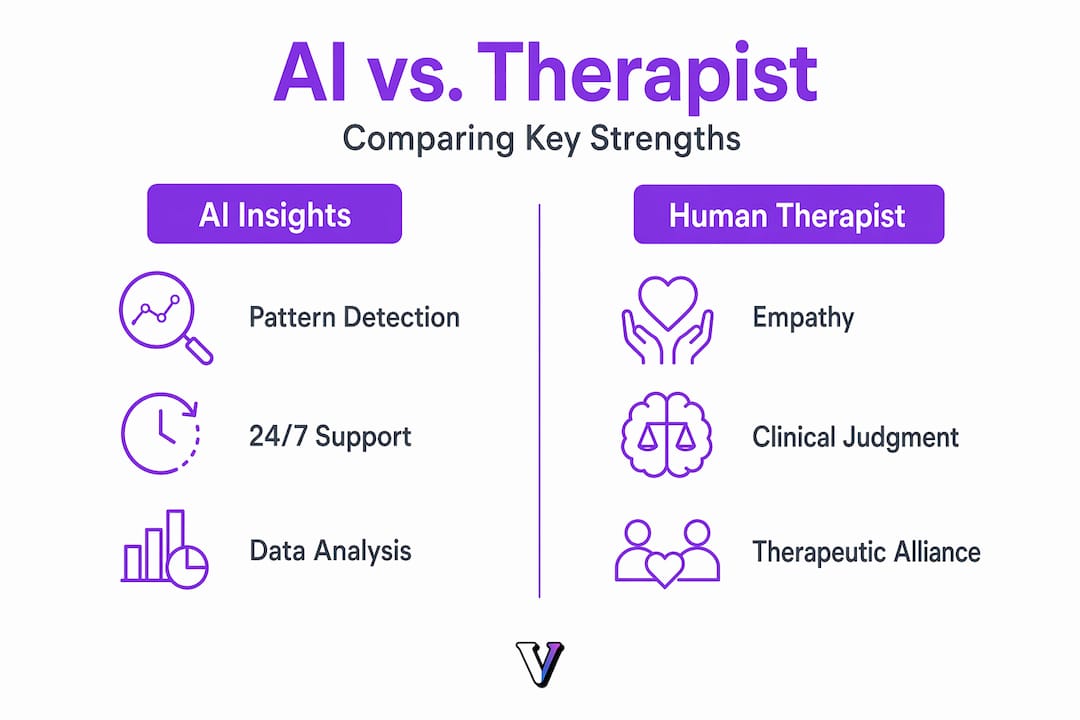
The strongest version of AI-enhanced mental health care is a system where AI handles what it does better than humans (data aggregation, pattern detection, consistent prompting) and humans handle what AI cannot (relational depth, ethical judgment, crisis response). Experts consistently emphasize that AI aids in homework and practice while therapists provide the human connection that drives lasting change.
Artificial intelligence counseling tools are most effective when they extend the therapeutic relationship outward, not when they try to replace it inward.
My take on where this is actually heading
I've watched the conversation about AI in mental health swing between utopian and catastrophic, and neither framing serves the people who actually need better care.
What I've found, working deeply in this space, is that the most honest position is one of structured optimism. The clinical evidence is real. A conversational AI outperforming group therapy in a 995-person trial is not a fluke. The risks are also real. Unvalidated chatbots causing harm in adolescent populations is not hypothetical.
What I've learned is that the people who benefit most from AI-enhanced mental health support are the ones who treat it as a tool, not a relationship. They use journaling and mood tracking to generate data that informs better conversations with their actual therapist. They do not outsource their emotional processing to an app; they use the app to do that processing more deliberately.
The uncomfortable truth is that most people asking about AI in mental health are really asking a different question: "Can I get better support than I am currently getting?" The answer to that question is yes. But it comes from integrating AI thoughtfully into a care model that still has a human at its center.
The dialogue between patients and providers about how AI is being used in their care needs to become standard practice. Right now, most people do not even know when AI is shaping their treatment. That has to change.
— Voisley
How Voisley supports AI-enhanced mental wellness

At Voisley, we built our platform around exactly the kind of AI-human integration this article describes. Our AI-powered journaling tools give you structured prompts, mood trend analysis, and emotional pattern insights you can actually use. Whether you are working with a therapist and want richer data to bring to your sessions, or you are building your self-awareness practice independently, Voisley gives you the structured space to do it. Explore guided journaling formats including gratitude, shadow work, and future goals, all backed by science and powered by AI that works with you, not at you.
FAQ
What is the role of AI insights in therapy?
AI insights in therapy support clinicians and individuals by analyzing patterns in language, mood, and behavior to surface trends that improve treatment decisions. They work best as a supplement to human-led care, not as a replacement for it.
Can AI replace a human therapist?
No. While AI tools can reduce symptoms and support engagement, the therapeutic alliance and clinical judgment that drive long-term recovery require a human therapist. AI extends care; it does not replace it.
Are AI mental health chatbots safe to use?
Most are not clinically validated. Research shows that many AI mental health chatbots may misrepresent their clinical value and can create harmful dynamics in vulnerable users. Always look for tools with published clinical evidence before relying on them for mental health support.
How do AI tools help with anxiety and depression?
Conversational AI has shown measurable reductions in anxiety and depression in clinical trials, including a 12-week study where it outperformed group therapy on standardized measures. The effect is strongest when the tool builds a consistent, alliance-based interaction with the user.
What should I ask before using an AI therapy tool?
Ask whether the tool has been clinically validated, how your data is stored and used, and whether a licensed clinician oversees its outputs. Treat any tool that cannot answer those questions as a wellness product, not a clinical one.