

TL;DR:
- Voice diary AI transforms spoken reflections into organized, emotionally analyzed journal entries, enhancing self-awareness and mood regulation. It offers quick, frictionless voice recordings, accurate transcriptions, and insightful mood and theme detection, making daily emotional tracking accessible and effective. Prioritizing privacy and consistent use, this technology supports long-term mental wellness and personal growth without replacing clinical therapy.
Voice diary AI is defined as an AI-powered system that converts spoken reflections into transcribed, organized, and emotionally analyzed journal entries. This technology sits at the intersection of voice journaling and machine learning, and it is reshaping how people process emotions and build self-awareness. Apps like Echo Journal, Acuity Daily, and Audionotes have moved the category well beyond simple smart voice recorders. Research shows 73% of users report better mood regulation with daily AI-assisted voice journaling, and 89% maintain their journaling habit longer compared to the 23% industry average for manual journaling. Those numbers tell a clear story: speaking your thoughts, and letting AI make sense of them, works better than staring at a blank page.
How does voice diary AI enhance emotional expression?
Voice diary AI outperforms traditional journaling on one critical dimension: it removes the friction between feeling something and recording it. Voice-first journaling bypasses blank page anxiety, allowing users to think out loud and engage directly in emotional processing. You do not need to compose sentences. You just speak.

The AI layer does the heavy lifting after you finish talking. It transcribes your words, strips out filler phrases, and organizes your thoughts into a coherent entry. AI cleanup features remove filler words and summarize rambling voice data, creating cleaner entries that are far more useful for long-term pattern recognition. A five-minute unstructured rant becomes a readable, searchable record of what you were actually feeling.
The emotional benefits compound over time. Users see a 63% improvement in stress management after 30 days of consistent use. Consistency is the key word here. Voice AI makes it easy enough to show up every day, and daily practice is what produces real emotional growth.
Key advantages of voice diary AI over written journaling include:
- No writing required. You speak naturally, and the AI handles structure.
- Faster entry. A 90-second voice note captures more than a 10-minute writing session for most people.
- Emotional tone detection. AI models flag mood shifts you might not consciously notice.
- Searchable history. Transcripts let you search past entries by theme, date, or keyword.
- Lower barrier to start. Opening an app and pressing record takes seconds.
Pro Tip: If you feel self-conscious speaking aloud, try recording in your car or during a short walk. The movement actually loosens up your thinking and makes voice journaling feel more natural.
What features define the best AI voice diary apps?
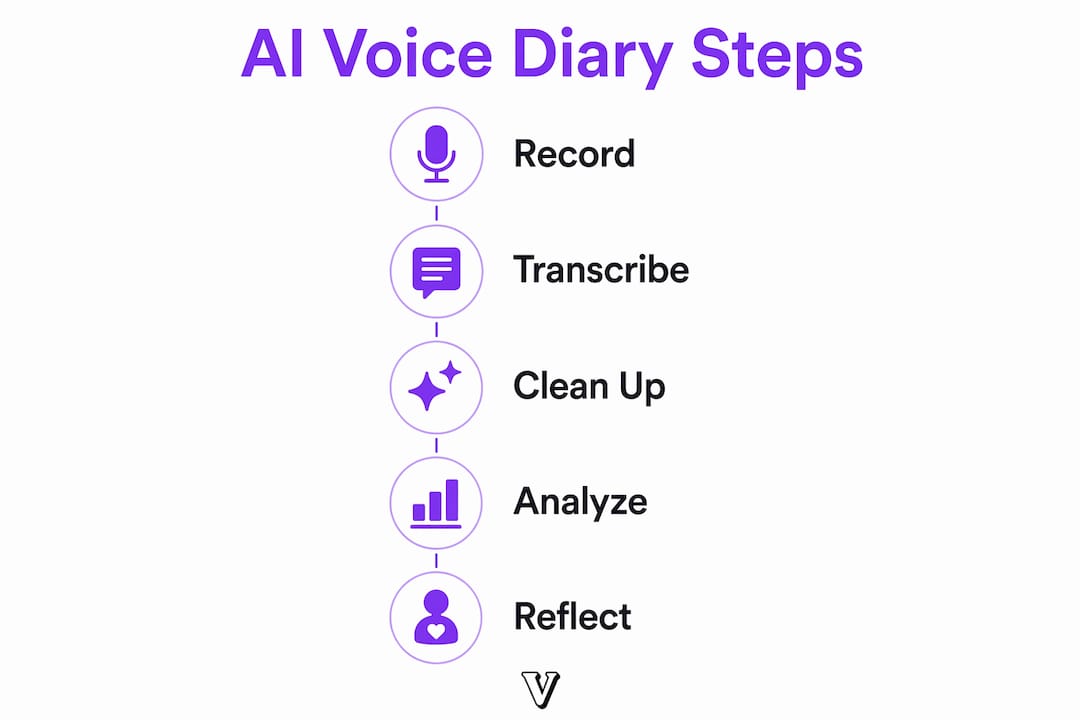
The best AI voice diary apps share a core set of features that separate them from basic digital voice notes tools. Understanding what to look for saves you from downloading something that feels impressive but delivers little actual insight.
Voice-to-text accuracy and AI cleanup
Transcription quality is the foundation. Without accurate voice-to-text, every downstream feature breaks down. The top apps use large language models to not only transcribe but also restructure your spoken words into readable prose. Audionotes, for example, specializes in trimming filler words and detecting emotional patterns, which makes reviewing past entries genuinely useful rather than painful.
Theme and mood extraction
Static storage is not enough. Agentic AI diaries actively classify moods, themes, and goals rather than just archiving voice notes. This transforms your recordings into a psychological map over time. Acuity Daily takes this further by breaking reflections into life categories including Career, Health, Relationships, Personal Growth, and Finances. It then delivers weekly 400-word summaries for deeper reflection, which is a genuinely useful feature for anyone tracking personal development.
Frictionless entry points
The best app in the world fails if opening it takes too long. Frictionless entry via Telegram integration or home screen widgets is critical for consistent voice journaling. Haru offers a conversational interface that feels like texting a journal rather than using a formal app. The fewer steps between you and recording, the more likely you are to actually use it.
Here is a comparison of leading AI voice diary apps in 2026:
| App | Core AI Feature | Entry Method | Pricing |
|---|---|---|---|
| Echo Journal | Mood tracking, encryption, entry deletion | App-based recording | Free trial available |
| Acuity Daily | Weekly summaries, life area categorization | App-based recording | $3–$5/month |
| Audionotes | Filler word removal, emotional pattern detection | App and web | Free tier + paid plans |
| Haru | Conversational AI diary interface | Chat-style input | Free with premium options |
Subscription pricing averages $3 to $5 per month across professional AI voice diary platforms, with some offering free trials up to three months. That pricing makes the category accessible for most people serious about mental wellness.
Pro Tip: Always use the free trial period to test whether an app's AI summaries actually resonate with you. The quality of insight extraction varies significantly between platforms, and you will know within two weeks whether it fits your reflection style.
How can you build a daily voice journaling routine?
Building a sustainable voice journaling habit requires structure, not willpower. The apps do the analysis, but you have to show up consistently for the data to mean anything. Here is a practical framework for integrating an AI audio diary into your daily mental wellness routine.
- Choose a fixed trigger. Attach your voice journaling session to an existing habit, such as your morning coffee, your commute, or the moment you get into bed. Triggers remove the decision of when to journal.
- Keep entries short to start. One to two minutes is enough. You are building a habit, not writing a memoir. The AI will extract themes even from brief entries.
- Use a simple opening prompt. Start with "Today I felt..." or "The thing on my mind right now is..." These phrases bypass overthinking and get you talking immediately.
- Review your AI summary weekly. Most apps generate weekly reports. Block 10 minutes on Sunday to read yours. This is where the real self-awareness work happens, because patterns become visible across multiple entries.
- Act on one insight per week. If your AI summary flags that you mentioned work stress five times this week, that is a signal worth addressing. Pick one concrete response, whether that is a conversation, a boundary, or a change in routine.
- Protect your privacy settings. Before you record anything personal, confirm that your app uses encryption and gives you full control over deletion. AI journaling insights boost emotional well-being most effectively when users feel safe enough to speak honestly.
The 41% increase in goal achievement reported by Echo Journal users after 30 days of AI journaling is not accidental. It reflects what happens when reflection becomes a daily practice rather than an occasional event.
What are the privacy risks of AI voice diaries?
Privacy is the most underexamined issue in the AI voice journaling category. You are recording your most unfiltered thoughts and sending them to a cloud server for processing. That requires trust, and trust requires transparency.
The strongest platforms in this space treat privacy as a product feature, not a legal footnote. Echo Journal, for instance, offers encryption and full user control including the ability to delete individual entries and entire accounts. Users' reflections and transcripts are never sold. That standard should be your baseline expectation for any app you consider.
Key privacy factors to evaluate before committing to a platform:
- End-to-end encryption. Your voice data and transcripts should be encrypted in transit and at rest.
- Data ownership. You should own your entries. The platform should not have the right to use your content for training AI models without explicit consent.
- Deletion rights. You should be able to delete any entry or your entire account at any time, with immediate effect.
- No third-party data sharing. Confirm the platform does not sell or share your data with advertisers or research partners.
One boundary worth stating clearly: voice diary AI is not therapy and not a chatbot therapist. These tools support self-reflection and pattern recognition. They do not replace clinical mental health care. AI is changing healthcare in meaningful ways, but the distinction between a wellness tool and a clinical intervention matters for how you use and interpret the insights you receive.
Pro Tip: Read the privacy policy before you record a single entry. Specifically look for language about "training data," "third-party sharing," and "data retention." If those terms are vague or absent, choose a different app.
Key takeaways
Voice diary AI delivers measurable emotional and behavioral benefits when used consistently, with privacy-first platforms and frictionless entry points being the two factors that determine long-term success.
| Point | Details |
|---|---|
| Habit persistence is the core benefit | AI voice diaries sustain journaling habits far beyond what manual writing achieves. |
| AI cleanup transforms raw speech | Filler word removal and summarization make voice entries genuinely useful for reflection. |
| Frictionless entry drives consistency | Apps with widgets or chat-style input remove the barriers that kill journaling habits. |
| Weekly AI summaries accelerate growth | Reviewing categorized insights weekly reveals emotional patterns that single entries miss. |
| Privacy standards are non-negotiable | Choose platforms with encryption, full deletion rights, and no data-sharing agreements. |
What Voisley has learned about voice journaling
The most surprising thing about voice journaling is not that it works. It is how quickly it works. At Voisley, we have watched users who struggled to maintain a written journal for more than a week sustain a daily voice practice for months. The reason is not novelty. It is that speaking feels like thinking, while writing feels like performing.
What we have also noticed is that the AI summary is where the real value lives, not the recording itself. Most users underestimate this. They focus on the act of speaking and treat the weekly report as optional. The users who grow fastest are the ones who treat the summary as the main event and the recording as the raw material.
There is also a counterintuitive truth about personalized voice diary tools: more features do not always mean more insight. The apps that produce the deepest self-awareness tend to be the ones that ask better questions and surface cleaner patterns, not the ones with the most integrations or the most elaborate dashboards. Simplicity in the interface creates space for complexity in the reflection.
If you are exploring mental wellness strategies for 2026, voice journaling is the one habit we would prioritize above all others. It is low-cost, low-effort to start, and the compounding effect on self-awareness is real. Try three or four apps during their free trial periods. The right one will feel obvious within a week.
— Voisley
Start your voice journaling practice with Voisley
Voisley combines AI-powered journaling with science-backed frameworks to give you a private, structured space for emotional expression and self-reflection. The platform includes mood tracking, personalized prompts, and visualizations that surface your emotional patterns over time.

Whether you are processing a difficult week or building a long-term self-awareness practice, Voisley's AI tools meet you where you are. The platform supports gratitude journaling, shadow work, and future goal setting, all within a privacy-first environment designed for honest reflection. Visit Voisley to start your free trial and experience what a daily voice journaling habit can do for your mental well-being.
FAQ
What is voice diary AI?
Voice diary AI is a technology that records your spoken reflections, transcribes them using AI, and extracts emotional themes, mood patterns, and insights to support self-reflection and personal growth.
How is a voice diary AI different from a regular voice recorder?
A standard voice recorder stores audio files. A voice diary AI transcribes, summarizes, and analyzes your entries to identify emotional patterns, recurring themes, and behavioral trends over time.
Are AI voice diary apps private and secure?
The best platforms, including Echo Journal, use end-to-end encryption and give users full control over entry deletion and account removal, with no data sold to third parties.
How long should a daily voice journal entry be?
One to two minutes is enough for a daily entry. AI models extract meaningful themes and mood data even from brief recordings, making short daily sessions more effective than occasional long ones.
Can voice diary AI replace therapy?
Voice diary AI is a self-reflection tool, not a clinical intervention. It supports emotional awareness and habit formation but does not replace professional mental health care from a licensed therapist or counselor.