

TL;DR:
- Habit formation turns repeated behaviors into automatic actions that support long-term wellness. Building multiple small habits through cues and reinforcement yields more sustainable health improvements than relying on motivation alone.
Habit formation is defined as the process by which repeated behaviors become automatic, requiring less conscious effort over time. This process sits at the center of long-term wellness because it converts deliberate health choices into default actions. Research shows about 66% of daily behavior is driven by habit. That figure means the majority of what you do for your health each day happens without active decision-making. The role of habit formation in wellness is not motivational theory. It is the neurological engine behind every sustainable lifestyle change you will ever make.
How do habits influence physical and mental wellness?
Habits regulate the behaviors that determine health outcomes most directly: exercise frequency, food choices, sleep timing, and stress responses. When these behaviors become automatic, you stop spending mental energy deciding whether to do them. That freed-up energy goes toward focus, creativity, and emotional regulation instead.
The physical benefits are well documented. People who build consistent exercise and nutrition habits show better cardiovascular markers, more stable blood sugar, and lower rates of chronic disease than those who rely on willpower alone. Willpower depletes. Habits do not.
Mental wellness gains are equally significant. Structured daily routines correlate with lower anxiety and depression by reducing the decision-making burden that drains cognitive resources. Fewer decisions means less stress. Less stress means more mental bandwidth for the things that matter.
The habit formation benefits that affect mental health include:
- Decision fatigue reduction: Automating routine choices preserves mental energy for complex problems.
- Emotional stability: Predictable routines create a sense of control, which reduces anxiety.
- Sleep quality: Consistent sleep and wake times train the body's circadian rhythm without effort.
- Stress buffering: Regular physical activity, when habitual, blunts the cortisol response to daily stressors.
- Self-efficacy: Each completed habit reinforces the belief that you can follow through, which compounds over time.
The impact of habits on health is cumulative. A single habit rarely transforms wellness on its own. The combination of several small automated behaviors, practiced consistently, produces outcomes that no single intervention can match.
What does neuroscience say about how habits form?
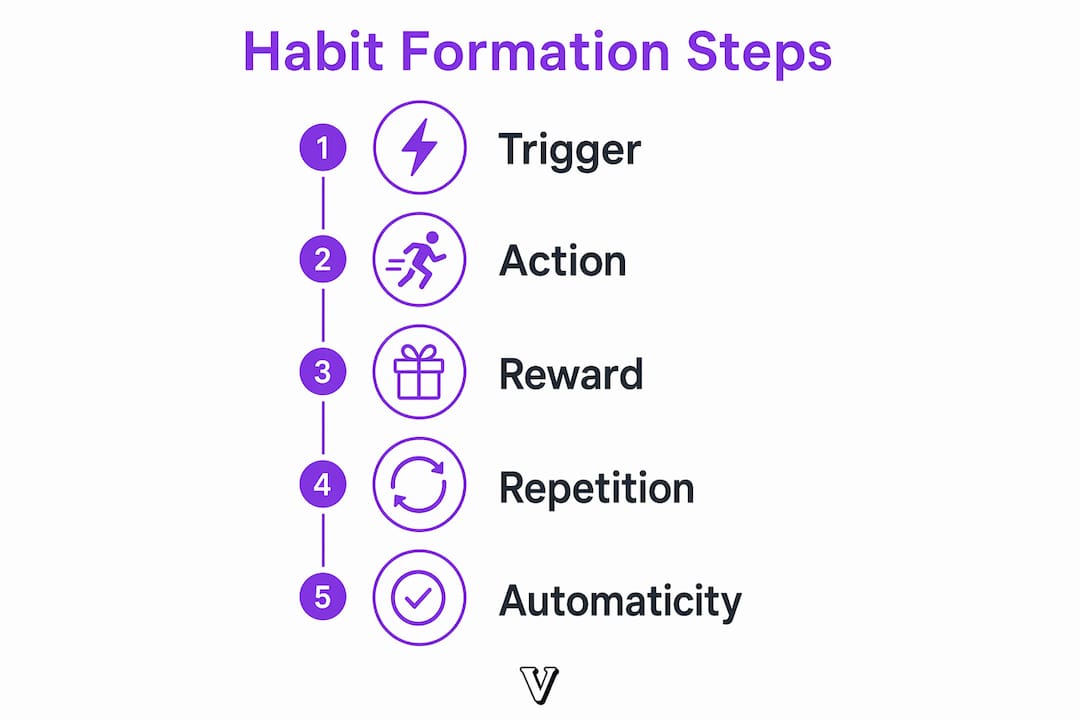
The brain does not build habits gradually the way most people assume. Research from Johns Hopkins University published in 2026 found that habit formation can occur via sudden "switch-like" changes in neural activity rather than slow, incremental progression. The brain appears to flip into a new pattern once enough repetition has occurred. That finding reframes how you should think about the early stages of building a new routine.

Repetition alone does not lock in a habit. Positive reinforcement accelerates habit strengthening by activating reward centers in the brain faster than repetition alone can. The reward does not need to be large. It needs to be immediate and emotionally genuine.
Habit stacking is one of the most effective techniques to exploit this mechanism. Anchoring new habits to existing behaviors creates reliable cues that trigger automaticity without requiring extra willpower. If you already make coffee every morning, attaching a two-minute breathing practice to that cue gives the new behavior a stable launch point.
Goals and habits are not the same thing. A goal is a desired outcome. A habit is the repeated behavior that produces it. Focusing only on goals without building the supporting habits is why most New Year's resolutions fail by February.
Pro Tip: After completing a new habit, pause for five seconds and consciously acknowledge the feeling of having done it. That brief moment of positive emotion activates your brain's reward system and speeds up the wiring of the behavior into your automatic routine.
| Feature | Goals | Habits |
|---|---|---|
| Focus | Outcome | Behavior |
| Requires willpower | Yes, consistently | Only in early stages |
| Fades without reinforcement | Yes | No, once automatic |
| Drives daily action | Indirectly | Directly |
Common myths about building healthy habits
The most persistent myth in habit formation is the 21-day rule. That figure has no scientific basis. Most new habits require up to 10 weeks of consistent effort before they become truly automatic. Expecting automaticity in three weeks sets people up to quit right when the habit is starting to take hold.
Perfectionism is the second major obstacle. People abandon new habits after one missed day because they treat the miss as failure. Missing once does not break a habit. Missing twice in a row starts to. The goal is consistency over time, not a perfect streak.
A third misconception is that suppressing a bad habit is the right strategy. Replacing negative habits with positive ones is more effective than trying to inhibit the old behavior. The neural pathway for the old habit stays active. Suppression requires ongoing effort. A competing positive habit gradually crowds out the old one by giving the brain a different response to the same cue.
Practical principles that correct these myths:
- Start smaller than feels meaningful. Micro-habits like "floss one tooth" succeed because they remove the friction that stops you from starting.
- Expect the timeline to be longer than you want. Ten weeks is a reasonable minimum for most behaviors.
- Replace, do not suppress. Swap the bad habit for a positive one that satisfies the same underlying need.
- Use emotion as a tool. Celebrating small wins triggers reward centers and accelerates habit wiring more reliably than discipline alone.
Pro Tip: When you miss a day, write down one sentence about what got in the way. That reflection converts a setback into data, which keeps you engaged with the habit instead of abandoning it.
Practical strategies for creating wellness routines that stick
Building healthy habits does not require a complete life overhaul. It requires a repeatable method applied to one behavior at a time.
-
Choose one habit. Attempting multiple new habits simultaneously splits your attention and reduces success rates for all of them. Pick the single behavior most likely to produce a cascade of other positive changes, such as consistent sleep timing or a daily walk.
-
Attach it to a trigger. Identify an existing behavior that happens reliably every day. Your morning coffee, your commute, or brushing your teeth all work. The new habit follows immediately after the trigger. This is habit stacking in practice, and it creates cue-driven automaticity without requiring you to remember to do it.
-
Write an if-then plan. Implementation intentions take the form of "If X happens, then I will do Y." Research on this technique shows it significantly reduces the chance of slipping back into old behaviors when disruptions occur. "If I feel stressed at 3:00 PM, then I will take a five-minute walk" is more effective than a general intention to manage stress better.
-
Make the habit tiny at first. Small, incremental changes build self-efficacy and sustain momentum better than ambitious targets. A two-minute meditation practice done daily beats a 30-minute session attempted twice and abandoned.
-
Celebrate immediately. The celebration does not need to be elaborate. A fist pump, a smile, or a brief internal acknowledgment of "I did it" counts. Positive emotion immediately after action activates brain reward systems and accelerates the habit's integration into automatic behavior.
-
Track it visibly. Seeing a chain of completed days creates its own motivation to continue. A simple calendar checkmark works. The visual record makes the habit feel real and worth protecting.
Wellness through habits is not about intensity. It is about frequency and consistency applied to behaviors small enough that you will actually do them when life gets difficult. That is the standard that separates lasting change from short-term effort.
Key Takeaways
Habit formation is the most reliable mechanism for sustained wellness because it converts intentional health behaviors into automatic ones that persist without ongoing willpower.
| Point | Details |
|---|---|
| Habits drive most daily behavior | About 66% of daily actions are habitual, making habit change a high-leverage health strategy. |
| Timelines are longer than expected | Most habits require up to 10 weeks to become automatic, not the commonly cited 21 days. |
| Replacement beats suppression | Building a positive habit crowds out a bad one more effectively than trying to inhibit it. |
| Tiny habits outperform big goals | Micro-habits anchored to existing cues succeed because they remove the friction that causes people to quit. |
| Emotion accelerates wiring | Celebrating immediately after a new habit activates reward centers and speeds up automaticity. |
What I've learned from watching habits actually change people
The most surprising thing about habit formation is how little drama it requires when done correctly. People expect transformation to feel significant. The habits that actually stick tend to feel almost boring at first. A two-minute gratitude note. A glass of water before coffee. A single deep breath before a meeting. None of these feel like wellness. All of them compound into something that does.
The biggest barrier I see is not laziness. It is impatience. People quit at week three because the habit does not feel automatic yet. They interpret that friction as evidence that the habit is not working. It is actually evidence that the habit is still forming. Pushing through that window, with realistic expectations and a small enough behavior, is where most of the real progress happens.
Sustainable personal growth does not come from overhauling your life in January. It comes from making one small decision consistently until it no longer feels like a decision. Then adding another. The people who build the most durable wellness routines are not the most disciplined. They are the ones who made the habits small enough to survive a bad week.
Emotional reinforcement matters more than most people realize. Tracking your mood alongside your habits reveals patterns that pure willpower never surfaces. When you can see that your anxiety drops on days you journal or walk, the habit stops feeling like a chore and starts feeling like a tool. That shift in perception is what makes it last.
— Voisley
How Voisley supports your habit formation goals
Building wellness habits is easier when you have a structured space to track your progress and reflect on what is working.

Voisley is a digital platform built around guided journaling, mood tracking, and AI-powered self-reflection. It gives you a private, structured space to notice your emotional patterns, celebrate small wins, and stay connected to the habits that support your mental and emotional health. Features like daily mindfulness prompts, gratitude journaling, and mood visualizations make it easier to see how your daily habits affect your overall well-being over time. If you are ready to build routines that actually stick, start with Voisley and let the data show you what is working.
FAQ
What is the role of habit formation in wellness?
Habit formation converts deliberate health behaviors into automatic ones, reducing the cognitive effort required to maintain them. This automation is what makes wellness routines sustainable over the long term.
How long does it take to build a new habit?
Most habits require up to 10 weeks of consistent practice to become automatic. The commonly cited 21-day rule is not supported by research.
Why is replacing a bad habit better than stopping it?
The neural pathway for an old habit stays active even when you try to suppress it. Building a competing positive habit gradually reduces the old pathway's influence, making relapse less likely.
What is habit stacking and does it work?
Habit stacking means attaching a new behavior to an existing daily routine, such as meditating right after making coffee. This technique works because the existing behavior acts as a reliable cue that triggers the new habit automatically.
How do small habits lead to lasting wellness changes?
Incremental habit changes build self-efficacy by creating repeated evidence that you can follow through. That confidence compounds, making it easier to add and sustain additional healthy behaviors over time.